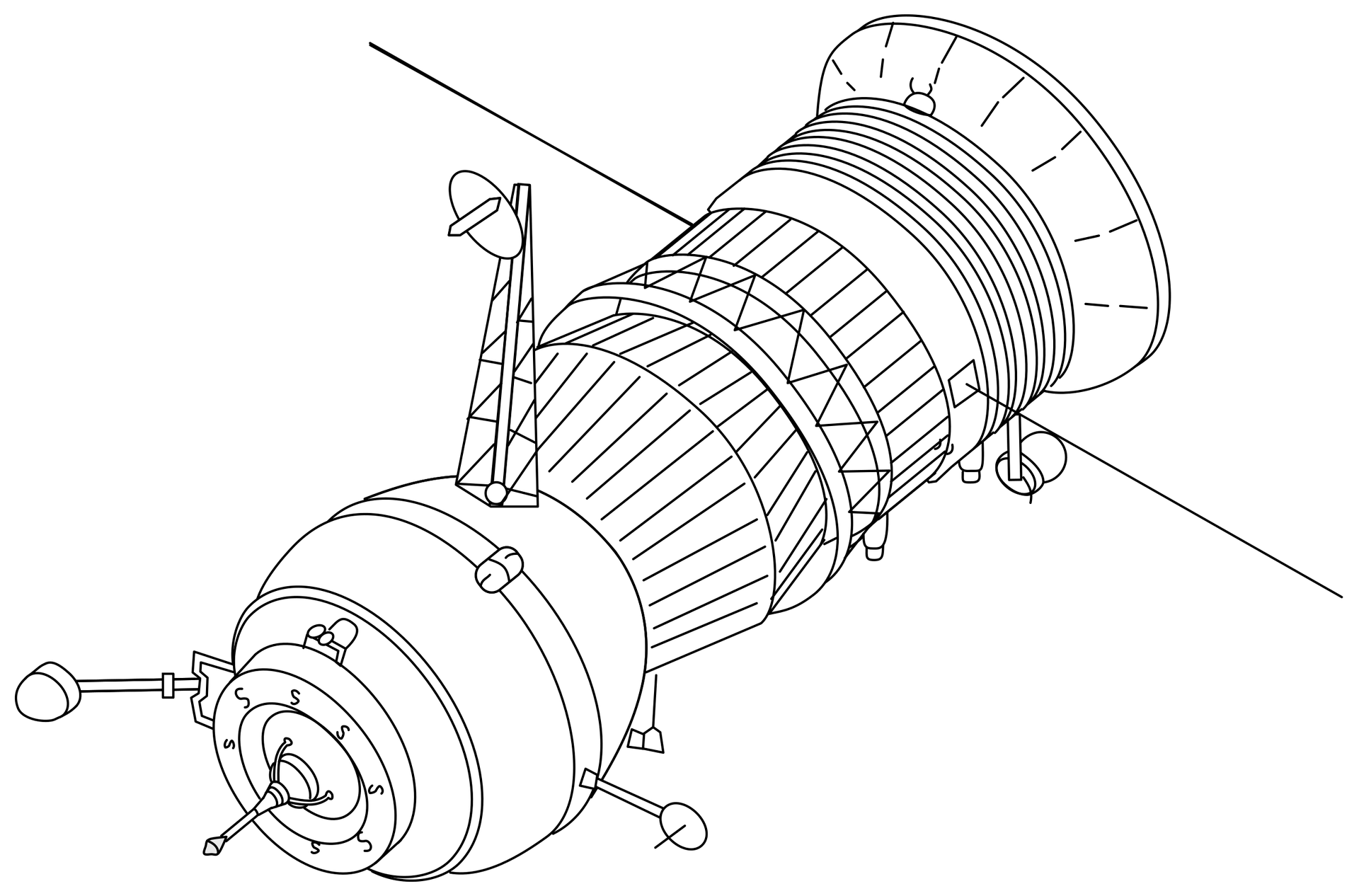
Progress 7K-TG
In-active Cargo Cargo Resupply Payload Capacity: 1700 kg Diameter: 2.72 m Height: 7.23 m()
Jan. 20, 1978
Salyut-7 & Mir Logistics
Flight Life
33 to 75 days
Description
Progress is derived from the manned Soyuz spacecraft and is launched on the same vehicle, a Soyuz rocket. The purpose of Progress is to deliver supplies needed to sustain human presence in orbit. Currently it is used as a re-supply spacecraft for the ISS.
History
Progress 7K-TG , was a Soviet uncrewed spacecraft used to resupply space stations in low Earth orbit. Forty three flew, delivering cargo to Salyut 6, Salyut 7, and Mir. It was the first version of the Progress spacecraft to fly, and spawned later derivatives including the Progress-M which replaced it, and the later Progress-M1.
Falcon 9
Starlink Group 17-51
Space Launch Complex 4E - Vandenberg SFB, CA, USAA batch of 24 satellites for the Starlink mega-constellation - SpaceX's project for space-based Internet communication system.
Starship
Flight 13
Orbital Launch Pad 2 - SpaceX Starbase, TX, USA13th test flight of the two-stage Starship launch vehicle. Second flight of Starship V3. For the first time, Starship will carry 20 V3 Starlink sa…
Kinetica 1
5 satellites
Launch Area 130 - Jiuquan Satellite Launch Center, People's Republic of ChinaShare-ride of 5 commercial Earth observation and technology demonstration satellites to SSO, including SpaceTY's TY-48. Details TBD.
Long March 3B/E
Tianlian 2-06
Launch Complex 2 (LC-2) - Xichang Satellite Launch Center, People's Republic of ChinaTianlian is a Chinese data tracking and relay communications geostationary satellite series. The TL 2 (Tian Lian 2) satellites represent the second g…
Gravity-1
9 satellites
Yellow Sea (launch location 5) - Haiyang Oriental SpaceportCarried 9 satellites on a share-ride to sun-synchronous orbit. Details TBD.
Falcon 9
MRV-1
Space Launch Complex 40 - Cape Canaveral SFS, FL, USAThe Northrop Grumman/SpaceLogistics MRV-1 is a mission extension payload including a mission robotic vehicle (MRV) and multiple mission extension pod…
Falcon 9
Starlink Group 17-39
Space Launch Complex 4E - Vandenberg SFB, CA, USAA batch of 24 satellites for the Starlink mega-constellation - SpaceX's project for space-based Internet communication system.
Soyuz 2.1b
16 x Rassvet-3
43/4 (43R) - Plesetsk Cosmodrome, Russian FederationNote: Payload identities uncertain. Batch of 16 Rassvet-3 Low Earth Orbit communication satellites for the Russian Byuro-1440 (Bureau 1440) conste…
Vikram-I
Demo Flight
Satish Dhawan Space Centre First Launch Pad - Satish Dhawan Space Centre, IndiaFirst launch of Skyroot Aerospace's Vikram-I launch vehicle. This first launch will carry 4 payloads: - Grahaa Space's SOLARAS S3 satellite - C…
Falcon 9
SDA Tranche 1 Transport Layer E
Space Launch Complex 4E - Vandenberg SFB, CA, USATranche 1 Transport Layer E is one of six missions by the United States Space Force Space Development Agency (SDA) for the Proliferated Warfighter Sp…

