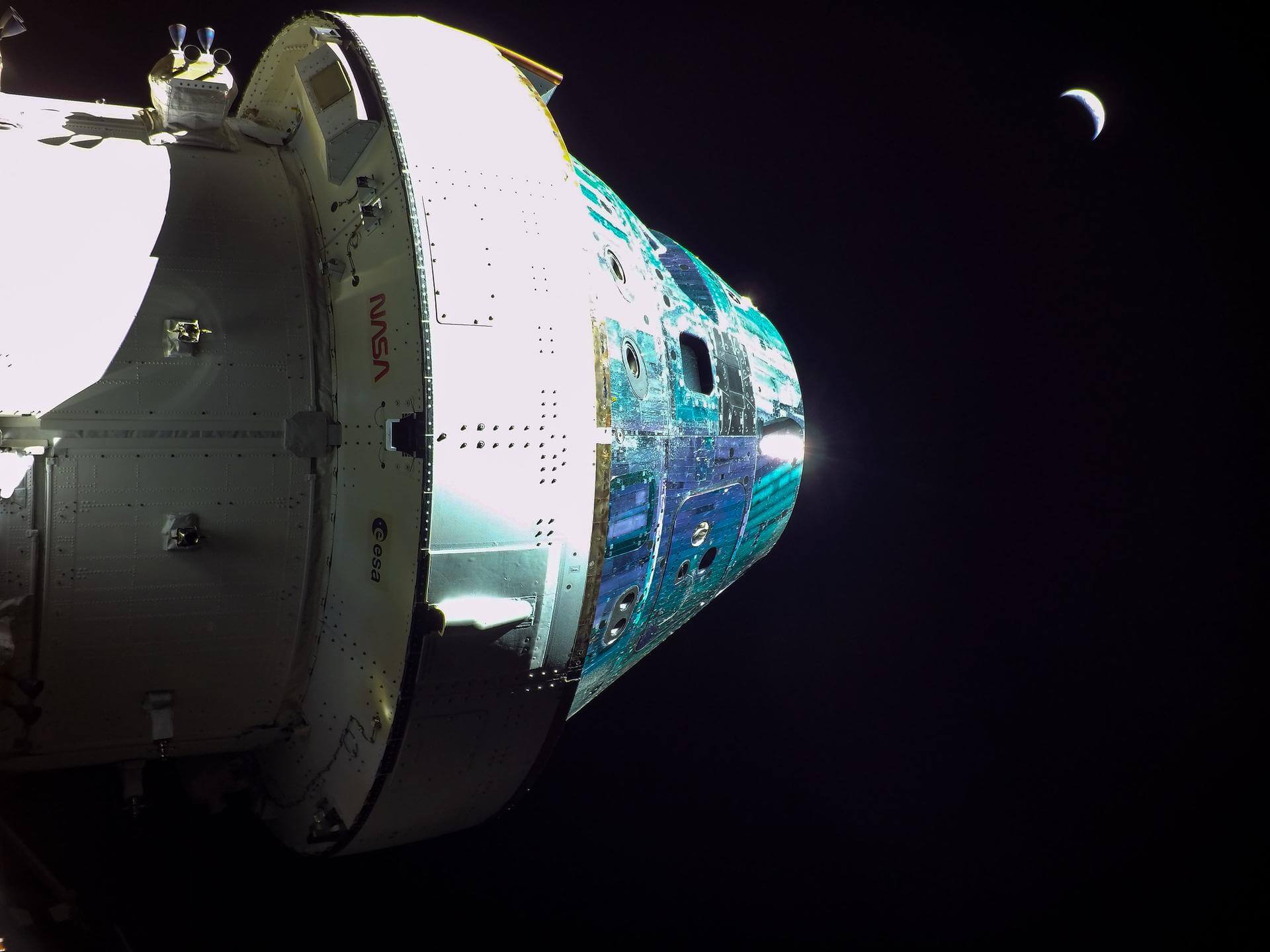
Orion
Active Human Rated Capsule Crew Capacity: 4 Payload Capacity: 100 kg Diameter: 5.03 m Height: 3.3 m()
Nov. 16, 2022
Lunar Missions.
Flight Life
21.1 days
Description
The Orion MPCV takes basic design elements from the Apollo Command Module that took astronauts to the moon, but its technology and capability are more advanced. It is designed to support long-duration deep space missions, with up to 21 days active crew time plus 6 months quiescent. During the quiescent period crew life support would be provided by another module such as a Deep Space Habitat. The spacecraft's life support, propulsion, thermal protection and avionics systems are designed to be upgradeable as new technologies become available. nn The MPCV spacecraft includes both crew and service modules, and a spacecraft adaptor. The MPCV's crew module is larger than Apollo's and can support more crew members for short or long-duration missions. The service module fuels and propels the spacecraft as well as storing oxygen and water for astronauts. The service module's structure is also being designed to provide locations to mount scientific experiments and cargo.
History
The Orion Multi-Purpose Crew Vehicle (Orion MPCV) is an American spacecraft intended to carry a crew of four astronauts to destinations at or beyond low Earth orbit (LEO). Currently under development by NASA for launch on the Space Launch System, Orion is intended to facilitate human exploration of asteroids and of Mars, as well as to provide a means of delivering or retrieving crew or supplies from the ISS if needed.
Long March 8A
SpaceSail Polar Group #14
Commercial LC-1 - Wenchang Space Launch Site, People's Republic of China20 Low Earth Orbit communication satellites with Ku, Q and V band payloads for the G60 constellation operated by Shanghai Spacesail Technologies with…
Falcon 9
Starlink Group 10-50
Space Launch Complex 40 - Cape Canaveral SFS, FL, USAA batch of 29 satellites for the Starlink mega-constellation - SpaceX's project for space-based Internet communication system. The Falcon 9 1st st…
Long March 6A
SpaceSail Polar Group #13
Launch Complex 9A - Taiyuan Satellite Launch Center, People's Republic of China18 Low Earth Orbit communication satellites with Ku, Q and V band payloads for the G60 constellation operated by Shanghai Spacesail Technologies with…
Pegasus XL
Swift Boost Mission
Kwajalein Atoll - Air launch to orbitContracted by NASA under the Small Business Innovation Research Phase 3 contract, Katalyst Space Technologies' LINK servicing spacecraft will rendezv…
Atlas V 551
Amazon Leo (LA-08)
Space Launch Complex 41 - Cape Canaveral SFS, FL, USAAmazon Leo, formerly known as Project Kuiper, is a mega constellation of satellites in Low Earth Orbit that will offer broadband internet access, thi…
Falcon 9
Starlink Group 17-46
Space Launch Complex 4E - Vandenberg SFB, CA, USAA batch of 24 satellites for the Starlink mega-constellation - SpaceX's project for space-based Internet communication system.
Long March 4B
Haiyang 2E
Launch Area 94 (SLS-2 / 603) - Jiuquan Satellite Launch Center, People's Republic of ChinaHaiyang 2E (Chinese: "Ocean"), abbreviated HY-2E, is a marine remote sensing satellite of China. The HY-2 series' primary objective is to measure oce…
Falcon 9
Sirius SXM-11
Space Launch Complex 40 - Cape Canaveral SFS, FL, USASXM-11 is the 12th high-powered, digital, audio radio satellite built by Lanteris Space (ex-Maxar, Space System/Loral) for SiriusXM. The SXM-11 satel…
Falcon 9
Starlink Group 17-40
Space Launch Complex 4E - Vandenberg SFB, CA, USAA batch of 24 satellites for the Starlink mega-constellation - SpaceX's project for space-based Internet communication system.
Electron
Ten Owl Of Ten (StriX Launch 10)
Rocket Lab Launch Complex 1B - Rocket Lab Launch Complex 1, Mahia Peninsula, New ZealandSynthetic aperture radar satellite for Japanese Earth imaging company Synspective.

