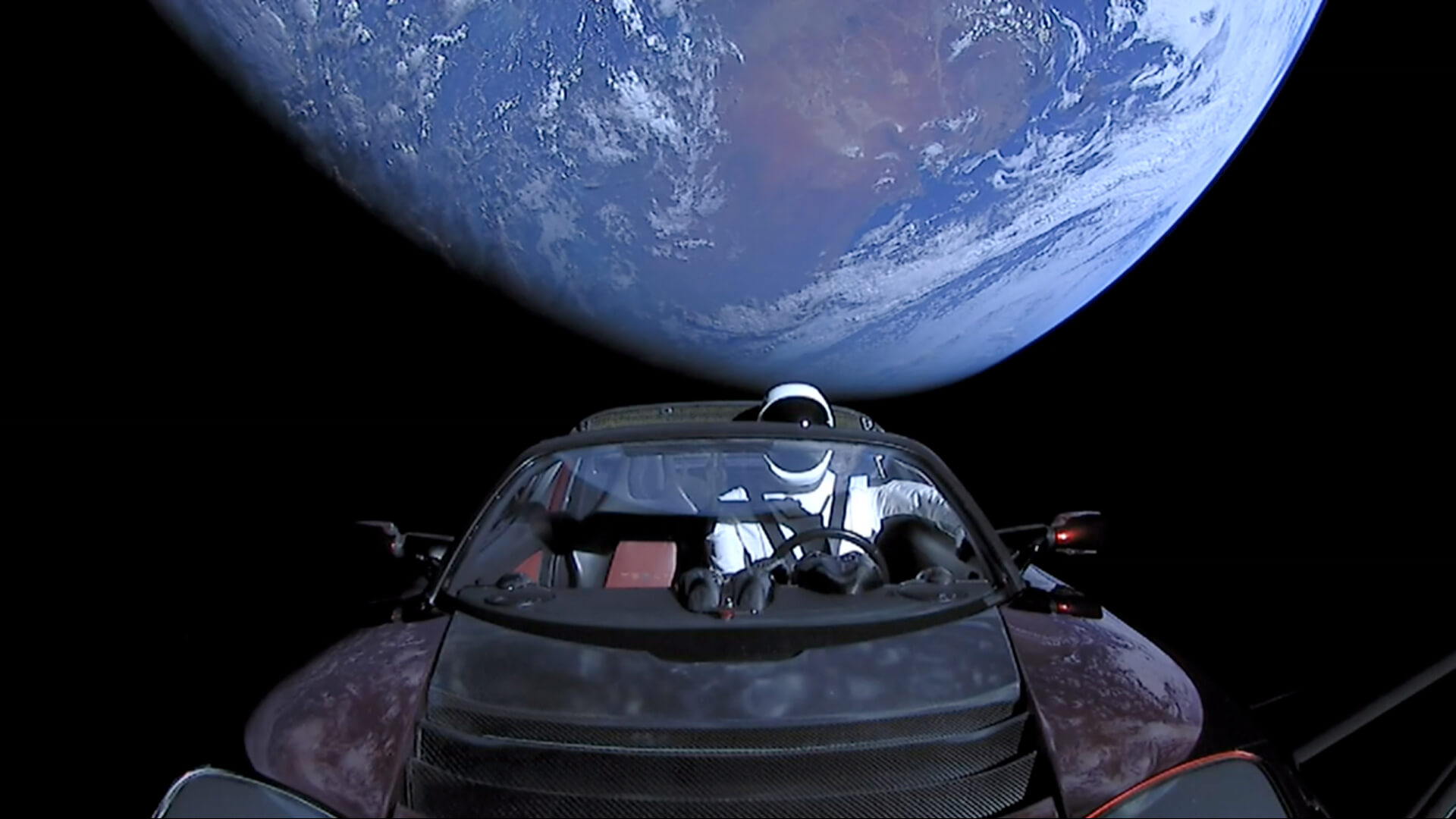
Tesla Roadster
In-active Cargo Mass Simulator Crew Capacity: 2 Diameter: 1.8 m Height: 4.0 m()
Feb. 6, 2018
A car in space.
Flight Life
It is now on an heliocentric orbit with no planned return to Earth.
Description
The car, mounted on the rocket's second stage, acquired enough velocity to escape Earth's gravity and enter an elliptical heliocentric orbit crossing the orbit of Mars. The orbit reaches a maximum distance from the Sun at aphelion of 1.66 astronomical units (au). During the early portion of the voyage outside the Earth's atmosphere, live video was transmitted back to the mission control center and live-streamed for slightly over four hours.
History
Elon Musk's Tesla Roadster is an electric sports car that served as the dummy payload for the February 2018 Falcon Heavy test flight and became an artificial satellite of the Sun. "Starman", a mannequin dressed in a spacesuit, occupies the driver's seat. The car and rocket are products of Tesla and SpaceX, respectively, both companies founded by Elon Musk. The 2008-model Roadster was previously used by Musk for commuting to work, and is the only production car in space.
Falcon 9
Starlink Group 10-19
Space Launch Complex 40 - Cape Canaveral SFS, FL, USAA batch of 29 satellites for the Starlink mega-constellation - SpaceX's project for space-based Internet communication system.
H3-22
Michibiki 7 (QZS-7)
Yoshinobu Launch Complex LP-2 - Tanegashima Space Center, JapanQZSS (Quasi Zenith Satellite System) is a Japanese satellite navigation system operating from inclined, elliptical geosynchronous orbits to achieve o…
Long March 7A
ChinaSat 4B
201 - Wenchang Space Launch Site, People's Republic of ChinaChinese communication geostationary satellite for unknown purposes.
Falcon 9
Starlink Group 17-38
Space Launch Complex 4E - Vandenberg SFB, CA, USAA batch of 24 satellites for the Starlink mega-constellation - SpaceX's project for space-based Internet communication system.
Electron
The Grain Goddess Provides (iQPS Launch 7)
Rocket Lab Launch Complex 1A - Rocket Lab Launch Complex 1, Mahia Peninsula, New ZealandSynthetic aperture radar Earth observation satellite for Japanese Earth imaging company iQPS.
Falcon 9
BlueBird 11-13 (Block 2 #6-8)
Space Launch Complex 40 - Cape Canaveral SFS, FL, USAAST SpaceMobile’s Block 2 BlueBird satellites are designed to deliver up to 10 times the bandwidth capacity of the BlueBird Block 1 satellites, requi…
Smart Dragon 3
OSE HS-01 & 02
Haiyang offshore launch location - Haiyang Oriental Spaceport2 hyper-spectral Earth observation satellites from Chinese company STAR.VISION. Both satellites are built in corporation with foreign customers: *…
Falcon 9
Starlink Group 17-53
Space Launch Complex 4E - Vandenberg SFB, CA, USAA batch of 24 satellites for the Starlink mega-constellation - SpaceX's project for space-based Internet communication system.
Long March 8A
SatNet LEO Group 23
Commercial LC-1 - Wenchang Space Launch Site, People's Republic of ChinaA batch of 9 Low Earth Orbit communication satellites for the Chinese state owned SatNet constellation operated by the China Satellite Network Group.…
Falcon 9
Starlink Group 17-52
Space Launch Complex 4E - Vandenberg SFB, CA, USAA batch of 24 satellites for the Starlink mega-constellation - SpaceX's project for space-based Internet communication system.

