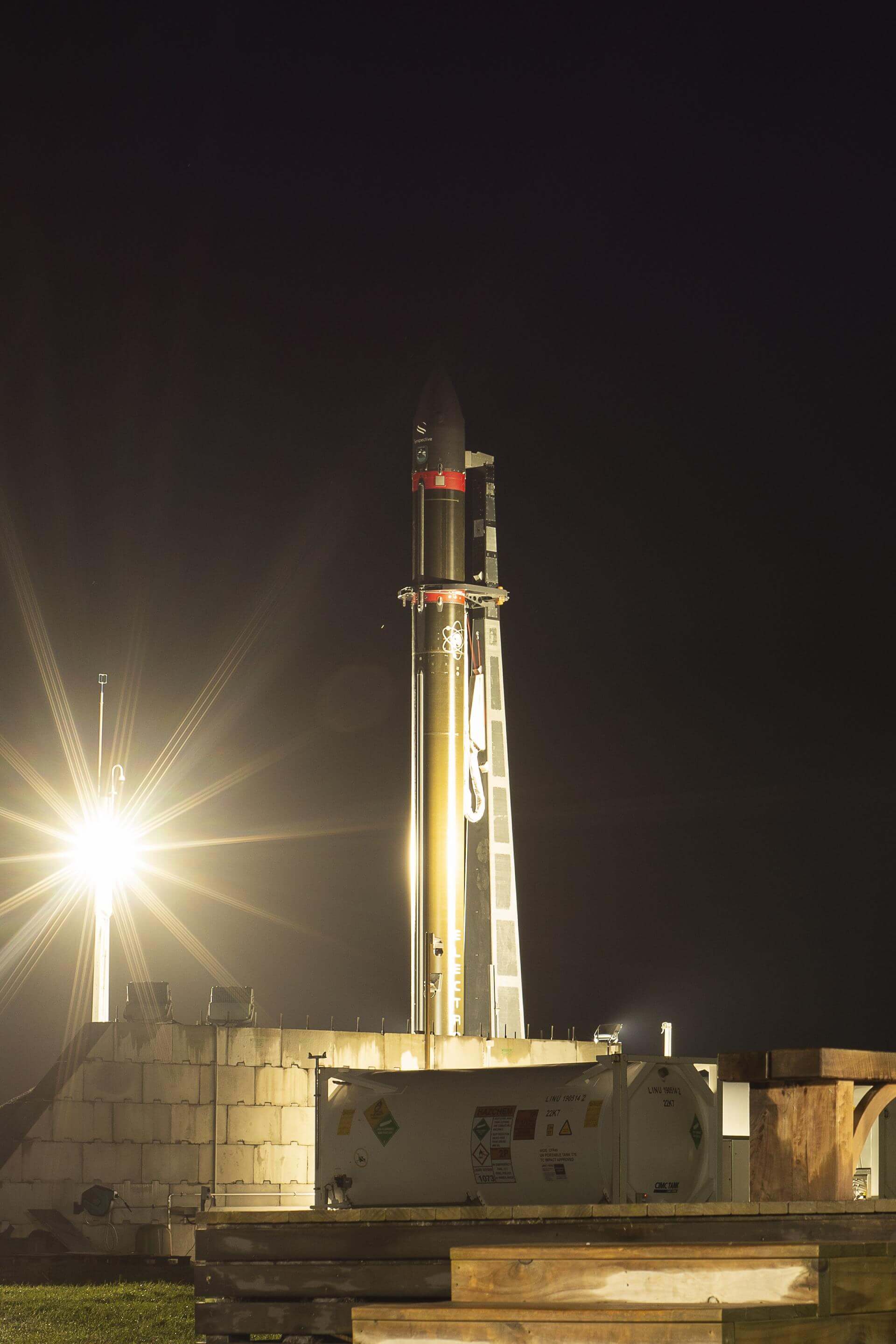
Electron - 24
Details
Status - Expended
Booster used during the "The Owl's Night Continues" mission

Electron | The Owl’s Night Continues (StriX-β)
Rocket Lab | United States of AmericaRocket Lab Launch Complex 1, Mahia Peninsula, New Zealand
Feb. 28, 2022, 8:37 p.m.
Status: Launch Successful
Mission:
StriX β is a Japanese synthetic aperture radar satellite built by Synspective as a demonstrator for their planned 25 satellite constellation. It will feature an X-band synthetic aperture radar. StriX β is an upgraded version of the StriX α prototype. The satellite features two deployable panes, one side carrying solar cells, the other carrying the X-band radar antenna. The StriX satellite constellation can target data with a ground resolution of 1-3 m, single polarized (VV), and a swath width of more than 10-30 km. The StriX observation modes are Stripmap and Sliding Spotlight mode and each satellite has an SAR antenna that is 5 meters in length and stowed during launch. The simple design of the satellites allows for affordable development of the constellation. StriX β was planned to be launched in 2021 on a Soyuz-2-1a Fregat or Soyuz-2-1b Fregat rideshare mission, but as this mission was delayed, it was re-booked on a dedicated Electron KS launch. Synspective is planning a constellation of 25 satellites called StriX, comprised of 100-kilogram satellites capable of imaging at a resolution of one to three meters. By 2022 the company plans to have six satellites in orbit. The company has not set a date by which it hopes to achieve 25 satellites.
Sun-Synchronous Orbit 24 - Maiden Flight South PacificElectron
The Grain Goddess Provides (iQPS Launch 7)
Rocket Lab Launch Complex 1A - Rocket Lab Launch Complex 1, Mahia Peninsula, New ZealandSynthetic aperture radar Earth observation satellite for Japanese Earth imaging company iQPS.
Falcon 9
BlueBird 11-13 (Block 2 #6-8)
Space Launch Complex 40 - Cape Canaveral SFS, FL, USAAST SpaceMobile’s Block 2 BlueBird satellites are designed to deliver up to 10 times the bandwidth capacity of the BlueBird Block 1 satellites, requi…
Smart Dragon 3
OSE HS-01 & 02
Haiyang offshore launch location - Haiyang Oriental Spaceport2 hyper-spectral Earth observation satellites from Chinese company STAR.VISION. Both satellites are built in corporation with foreign customers: *…
Falcon 9
Starlink Group 17-53
Space Launch Complex 4E - Vandenberg SFB, CA, USAA batch of 24 satellites for the Starlink mega-constellation - SpaceX's project for space-based Internet communication system.
Long March 8A
SatNet LEO Group 23
Commercial LC-1 - Wenchang Space Launch Site, People's Republic of ChinaA batch of 9 Low Earth Orbit communication satellites for the Chinese state owned SatNet constellation operated by the China Satellite Network Group.…

