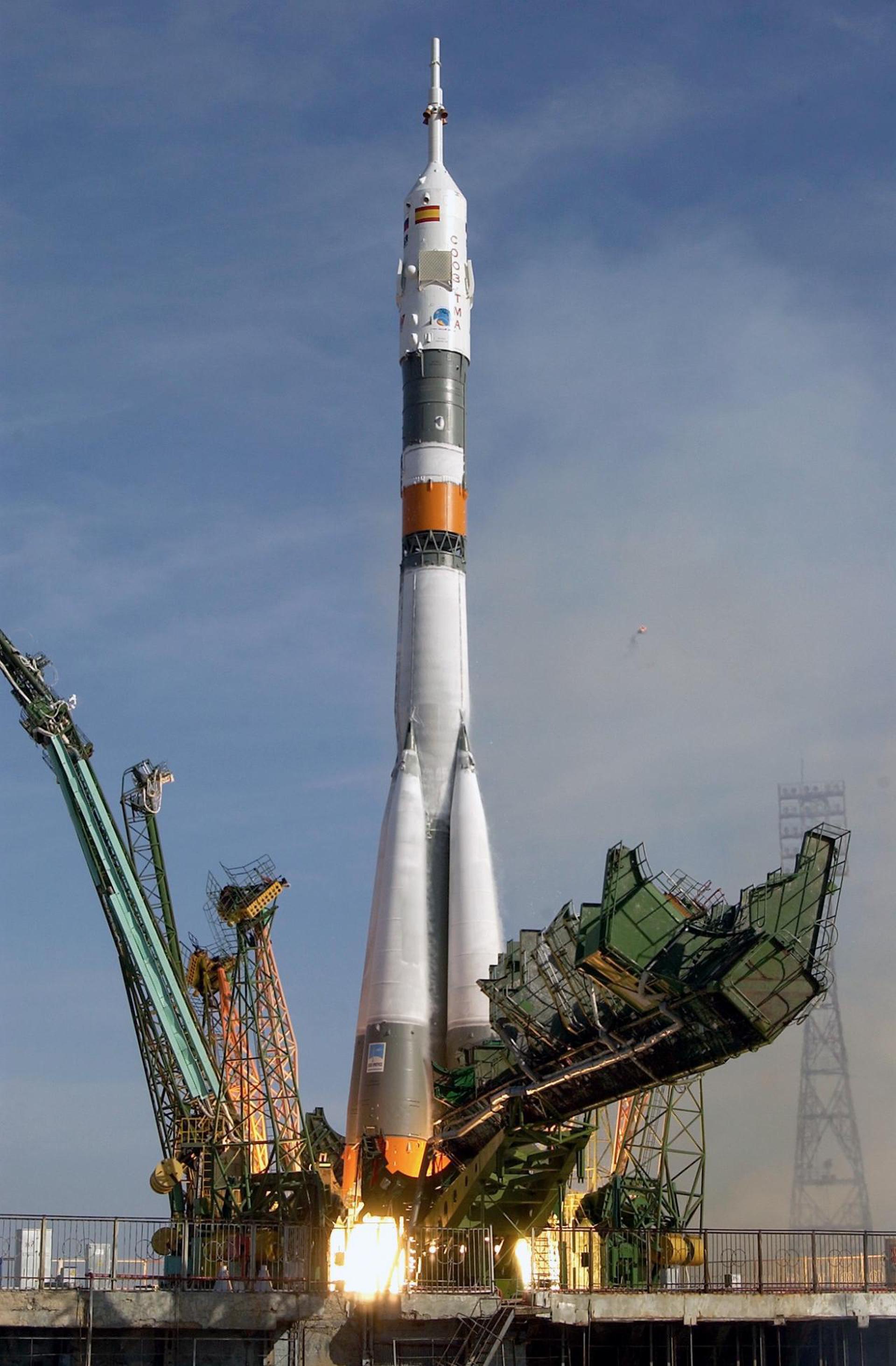
Soyuz U
In-activeRussian Federal Space Agency (ROSCOSMOS) (RFSA)
May 18, 1973
Description
Specifications
-
Minimum Stage
2 -
Max Stage
3 -
Length
51.1 m -
Diameter
2.95 m -
Fairing Diameter
― -
Launch Mass
313.0 T -
Thrust
―
Family
-
Name
Soyuz U -
Family
― -
Variant
― -
Alias
― -
Full Name
Soyuz U
Payload Capacity
-
Launch Cost
― -
Low Earth Orbit
6900.0 kg -
Geostationary Transfer
Orbit
― -
Direct Geostationary
― -
Sun-Synchronous Capacity
―
Russian Federal Space Agency (ROSCOSMOS)
Government
Administrator: Yuri Borisov
RFSA 1992The Roscosmos State Corporation for Space Activities, commonly known as Roscosmos, is the governmental body responsible for the space science program of the Russian Federation and general aerospace research. Soyuz has many launch locations the Russian sites are Baikonur, Plesetsk and Vostochny however Ariane also purchases the vehicle and launches it from French Guiana.
Soyuz-U | Progress MS-05 (66P)
Russian Federal Space Agency (ROSCOSMOS) | RussiaBaikonur Cosmodrome, Republic of Kazakhstan
Feb. 22, 2017, 5:58 a.m.
Soyuz-U | Progress MS-04 (65P)
Russian Federal Space Agency (ROSCOSMOS) | RussiaBaikonur Cosmodrome, Republic of Kazakhstan
Dec. 1, 2016, 2:51 p.m.
Soyuz-U | Progress MS-03 (64P)
Russian Federal Space Agency (ROSCOSMOS) | RussiaBaikonur Cosmodrome, Republic of Kazakhstan
July 16, 2016, 9:41 p.m.
Soyuz-U | Progress M-29M (61P)
Russian Federal Space Agency (ROSCOSMOS) | RussiaBaikonur Cosmodrome, Republic of Kazakhstan
Oct. 1, 2015, 4:49 p.m.
Soyuz U | Progress M-28M (60P)
Russian Federal Space Agency (ROSCOSMOS) | RussiaBaikonur Cosmodrome, Republic of Kazakhstan
July 3, 2015, 4:55 a.m.
Soyuz-U | Progress M-26M
Russian Federal Space Agency (ROSCOSMOS) | RussiaBaikonur Cosmodrome, Republic of Kazakhstan
Feb. 17, 2015, 11 a.m.
Soyuz-U | Progress M-24M (56P)
Russian Federal Space Agency (ROSCOSMOS) | RussiaBaikonur Cosmodrome, Republic of Kazakhstan
July 23, 2014, 9:44 p.m.
Soyuz-U | EgyptSat 2 / ايجيبت سات
Russian Federal Space Agency (ROSCOSMOS) | RussiaBaikonur Cosmodrome, Republic of Kazakhstan
April 16, 2014, 4:20 p.m.
Soyuz-U | Progress M-23M (55P)
Russian Federal Space Agency (ROSCOSMOS) | RussiaBaikonur Cosmodrome, Republic of Kazakhstan
April 9, 2014, 3:26 p.m.
Soyuz-U | Progress M-22M (54P)
Russian Federal Space Agency (ROSCOSMOS) | RussiaBaikonur Cosmodrome, Republic of Kazakhstan
Feb. 5, 2014, 4:23 p.m.
Soyuz-U | Progress M-21M (53P)
Russian Federal Space Agency (ROSCOSMOS) | RussiaBaikonur Cosmodrome, Republic of Kazakhstan
Nov. 25, 2013, 8:53 p.m.
Soyuz-U | Progress M-20M (52P)
Russian Federal Space Agency (ROSCOSMOS) | RussiaBaikonur Cosmodrome, Republic of Kazakhstan
July 27, 2013, 8:45 p.m.
Soyuz-U | Progress M-19M (51P)
Russian Federal Space Agency (ROSCOSMOS) | RussiaBaikonur Cosmodrome, Republic of Kazakhstan
April 24, 2013, 10:12 a.m.
Soyuz-U | Progress M-18M (50P)
Russian Federal Space Agency (ROSCOSMOS) | RussiaBaikonur Cosmodrome, Republic of Kazakhstan
Feb. 11, 2013, 2:41 p.m.
Soyuz-U | Progress M-17M (49P)
Russian Federal Space Agency (ROSCOSMOS) | RussiaBaikonur Cosmodrome, Republic of Kazakhstan
Oct. 31, 2012, 7:41 a.m.
Soyuz-U | Progress M-16M (48P)
Russian Federal Space Agency (ROSCOSMOS) | RussiaBaikonur Cosmodrome, Republic of Kazakhstan
Aug. 1, 2012, 7:35 p.m.
Soyuz-U | Kobalt-M No.8 (Kosmos-2480)
Russian Federal Space Agency (ROSCOSMOS) | RussiaPlesetsk Cosmodrome, Russian Federation
May 17, 2012, 2:05 p.m.
Soyuz-U | Progress M-15M (47P)
Russian Federal Space Agency (ROSCOSMOS) | RussiaBaikonur Cosmodrome, Republic of Kazakhstan
April 20, 2012, 12:50 p.m.
Soyuz-U | Progress M-14M (46P)
Russian Federal Space Agency (ROSCOSMOS) | RussiaBaikonur Cosmodrome, Republic of Kazakhstan
Jan. 25, 2012, 11:06 p.m.
Soyuz-U | Progress M-13M (45P)
Russian Federal Space Agency (ROSCOSMOS) | RussiaBaikonur Cosmodrome, Republic of Kazakhstan
Oct. 30, 2011, 10:11 a.m.
Soyuz-U | Progress M-12M (44P)
Russian Federal Space Agency (ROSCOSMOS) | RussiaBaikonur Cosmodrome, Republic of Kazakhstan
Aug. 24, 2011, midnight
Soyuz-U | Kobalt-M No.7 (Kosmos 2472)
Russian Federal Space Agency (ROSCOSMOS) | RussiaPlesetsk Cosmodrome, Russian Federation
June 27, 2011, 4 p.m.
Soyuz-U | Progress M-11M (43P)
Russian Federal Space Agency (ROSCOSMOS) | RussiaBaikonur Cosmodrome, Republic of Kazakhstan
June 21, 2011, 2:38 p.m.
Soyuz-U | Progress M-10M (42P)
Russian Federal Space Agency (ROSCOSMOS) | RussiaBaikonur Cosmodrome, Republic of Kazakhstan
April 27, 2011, 1:05 p.m.
Soyuz-U | Progress M-09M (41P)
Russian Federal Space Agency (ROSCOSMOS) | RussiaBaikonur Cosmodrome, Republic of Kazakhstan
Jan. 28, 2011, 1:31 a.m.
Soyuz-U | Progress M-08M (40P)
Russian Federal Space Agency (ROSCOSMOS) | RussiaBaikonur Cosmodrome, Republic of Kazakhstan
Oct. 27, 2010, 3:11 p.m.
Soyuz-U | Progress M-07M (39P)
Russian Federal Space Agency (ROSCOSMOS) | RussiaBaikonur Cosmodrome, Republic of Kazakhstan
Sept. 10, 2010, 10:22 a.m.
Soyuz-U | Progress M-06M (38P)
Russian Federal Space Agency (ROSCOSMOS) | RussiaBaikonur Cosmodrome, Republic of Kazakhstan
June 30, 2010, 3:35 p.m.
Soyuz-U | Progress M-05M (37P)
Russian Federal Space Agency (ROSCOSMOS) | RussiaBaikonur Cosmodrome, Republic of Kazakhstan
April 28, 2010, 5:15 p.m.
Soyuz-U | Kobalt-M (Kosmos 2462)
Russian Federal Space Agency (ROSCOSMOS) | RussiaPlesetsk Cosmodrome, Russian Federation
April 16, 2010, 3 p.m.
Soyuz-U | Progress M-04M (36P)
Russian Federal Space Agency (ROSCOSMOS) | RussiaBaikonur Cosmodrome, Republic of Kazakhstan
Feb. 3, 2010, 3:45 a.m.
Soyuz U | Progress M-MIM2
Russian Federal Space Agency (ROSCOSMOS) | RussiaBaikonur Cosmodrome, Republic of Kazakhstan
Nov. 10, 2009, 2:22 p.m.
Soyuz U | Progress M-03M
Russian Federal Space Agency (ROSCOSMOS) | RussiaBaikonur Cosmodrome, Republic of Kazakhstan
Oct. 15, 2009, 1:14 a.m.
Soyuz U | Progress M-67
Russian Federal Space Agency (ROSCOSMOS) | RussiaBaikonur Cosmodrome, Republic of Kazakhstan
July 24, 2009, 10:56 a.m.
Soyuz U | Progress M-02M
Russian Federal Space Agency (ROSCOSMOS) | RussiaBaikonur Cosmodrome, Republic of Kazakhstan
May 7, 2009, 6:37 p.m.
Soyuz U | Progress M-66
Russian Federal Space Agency (ROSCOSMOS) | RussiaBaikonur Cosmodrome, Republic of Kazakhstan
Feb. 10, 2009, 5:49 a.m.
Soyuz U | Progress M-01M
Russian Federal Space Agency (ROSCOSMOS) | RussiaBaikonur Cosmodrome, Republic of Kazakhstan
Nov. 26, 2008, 12:38 p.m.
Soyuz U | Progress M-65
Russian Federal Space Agency (ROSCOSMOS) | RussiaBaikonur Cosmodrome, Republic of Kazakhstan
Sept. 10, 2008, 7:50 p.m.
Soyuz U | Progress M-64
Russian Federal Space Agency (ROSCOSMOS) | RussiaBaikonur Cosmodrome, Republic of Kazakhstan
May 14, 2008, 8:22 p.m.
Soyuz U | Progress M-63
Russian Federal Space Agency (ROSCOSMOS) | RussiaBaikonur Cosmodrome, Republic of Kazakhstan
Feb. 5, 2008, 1:02 p.m.
Soyuz U | Progress M-62
Russian Federal Space Agency (ROSCOSMOS) | RussiaBaikonur Cosmodrome, Republic of Kazakhstan
Dec. 23, 2007, 7:12 a.m.
Soyuz U | Progress M-61
Russian Federal Space Agency (ROSCOSMOS) | RussiaBaikonur Cosmodrome, Republic of Kazakhstan
Aug. 2, 2007, 5:33 p.m.
Soyuz U | Progress M-60
Russian Federal Space Agency (ROSCOSMOS) | RussiaBaikonur Cosmodrome, Republic of Kazakhstan
May 12, 2007, 3:25 a.m.
Soyuz U | Progress M-59
Russian Federal Space Agency (ROSCOSMOS) | RussiaBaikonur Cosmodrome, Republic of Kazakhstan
Jan. 18, 2007, 2:12 a.m.
Soyuz U | Progress M-58
Russian Federal Space Agency (ROSCOSMOS) | RussiaBaikonur Cosmodrome, Republic of Kazakhstan
Oct. 23, 2006, 1:40 p.m.
Soyuz U | Progress M-57
Russian Federal Space Agency (ROSCOSMOS) | RussiaBaikonur Cosmodrome, Republic of Kazakhstan
June 24, 2006, 3:08 p.m.
Soyuz U | Progress M-56
Russian Federal Space Agency (ROSCOSMOS) | RussiaBaikonur Cosmodrome, Republic of Kazakhstan
April 24, 2006, 4:03 p.m.
Soyuz U | Progress M-55
Russian Federal Space Agency (ROSCOSMOS) | RussiaBaikonur Cosmodrome, Republic of Kazakhstan
Dec. 21, 2005, 6:38 p.m.
Soyuz U | Progress M-54
Russian Federal Space Agency (ROSCOSMOS) | RussiaBaikonur Cosmodrome, Republic of Kazakhstan
Sept. 8, 2005, 1:07 p.m.
Soyuz U | Progress M-53
Russian Federal Space Agency (ROSCOSMOS) | RussiaBaikonur Cosmodrome, Republic of Kazakhstan
June 16, 2005, 11:09 p.m.
Soyuz U | Progress M-52
Russian Federal Space Agency (ROSCOSMOS) | RussiaBaikonur Cosmodrome, Republic of Kazakhstan
Feb. 28, 2005, 7:09 p.m.
Soyuz U | Progress M-51
Russian Federal Space Agency (ROSCOSMOS) | RussiaBaikonur Cosmodrome, Republic of Kazakhstan
Dec. 23, 2004, 10:19 p.m.
Soyuz U | Progress M-50
Russian Federal Space Agency (ROSCOSMOS) | RussiaBaikonur Cosmodrome, Republic of Kazakhstan
Aug. 11, 2004, 5:03 a.m.
Soyuz U | Progress M-49
Russian Federal Space Agency (ROSCOSMOS) | RussiaBaikonur Cosmodrome, Republic of Kazakhstan
May 25, 2004, 12:34 p.m.
Soyuz U | Progress M1-11
Russian Federal Space Agency (ROSCOSMOS) | RussiaBaikonur Cosmodrome, Republic of Kazakhstan
Jan. 29, 2004, 11:58 a.m.
Soyuz U | Progress M-48
Russian Federal Space Agency (ROSCOSMOS) | RussiaBaikonur Cosmodrome, Republic of Kazakhstan
Aug. 29, 2003, 1:47 a.m.
Soyuz U | Progress M1-10
Russian Federal Space Agency (ROSCOSMOS) | RussiaBaikonur Cosmodrome, Republic of Kazakhstan
June 8, 2003, 10:34 a.m.
Soyuz U | Progress M-47
Russian Federal Space Agency (ROSCOSMOS) | RussiaBaikonur Cosmodrome, Republic of Kazakhstan
Feb. 2, 2003, 12:59 p.m.
Soyuz U | Progress M-46
Russian Federal Space Agency (ROSCOSMOS) | RussiaBaikonur Cosmodrome, Republic of Kazakhstan
June 26, 2002, 5:36 a.m.
Soyuz-U | Soyuz TM-34
Russian Federal Space Agency (ROSCOSMOS) | RussiaBaikonur Cosmodrome, Republic of Kazakhstan
April 25, 2002, 6:26 a.m.
Status: Launch Successful
Mission:
Soyuz TM-34 was a visiting mission to ISS, which carried 3 cosmonauts and astronauts. Russian Commander, cosmonaut Yuri Gidzenko alongside Flight Engineer, ESA astronaut Roberto Vittori and Flight Engineer/Spaceflight Participant Mark Shuttleworth launched aboard the Soyuz spacecraft on April 25, 2002, 06:26:35 UTC. They docked with the station two days later. During their stay there, crew assisted Expedition 4 members in station work. Soyuz TM-34 crew returned aboard Soyuz TM-33, landing safely back on Earth on May 5, 2002, 03:51:53 UTC.
Low Earth OrbitSoyuz U | Progress M1-8
Russian Federal Space Agency (ROSCOSMOS) | RussiaBaikonur Cosmodrome, Republic of Kazakhstan
March 21, 2002, 8:13 p.m.
Soyuz U | Soyuz TM-33
Russian Federal Space Agency (ROSCOSMOS) | RussiaBaikonur Cosmodrome, Republic of Kazakhstan
Oct. 21, 2001, 8:59 a.m.
Status: Launch Successful
Mission:
Soyuz TM-33 was a visiting mission to ISS, which carried 3 cosmonauts and astronauts. Russian Commander, cosmonaut Viktor Afanasyev alongside Flight Engineer, ESA astronaut Claudie Haigneré and Flight Engineer/Spaceflight Participant, Konstantin Kozeyev launched aboard the Soyuz spacecraft on October 21, 2001, 08:59:35 UTC. They docked with the station two days later. During their stay there, crew assisted Expedition 3 members in station work. Soyuz TM-33 crew returned aboard Soyuz TM-32, landing safely back on Earth on October 31, 2001, 05:00:00 UTC.
Low Earth OrbitSoyuz U | Progress M-SO1
Russian Federal Space Agency (ROSCOSMOS) | RussiaBaikonur Cosmodrome, Republic of Kazakhstan
Sept. 14, 2001, 11:34 p.m.
Soyuz U | Progress M-45
Russian Federal Space Agency (ROSCOSMOS) | RussiaBaikonur Cosmodrome, Republic of Kazakhstan
Aug. 21, 2001, 9:23 a.m.
Soyuz-U | Soyuz TM-32
Russian Federal Space Agency (ROSCOSMOS) | RussiaBaikonur Cosmodrome, Republic of Kazakhstan
April 28, 2001, 7:37 a.m.
Status: Launch Successful
Mission:
Soyuz TM-32 was a visiting mission to ISS, which carried 3 cosmonauts and astronauts. Russian Commander, cosmonaut Talgat Musabayev alongside Flight Engineer, Yuri Baturin and Flight Engineer/Spaceflight Participant Dennis Tito launched aboard the Soyuz spacecraft on April 28, 2001, 07:37:20 UTC. They docked with the station two days later. During their stay there, crew assisted Expedition 2 members in station work. Soyuz TM-32 crew returned aboard Soyuz TM-31, landing safely back on Earth on May 6, 2001, 05:41:28 UTC.
Low Earth OrbitSoyuz U | Progress M-44
Russian Federal Space Agency (ROSCOSMOS) | RussiaBaikonur Cosmodrome, Republic of Kazakhstan
Feb. 26, 2001, 8:09 a.m.
Soyuz U | Progress M1-5
Russian Federal Space Agency (ROSCOSMOS) | RussiaBaikonur Cosmodrome, Republic of Kazakhstan
Jan. 24, 2001, 4:28 a.m.
Soyuz U | Progress M1-4
Russian Federal Space Agency (ROSCOSMOS) | RussiaBaikonur Cosmodrome, Republic of Kazakhstan
Nov. 16, 2000, 1:32 a.m.
Soyuz-U | Soyuz TM-31
Russian Federal Space Agency (ROSCOSMOS) | RussiaBaikonur Cosmodrome, Republic of Kazakhstan
Oct. 31, 2000, 7:52 a.m.
Status: Launch Successful
Mission:
Soyuz TM-31 began Expedition 1 by carrying 3 cosmonauts and astronauts to the International Space Station. Russian Commander, cosmonaut Yuri Gidzenko alongside Flight Engineer, Sergei Krikalev and Flight Engineer/Spaceflight Participant William Shepherd launched aboard the Soyuz spacecraft on October 31, 2000, 07:52:47 UTC. They docked with the station two days later. During their stay there, crew performed first maintenance and repair works, carried out first experiments and conducted several EVAs. They were also visited by several Progress resupply spacecrafts and STS-97 and STS-98 crews, and welcomed aboart STS-102 with the next expedition crew. Expedition 1 returned with STS-102, landing safely back on Earth on 21 March 2001, 07:33:06 UTC.
Low Earth OrbitSoyuz U | Progress M-43
Russian Federal Space Agency (ROSCOSMOS) | RussiaBaikonur Cosmodrome, Republic of Kazakhstan
Oct. 16, 2000, 9:27 p.m.
Soyuz U | Progress M1-3
Russian Federal Space Agency (ROSCOSMOS) | RussiaBaikonur Cosmodrome, Republic of Kazakhstan
Aug. 6, 2000, 6:26 p.m.
Soyuz U | Progress M1-2
Russian Federal Space Agency (ROSCOSMOS) | RussiaBaikonur Cosmodrome, Republic of Kazakhstan
April 25, 2000, 8:08 p.m.
Soyuz-U | Soyuz TM-30
Russian Federal Space Agency (ROSCOSMOS) | RussiaBaikonur Cosmodrome, Republic of Kazakhstan
April 4, 2000, 5:01 a.m.
Status: Launch Successful
Mission:
Soyuz TM-30 was the 39th mission and the 28th long-duration expedition to Mir space station. It was the final human spaceflight to Mir. The mission began on April 4, 2000, 05:01:29 UTC, launching Commander Sergei Zalyotin and Flight Engineer Aleksandr Kaleri into orbit. They docked with Mir two days later. During their stay there, cosmonauts performed an EVA and various maintenance and repair tasks. Station crew was visited by several Progress resupply spacecrafts. The mission was privately funded by MirCorp company, which planned to refurbish and privatize the aging Mir space station, however insufficient funding and investment made these plans impossible to come true. The mission concluded with a safe landing back on Earth on June 16, 2000, 00:44 UTC.
Low Earth OrbitSoyuz U | Progress M1-1
Russian Federal Space Agency (ROSCOSMOS) | RussiaBaikonur Cosmodrome, Republic of Kazakhstan
Feb. 1, 2000, 6:47 a.m.
Soyuz U | Progress M-42
Russian Federal Space Agency (ROSCOSMOS) | RussiaBaikonur Cosmodrome, Republic of Kazakhstan
July 16, 1999, 4:37 p.m.
Soyuz U | Progress M-41
Russian Federal Space Agency (ROSCOSMOS) | RussiaBaikonur Cosmodrome, Republic of Kazakhstan
April 2, 1999, 11:28 a.m.
Soyuz-U | Soyuz TM-29
Russian Federal Space Agency (ROSCOSMOS) | RussiaBaikonur Cosmodrome, Republic of Kazakhstan
Feb. 20, 1999, 4:18 a.m.
Status: Launch Successful
Mission:
Soyuz TM-29 was the 38th mission and the 27th long-duration expedition to Mir space station. The mission began on February 20, 1999, 04:18:01 UTC, launching Commander Viktor Afanasyev, Flight Engineer Jean-Pierre Haigneré and Research Cosmonaut/Fight Engineer Ivan Bella, who became the first Slovakian cosmonaut, into orbit. They docked with Mir two days later. During their stay there, cosmonauts performed several EVAs and various scientific experiments. Station crew was visited by several Progress resupply spacecrafts. The mission concluded with a safe landing back on Earth on August 28, 1999, 00:34:20 UTC.
Low Earth OrbitSoyuz U | Progress M-40
Russian Federal Space Agency (ROSCOSMOS) | RussiaBaikonur Cosmodrome, Republic of Kazakhstan
Oct. 25, 1998, 4:14 a.m.
Soyuz-U | Soyuz TM-28
Russian Federal Space Agency (ROSCOSMOS) | RussiaBaikonur Cosmodrome, Republic of Kazakhstan
Aug. 13, 1998, 9:43 a.m.
Status: Launch Successful
Mission:
Soyuz TM-28 was the 37th mission and the 26th long-duration expedition to Mir space station. The mission began on August 13, 1998, 09:43:11 UTC, launching Commander Gennady Padalka, Flight Engineer Sergei Avdeyev and Research Cosmonaut Yuri Baturin into orbit. They docked with Mir two days later. During their stay there, cosmonauts performed several EVAs and various scientific experiments in medicine, biotechnology, Earth sciences etc. Station crew was visited by several Progress resupply spacecrafts, and welcomed aboard Soyuz TM-29 with the next expedition crew. The mission concluded with a safe landing back on Earth on February 28, 1999, 02:14:30 UTC.
Low Earth OrbitSoyuz U | Progress M-39
Russian Federal Space Agency (ROSCOSMOS) | RussiaBaikonur Cosmodrome, Republic of Kazakhstan
May 14, 1998, 10:12 p.m.
Soyuz U | Progress M-38
Russian Federal Space Agency (ROSCOSMOS) | RussiaBaikonur Cosmodrome, Republic of Kazakhstan
March 14, 1998, 10:45 p.m.
Soyuz U | Soyuz TM-27
Russian Federal Space Agency (ROSCOSMOS) | RussiaBaikonur Cosmodrome, Republic of Kazakhstan
Jan. 29, 1998, 4:33 p.m.
Status: Launch Successful
Mission:
Soyuz TM-27 was the 35th mission and the 25th long-duration expedition to Mir space station. It was also a part of the US/Russian Shuttle-Mir Program. The mission began on January 29, 1998, 16:33:42 UTC, launching Commander Talgat Musabayev, Flight Engineer Nikolai Budarin and Research Cosmonaut Léopold Eyharts into orbit. They docked with Mir two days later. During their stay there, cosmonauts performed several EVAs and various scientific experiments in medicine, biotechnology, Earth sciences etc. Station crew was visited by several Progress resupply spacecrafts, STS-91, and welcomed aboard Soyuz TM-28 with the next expedition crew. The mission concluded with a safe landing back on Earth on August 25, 1998, 05:24:44 UTC.
Low Earth OrbitSoyuz U | Progress M-37
Russian Federal Space Agency (ROSCOSMOS) | RussiaBaikonur Cosmodrome, Republic of Kazakhstan
Dec. 20, 1997, 8:45 a.m.
Soyuz U | Resurs F-1M
Russian Federal Space Agency (ROSCOSMOS) | RussiaPlesetsk Cosmodrome, Russian Federation
Nov. 18, 1997, 11:14 a.m.
Soyuz U | Foton 11 & Mirka
Russian Federal Space Agency (ROSCOSMOS) | RussiaPlesetsk Cosmodrome, Russian Federation
Oct. 9, 1997, 5:59 p.m.
Soyuz U | Progress M-36
Russian Federal Space Agency (ROSCOSMOS) | RussiaBaikonur Cosmodrome, Republic of Kazakhstan
Oct. 5, 1997, 3:08 p.m.
Soyuz-U | Soyuz TM-26
Russian Federal Space Agency (ROSCOSMOS) | RussiaBaikonur Cosmodrome, Republic of Kazakhstan
Aug. 5, 1997, 3:35 p.m.
Status: Launch Successful
Mission:
Soyuz TM-26 was the 32nd mission and the 24rd long-duration expedition to Mir space station. It was also a part of the US/Russian Shuttle-Mir Program. The mission began on August 5, 1997, 15:35:54 UTC, launching Commander Anatoly Solovyev and Flight Engineer Pavel Vinogradov into orbit. They docked with Mir two days later. During their stay there, cosmonauts performed several EVAs and various scientific experiments in medicine, biotechnology, Earth sciences etc. Station crew was visited by several Progress resupply spacecrafts, STS-86 and STS-89, and welcomed aboard Soyuz TM-27 with the next expedition crew. The mission concluded with a safe landing back on Earth on February 19, 1998, 09:10:30 UTC.
Low Earth OrbitSoyuz U | Progress M-35
Russian Federal Space Agency (ROSCOSMOS) | RussiaBaikonur Cosmodrome, Republic of Kazakhstan
July 5, 1997, 4:11 a.m.
Soyuz U | Orlets-1 6
Russian Federal Space Agency (ROSCOSMOS) | RussiaBaikonur Cosmodrome, Republic of Kazakhstan
May 15, 1997, 12:10 p.m.
Soyuz U | Progress M-34
Russian Federal Space Agency (ROSCOSMOS) | RussiaBaikonur Cosmodrome, Republic of Kazakhstan
April 6, 1997, 4:04 p.m.
Soyuz-U | Soyuz TM-25
Russian Federal Space Agency (ROSCOSMOS) | RussiaBaikonur Cosmodrome, Republic of Kazakhstan
Feb. 10, 1997, 2:09 p.m.
Status: Launch Successful
Mission:
Soyuz TM-25 was the 30th mission and the 23rd long-duration expedition to Mir space station. It was also a part of the US/Russian Shuttle-Mir Program. The mission began on February 10, 1997, 14:09:30 UTC, launching Commander Vasili Tsibliyev, Flight Engineer Aleksandr Lazutkin and Research Cosmonaut Reinhold Ewald into orbit. They docked with Mir two days later. During their stay there, cosmonauts performed an EVA and various scientific experiments in medicine, biotechnology, Earth sciences etc. Station crew was visited by several Progress resupply spacecrafts, STS-84, and welcomed aboard Soyuz TM-26 with the next expedition crew. The mission concluded with a safe landing back on Earth on August 14, 1997, 12:17:10 UTC.
Low Earth OrbitSoyuz U | Bion 11
Russian Federal Space Agency (ROSCOSMOS) | RussiaPlesetsk Cosmodrome, Russian Federation
Dec. 24, 1996, 1:50 p.m.
Soyuz U | Progress M-33
Russian Federal Space Agency (ROSCOSMOS) | RussiaBaikonur Cosmodrome, Republic of Kazakhstan
Nov. 19, 1996, 11:20 p.m.
Soyuz-U | Soyuz TM-24
Russian Federal Space Agency (ROSCOSMOS) | RussiaBaikonur Cosmodrome, Republic of Kazakhstan
Aug. 17, 1996, 1:18 p.m.
Status: Launch Successful
Mission:
Soyuz TM-24 was the 27th mission and the 22nd long-duration expedition to Mir space station. It was also a part of the US/Russian Shuttle-Mir Program. The mission began on 17 August 1996, 13:18:03 UTC, launching Commander Valery Korzun, Flight Engineer Aleksandr Kaleri and Research Cosmonaut Claudie André-Deshays into orbit. They docked with Mir two days later. During their stay there, cosmonauts performed several EVAs and various scientific experiments. Station crew was visited by several Progress resupply spacecrafts, STS-79 and STS-81, and welcomed aboard Soyuz TM-25 with the next expedition crew. The mission concluded with a safe landing back on Earth on March 2, 1997, 06:44:16 UTC.
Low Earth OrbitSoyuz U | Progress M-32
Russian Federal Space Agency (ROSCOSMOS) | RussiaBaikonur Cosmodrome, Republic of Kazakhstan
July 31, 1996, 8 p.m.
Soyuz U | Yantar-1KFT 18
Russian Federal Space Agency (ROSCOSMOS) | RussiaBaikonur Cosmodrome, Republic of Kazakhstan
May 14, 1996, 8:55 a.m.
Soyuz U | Progress M-31
Russian Federal Space Agency (ROSCOSMOS) | RussiaBaikonur Cosmodrome, Republic of Kazakhstan
May 5, 1996, 7:04 a.m.
Soyuz-U | Soyuz TM-23
Russian Federal Space Agency (ROSCOSMOS) | RussiaBaikonur Cosmodrome, Republic of Kazakhstan
Feb. 21, 1996, 12:34 p.m.
Status: Launch Successful
Mission:
Soyuz TM-23 was the 25th mission and the 21st long-duration expedition to Mir space station. It was also a part of the US/Russian Shuttle-Mir Program. The mission began on February 21, 1996, 12:34:05 UTC, launching Commander Yuri Onufrienko and Flight Engineer Yury Usachov into orbit. They docked with Mir two days later. During their stay there, cosmonauts performed several EVAs and various scientific experiments. Station crew was visited by several Progress resupply spacecrafts, STS-76, and welcomed aboard Soyuz TM-24 with the next expedition crew. The mission concluded with a safe landing back on Earth on September 2, 1996, 07:41:40 UTC.
Low Earth OrbitSoyuz U | Progress M-30
Russian Federal Space Agency (ROSCOSMOS) | RussiaBaikonur Cosmodrome, Republic of Kazakhstan
Dec. 18, 1995, 2:31 p.m.
Soyuz U | Progress M-29
Russian Federal Space Agency (ROSCOSMOS) | RussiaBaikonur Cosmodrome, Republic of Kazakhstan
Oct. 8, 1995, 6:50 p.m.
Soyuz U | Yantar-4KS1M 7
Russian Federal Space Agency (ROSCOSMOS) | RussiaBaikonur Cosmodrome, Republic of Kazakhstan
Sept. 29, 1995, 4:25 a.m.
Soyuz U | Resurs-F2 10
Russian Federal Space Agency (ROSCOSMOS) | RussiaPlesetsk Cosmodrome, Russian Federation
Sept. 26, 1995, 11:20 a.m.
Soyuz U | Progress M-28
Russian Federal Space Agency (ROSCOSMOS) | RussiaBaikonur Cosmodrome, Republic of Kazakhstan
July 20, 1995, 3:04 a.m.
Soyuz U | Progress M-27
Russian Federal Space Agency (ROSCOSMOS) | RussiaBaikonur Cosmodrome, Republic of Kazakhstan
April 9, 1995, 7:34 p.m.
Soyuz U | Foton 10
Russian Federal Space Agency (ROSCOSMOS) | RussiaPlesetsk Cosmodrome, Russian Federation
Feb. 16, 1995, 5:39 p.m.
Soyuz U | Progress M-26
Russian Federal Space Agency (ROSCOSMOS) | RussiaBaikonur Cosmodrome, Republic of Kazakhstan
Feb. 15, 1995, 4:48 p.m.
Soyuz U | Yantar-4KS1M 6
Russian Federal Space Agency (ROSCOSMOS) | RussiaBaikonur Cosmodrome, Republic of Kazakhstan
Dec. 29, 1994, 11:30 a.m.
Soyuz U | Progress M-25
Russian Federal Space Agency (ROSCOSMOS) | RussiaBaikonur Cosmodrome, Republic of Kazakhstan
Nov. 11, 1994, 7:21 a.m.
Soyuz U | Progress M-24
Russian Federal Space Agency (ROSCOSMOS) | RussiaBaikonur Cosmodrome, Republic of Kazakhstan
Aug. 25, 1994, 2:25 p.m.
Soyuz U | Yantar-1KFT 17
Russian Federal Space Agency (ROSCOSMOS) | RussiaBaikonur Cosmodrome, Republic of Kazakhstan
July 29, 1994, 9:30 a.m.
Soyuz U | Progress M-23
Russian Federal Space Agency (ROSCOSMOS) | RussiaBaikonur Cosmodrome, Republic of Kazakhstan
May 22, 1994, 4:30 a.m.
Soyuz U | Yantar-4KS1M 5
Russian Federal Space Agency (ROSCOSMOS) | RussiaBaikonur Cosmodrome, Republic of Kazakhstan
April 28, 1994, 5:14 p.m.
Soyuz U | Progress M-22
Russian Federal Space Agency (ROSCOSMOS) | RussiaBaikonur Cosmodrome, Republic of Kazakhstan
March 22, 1994, 4:54 a.m.
Soyuz U | Progress M-21
Russian Federal Space Agency (ROSCOSMOS) | RussiaBaikonur Cosmodrome, Republic of Kazakhstan
Jan. 28, 1994, 2:12 a.m.
Soyuz U | Yantar-4KS1M 4
Russian Federal Space Agency (ROSCOSMOS) | RussiaBaikonur Cosmodrome, Republic of Kazakhstan
Nov. 5, 1993, 8:25 a.m.
Soyuz U | Progress M-20
Russian Federal Space Agency (ROSCOSMOS) | RussiaBaikonur Cosmodrome, Republic of Kazakhstan
Oct. 11, 1993, 9:33 p.m.
Soyuz U | Progress M-19
Russian Federal Space Agency (ROSCOSMOS) | RussiaBaikonur Cosmodrome, Republic of Kazakhstan
Aug. 10, 1993, 10:23 p.m.
Soyuz U | Resurs-F2 9
Russian Federal Space Agency (ROSCOSMOS) | RussiaPlesetsk Cosmodrome, Russian Federation
May 21, 1993, 9:15 a.m.
Soyuz U | Yantar-1KFT 16
Russian Federal Space Agency (ROSCOSMOS) | RussiaBaikonur Cosmodrome, Republic of Kazakhstan
April 27, 1993, 10:35 a.m.
Soyuz U | Yantar-4K2 69
Russian Federal Space Agency (ROSCOSMOS) | RussiaPlesetsk Cosmodrome, Russian Federation
April 2, 1993, 2:30 p.m.
Soyuz U | Yantar-4K2 68
Russian Federal Space Agency (ROSCOSMOS) | RussiaPlesetsk Cosmodrome, Russian Federation
Jan. 19, 1993, 2:49 p.m.
Soyuz U | Orlets-1 4
Russian Federal Space Agency (ROSCOSMOS) | RussiaBaikonur Cosmodrome, Republic of Kazakhstan
Dec. 22, 1992, noon
Soyuz U | Yantar-4KS1M 3
Russian Federal Space Agency (ROSCOSMOS) | RussiaBaikonur Cosmodrome, Republic of Kazakhstan
Dec. 9, 1992, 11:25 a.m.
Soyuz U | Yantar-4K2 67
Russian Federal Space Agency (ROSCOSMOS) | RussiaPlesetsk Cosmodrome, Russian Federation
Nov. 20, 1992, 3:29 p.m.
Soyuz U | Foton 8
Russian Federal Space Agency (ROSCOSMOS) | RussiaPlesetsk Cosmodrome, Russian Federation
Oct. 8, 1992, 7 p.m.
Soyuz U | Yantar-4K2 66
Russian Federal Space Agency (ROSCOSMOS) | RussiaPlesetsk Cosmodrome, Russian Federation
Sept. 22, 1992, 4:10 p.m.
Soyuz U | Resurs-F 16
Russian Federal Space Agency (ROSCOSMOS) | RussiaPlesetsk Cosmodrome, Russian Federation
Aug. 19, 1992, 10:20 a.m.
Soyuz U | Yantar-4K2 65
Russian Federal Space Agency (ROSCOSMOS) | RussiaPlesetsk Cosmodrome, Russian Federation
July 24, 1992, 7:40 p.m.
Soyuz U | Yantar-4K2 64
Russian Federal Space Agency (ROSCOSMOS) | RussiaPlesetsk Cosmodrome, Russian Federation
May 28, 1992, 7:09 p.m.
Soyuz U | Yantar-1KFT 15
Russian Federal Space Agency (ROSCOSMOS) | RussiaBaikonur Cosmodrome, Republic of Kazakhstan
April 29, 1992, 10:10 a.m.
Soyuz U | Resurs-F2 8
Russian Federal Space Agency (ROSCOSMOS) | RussiaPlesetsk Cosmodrome, Russian Federation
April 29, 1992, 9 a.m.
Soyuz U | Yantar-4KS1M 2
Russian Federal Space Agency (ROSCOSMOS) | RussiaBaikonur Cosmodrome, Republic of Kazakhstan
April 8, 1992, 12:20 p.m.
Soyuz U | Yantar-4K2 62
Russian Federal Space Agency (ROSCOSMOS) | RussiaPlesetsk Cosmodrome, Russian Federation
Jan. 21, 1992, 3 p.m.
Soyuz U | Yantar-1KFT 14
Russian Federal Space Agency (ROSCOSMOS) | RussiaBaikonur Cosmodrome, Republic of Kazakhstan
Dec. 17, 1991, 11 a.m.
Soyuz U | Yantar-4K2 61
Russian Federal Space Agency (ROSCOSMOS) | RussiaPlesetsk Cosmodrome, Russian Federation
Nov. 20, 1991, 7:15 p.m.
Soyuz U | Yantar-4K2 60
Russian Federal Space Agency (ROSCOSMOS) | RussiaPlesetsk Cosmodrome, Russian Federation
Sept. 19, 1991, 4:20 p.m.
Soyuz U | Resurs-F 12
Russian Federal Space Agency (ROSCOSMOS) | RussiaPlesetsk Cosmodrome, Russian Federation
July 23, 1991, 9:05 a.m.
Soyuz U | Yantar-4KS1M 1
Russian Federal Space Agency (ROSCOSMOS) | RussiaBaikonur Cosmodrome, Republic of Kazakhstan
July 10, 1991, 2 p.m.
Soyuz U | Yantar-4K2 59
Russian Federal Space Agency (ROSCOSMOS) | RussiaPlesetsk Cosmodrome, Russian Federation
May 24, 1991, 3:29 p.m.
Soyuz U | Yantar-4K2 58
Russian Federal Space Agency (ROSCOSMOS) | RussiaPlesetsk Cosmodrome, Russian Federation
March 26, 1991, 1:45 p.m.
Soyuz U | Yantar-1KFT 13
Russian Federal Space Agency (ROSCOSMOS) | RussiaBaikonur Cosmodrome, Republic of Kazakhstan
Feb. 15, 1991, 9:30 a.m.
Soyuz U | Yantar-4K2 57
Russian Federal Space Agency (ROSCOSMOS) | RussiaPlesetsk Cosmodrome, Russian Federation
Feb. 7, 1991, 6:15 p.m.
Soyuz U | Yantar-4KS1 15
Russian Federal Space Agency (ROSCOSMOS) | RussiaBaikonur Cosmodrome, Republic of Kazakhstan
Dec. 21, 1990, 6:20 a.m.
Soyuz U | Yantar-4K2 56
Russian Federal Space Agency (ROSCOSMOS) | RussiaPlesetsk Cosmodrome, Russian Federation
Dec. 4, 1990, 6:30 p.m.
Soyuz U | Zenit-8 95
Russian Federal Space Agency (ROSCOSMOS) | RussiaPlesetsk Cosmodrome, Russian Federation
Nov. 16, 1990, 4:30 p.m.
Soyuz U | Yantar-4K2 55
Russian Federal Space Agency (ROSCOSMOS) | RussiaPlesetsk Cosmodrome, Russian Federation
Oct. 16, 1990, 7 p.m.
Soyuz U | Zenit-8 94
Russian Federal Space Agency (ROSCOSMOS) | RussiaPlesetsk Cosmodrome, Russian Federation
Aug. 31, 1990, 8 a.m.
Soyuz U | Zenit-8 93
Russian Federal Space Agency (ROSCOSMOS) | RussiaPlesetsk Cosmodrome, Russian Federation
July 20, 1990, 8:40 a.m.
Soyuz U | Yantar-4K2 53
Russian Federal Space Agency (ROSCOSMOS) | RussiaPlesetsk Cosmodrome, Russian Federation
July 3, 1990, 7:19 p.m.
Soyuz U | Zenit-8 92
Russian Federal Space Agency (ROSCOSMOS) | RussiaPlesetsk Cosmodrome, Russian Federation
June 19, 1990, 8:45 a.m.
Soyuz U | Resurs-F 6
Russian Federal Space Agency (ROSCOSMOS) | RussiaPlesetsk Cosmodrome, Russian Federation
May 29, 1990, 7:19 a.m.
Soyuz U | Yantar-1KFT 12
Russian Federal Space Agency (ROSCOSMOS) | RussiaBaikonur Cosmodrome, Republic of Kazakhstan
May 15, 1990, 9:55 a.m.
Soyuz U | Yantar-4K2 52
Russian Federal Space Agency (ROSCOSMOS) | RussiaPlesetsk Cosmodrome, Russian Federation
May 7, 1990, 6:39 p.m.
Soyuz U | Zenit-8 91
Russian Federal Space Agency (ROSCOSMOS) | RussiaPlesetsk Cosmodrome, Russian Federation
April 17, 1990, 8 a.m.
Soyuz U | Yantar-4KS1 14
Russian Federal Space Agency (ROSCOSMOS) | RussiaBaikonur Cosmodrome, Republic of Kazakhstan
April 13, 1990, 6:53 p.m.
Soyuz U | Foton 6
Russian Federal Space Agency (ROSCOSMOS) | RussiaPlesetsk Cosmodrome, Russian Federation
April 11, 1990, 5 p.m.
Soyuz U | Yantar-4K2 51
Russian Federal Space Agency (ROSCOSMOS) | RussiaPlesetsk Cosmodrome, Russian Federation
April 3, 1990, 6 p.m.
Soyuz U | Zenit-8 90
Russian Federal Space Agency (ROSCOSMOS) | RussiaPlesetsk Cosmodrome, Russian Federation
March 22, 1990, 7:20 a.m.
Soyuz U | Yantar-4K2 50
Russian Federal Space Agency (ROSCOSMOS) | RussiaPlesetsk Cosmodrome, Russian Federation
Jan. 25, 1990, 5:15 p.m.
Soyuz U | Zenit-8 89
Russian Federal Space Agency (ROSCOSMOS) | RussiaPlesetsk Cosmodrome, Russian Federation
Jan. 17, 1990, 2:45 p.m.
Soyuz U | Yantar-4K2 49
Russian Federal Space Agency (ROSCOSMOS) | RussiaPlesetsk Cosmodrome, Russian Federation
Nov. 30, 1989, 3 p.m.
Soyuz U | Yantar-4KS1 13
Russian Federal Space Agency (ROSCOSMOS) | RussiaBaikonur Cosmodrome, Republic of Kazakhstan
Nov. 17, 1989, 10:50 a.m.
Soyuz U | Zenit-8 88
Russian Federal Space Agency (ROSCOSMOS) | RussiaPlesetsk Cosmodrome, Russian Federation
Oct. 17, 1989, 1 p.m.
Soyuz U | Yantar-4K2 48
Russian Federal Space Agency (ROSCOSMOS) | RussiaPlesetsk Cosmodrome, Russian Federation
Oct. 3, 1989, 2:59 p.m.
Soyuz U | Zenit-8 87
Russian Federal Space Agency (ROSCOSMOS) | RussiaBaikonur Cosmodrome, Republic of Kazakhstan
Sept. 22, 1989, 8 a.m.
Soyuz U | Bion 9
Russian Federal Space Agency (ROSCOSMOS) | RussiaPlesetsk Cosmodrome, Russian Federation
Sept. 15, 1989, 6:30 a.m.
Soyuz U | Zenit-8 86
Russian Federal Space Agency (ROSCOSMOS) | RussiaPlesetsk Cosmodrome, Russian Federation
Aug. 22, 1989, 12:59 p.m.
Soyuz U | Resurs-F2 4
Russian Federal Space Agency (ROSCOSMOS) | RussiaPlesetsk Cosmodrome, Russian Federation
Aug. 15, 1989, 10:29 a.m.
Soyuz U | Zenit-8 85
Russian Federal Space Agency (ROSCOSMOS) | RussiaPlesetsk Cosmodrome, Russian Federation
Aug. 2, 1989, 11:29 a.m.
Soyuz U | Zenit-8 84
Russian Federal Space Agency (ROSCOSMOS) | RussiaPlesetsk Cosmodrome, Russian Federation
July 20, 1989, 8:59 a.m.
Soyuz U | Orlets-1 1
Russian Federal Space Agency (ROSCOSMOS) | RussiaBaikonur Cosmodrome, Republic of Kazakhstan
July 18, 1989, 12:10 p.m.
Soyuz U | Resurs-F 3
Russian Federal Space Agency (ROSCOSMOS) | RussiaPlesetsk Cosmodrome, Russian Federation
July 18, 1989, 9:44 a.m.
Soyuz U | Yantar-4K2 47
Russian Federal Space Agency (ROSCOSMOS) | RussiaPlesetsk Cosmodrome, Russian Federation
July 12, 1989, 3 p.m.
Soyuz U | Resurs-F 2
Russian Federal Space Agency (ROSCOSMOS) | RussiaPlesetsk Cosmodrome, Russian Federation
June 27, 1989, 8:04 a.m.
Soyuz U | Zenit-8 82
Russian Federal Space Agency (ROSCOSMOS) | RussiaBaikonur Cosmodrome, Republic of Kazakhstan
June 16, 1989, 9:30 a.m.
Soyuz U | Zenit-8 81
Russian Federal Space Agency (ROSCOSMOS) | RussiaPlesetsk Cosmodrome, Russian Federation
June 1, 1989, 12:59 p.m.
Soyuz U | Yantar-1KFT 11
Russian Federal Space Agency (ROSCOSMOS) | RussiaBaikonur Cosmodrome, Republic of Kazakhstan
May 24, 1989, 10:30 a.m.
Soyuz U | Yantar-4K2 46
Russian Federal Space Agency (ROSCOSMOS) | RussiaBaikonur Cosmodrome, Republic of Kazakhstan
May 17, 1989, 1 p.m.
Soyuz U | Foton 5
Russian Federal Space Agency (ROSCOSMOS) | RussiaPlesetsk Cosmodrome, Russian Federation
April 26, 1989, 5 p.m.
Soyuz U | Yantar-4K2 45
Russian Federal Space Agency (ROSCOSMOS) | RussiaPlesetsk Cosmodrome, Russian Federation
April 20, 1989, 6:29 p.m.
Soyuz U | Yantar-4KS1 12
Russian Federal Space Agency (ROSCOSMOS) | RussiaBaikonur Cosmodrome, Republic of Kazakhstan
March 23, 1989, 12:25 p.m.
Soyuz U | Yantar-4K2 44
Russian Federal Space Agency (ROSCOSMOS) | RussiaPlesetsk Cosmodrome, Russian Federation
March 2, 1989, 6:59 p.m.
Soyuz U | Zenit-8 77
Russian Federal Space Agency (ROSCOSMOS) | RussiaPlesetsk Cosmodrome, Russian Federation
Feb. 17, 1989, 2:59 p.m.
Soyuz U | Zenit-8 76
Russian Federal Space Agency (ROSCOSMOS) | RussiaPlesetsk Cosmodrome, Russian Federation
Feb. 10, 1989, 4:55 p.m.
Soyuz U | Yantar-4K2 43
Russian Federal Space Agency (ROSCOSMOS) | RussiaBaikonur Cosmodrome, Republic of Kazakhstan
Jan. 28, 1989, 12:30 p.m.
Soyuz U | Zenit-8 75
Russian Federal Space Agency (ROSCOSMOS) | RussiaBaikonur Cosmodrome, Republic of Kazakhstan
Jan. 18, 1989, 8:20 a.m.
Soyuz U | Resurs-F2 3
Russian Federal Space Agency (ROSCOSMOS) | RussiaPlesetsk Cosmodrome, Russian Federation
Jan. 12, 1989, 11:29 a.m.
Soyuz U | Yantar-1KFT 10
Russian Federal Space Agency (ROSCOSMOS) | RussiaBaikonur Cosmodrome, Republic of Kazakhstan
Dec. 29, 1988, 10 a.m.
Soyuz U | Yantar-4K2 42
Russian Federal Space Agency (ROSCOSMOS) | RussiaPlesetsk Cosmodrome, Russian Federation
Dec. 16, 1988, 7 p.m.
Soyuz U | Zenit-8 73
Russian Federal Space Agency (ROSCOSMOS) | RussiaBaikonur Cosmodrome, Republic of Kazakhstan
Nov. 30, 1988, 9 a.m.
Soyuz U | Zenit-8 72
Russian Federal Space Agency (ROSCOSMOS) | RussiaPlesetsk Cosmodrome, Russian Federation
Nov. 24, 1988, 2:50 p.m.
Soyuz U | Yantar-4KS1 11
Russian Federal Space Agency (ROSCOSMOS) | RussiaBaikonur Cosmodrome, Republic of Kazakhstan
Nov. 11, 1988, 10:30 a.m.
Soyuz U | Zenit-8 71
Russian Federal Space Agency (ROSCOSMOS) | RussiaPlesetsk Cosmodrome, Russian Federation
Oct. 27, 1988, 11:31 a.m.
Soyuz U | Zenit-8 70
Russian Federal Space Agency (ROSCOSMOS) | RussiaPlesetsk Cosmodrome, Russian Federation
Oct. 13, 1988, 11:19 a.m.
Soyuz U | Yantar-4K2 41
Russian Federal Space Agency (ROSCOSMOS) | RussiaPlesetsk Cosmodrome, Russian Federation
Sept. 15, 1988, 3 p.m.
Soyuz U | Resurs-F1 17F43 31L 4
Russian Federal Space Agency (ROSCOSMOS) | RussiaPlesetsk Cosmodrome, Russian Federation
Sept. 9, 1988, 10:40 a.m.
Soyuz U | Zenit-8 68
Russian Federal Space Agency (ROSCOSMOS) | RussiaPlesetsk Cosmodrome, Russian Federation
Sept. 6, 1988, 7:30 a.m.
Soyuz U | Resurs-F2 2
Russian Federal Space Agency (ROSCOSMOS) | RussiaPlesetsk Cosmodrome, Russian Federation
Aug. 23, 1988, 11:15 a.m.
Soyuz U | Zenit-8 67
Russian Federal Space Agency (ROSCOSMOS) | RussiaBaikonur Cosmodrome, Republic of Kazakhstan
Aug. 23, 1988, 9:20 a.m.
Soyuz U | Yantar-4K2 40
Russian Federal Space Agency (ROSCOSMOS) | RussiaBaikonur Cosmodrome, Republic of Kazakhstan
Aug. 16, 1988, 1 p.m.
Soyuz U | Zenit-8 66
Russian Federal Space Agency (ROSCOSMOS) | RussiaBaikonur Cosmodrome, Republic of Kazakhstan
Aug. 8, 1988, 9:25 a.m.
Soyuz U | Resurs-F1 17F43 30L 3
Russian Federal Space Agency (ROSCOSMOS) | RussiaPlesetsk Cosmodrome, Russian Federation
July 27, 1988, 9:05 a.m.
Soyuz U | Yantar-4KS1 10
Russian Federal Space Agency (ROSCOSMOS) | RussiaBaikonur Cosmodrome, Republic of Kazakhstan
July 9, 1988, 1:25 p.m.
Soyuz U | Resurs-F1 17F43 29L 2
Russian Federal Space Agency (ROSCOSMOS) | RussiaPlesetsk Cosmodrome, Russian Federation
July 7, 1988, 8:05 a.m.
Soyuz U | Zenit-8 65
Russian Federal Space Agency (ROSCOSMOS) | RussiaPlesetsk Cosmodrome, Russian Federation
June 23, 1988, 7:45 a.m.
Soyuz U | Yantar-4K2 39
Russian Federal Space Agency (ROSCOSMOS) | RussiaBaikonur Cosmodrome, Republic of Kazakhstan
June 22, 1988, 1 p.m.
Soyuz U | Zenit-8 64
Russian Federal Space Agency (ROSCOSMOS) | RussiaBaikonur Cosmodrome, Republic of Kazakhstan
June 11, 1988, 10 a.m.
Soyuz U | Resurs-F1 17F43 28L 1
Russian Federal Space Agency (ROSCOSMOS) | RussiaPlesetsk Cosmodrome, Russian Federation
May 31, 1988, 7:45 a.m.
Soyuz U | Zenit-8 63
Russian Federal Space Agency (ROSCOSMOS) | RussiaBaikonur Cosmodrome, Republic of Kazakhstan
May 19, 1988, 9:15 a.m.
Soyuz U | Yantar-1KFT 9
Russian Federal Space Agency (ROSCOSMOS) | RussiaBaikonur Cosmodrome, Republic of Kazakhstan
May 18, 1988, 10:30 a.m.
Soyuz U | Yantar-4K2 38
Russian Federal Space Agency (ROSCOSMOS) | RussiaPlesetsk Cosmodrome, Russian Federation
May 12, 1988, 2:39 p.m.
Soyuz U | Zenit-8 62
Russian Federal Space Agency (ROSCOSMOS) | RussiaBaikonur Cosmodrome, Republic of Kazakhstan
April 27, 1988, 9:10 a.m.
Soyuz U | Foton 4
Russian Federal Space Agency (ROSCOSMOS) | RussiaPlesetsk Cosmodrome, Russian Federation
April 14, 1988, 5 p.m.
Soyuz U | Zenit-8 61
Russian Federal Space Agency (ROSCOSMOS) | RussiaPlesetsk Cosmodrome, Russian Federation
April 11, 1988, 11:15 a.m.
Soyuz U | Yantar-4KS1 9
Russian Federal Space Agency (ROSCOSMOS) | RussiaBaikonur Cosmodrome, Republic of Kazakhstan
March 30, 1988, noon
Soyuz U | Yantar-4K2 37
Russian Federal Space Agency (ROSCOSMOS) | RussiaPlesetsk Cosmodrome, Russian Federation
March 24, 1988, 2:10 p.m.
Soyuz U | Zenit-8 60
Russian Federal Space Agency (ROSCOSMOS) | RussiaPlesetsk Cosmodrome, Russian Federation
March 10, 1988, 10:30 a.m.
Soyuz U | Zenit-8 59
Russian Federal Space Agency (ROSCOSMOS) | RussiaBaikonur Cosmodrome, Republic of Kazakhstan
Feb. 19, 1988, 8 a.m.
Soyuz U | Resurs-F1 17F40 108L 7
Russian Federal Space Agency (ROSCOSMOS) | RussiaPlesetsk Cosmodrome, Russian Federation
Feb. 18, 1988, 9:49 a.m.
Soyuz U | Yantar-4K2 36
Russian Federal Space Agency (ROSCOSMOS) | RussiaBaikonur Cosmodrome, Republic of Kazakhstan
Feb. 3, 1988, 12:14 p.m.
Soyuz U | Zenit-8 58
Russian Federal Space Agency (ROSCOSMOS) | RussiaPlesetsk Cosmodrome, Russian Federation
Jan. 26, 1988, 11:20 a.m.
Soyuz U | Zenit-8 57
Russian Federal Space Agency (ROSCOSMOS) | RussiaPlesetsk Cosmodrome, Russian Federation
Dec. 29, 1987, 11:40 a.m.
Soyuz U | Resurs-F2 1
Russian Federal Space Agency (ROSCOSMOS) | RussiaPlesetsk Cosmodrome, Russian Federation
Dec. 26, 1987, 11:30 a.m.
Soyuz U | Zenit-8 56
Russian Federal Space Agency (ROSCOSMOS) | RussiaBaikonur Cosmodrome, Republic of Kazakhstan
Dec. 25, 1987, 8:44 a.m.
Soyuz U | Yantar-4K2 35
Russian Federal Space Agency (ROSCOSMOS) | RussiaBaikonur Cosmodrome, Republic of Kazakhstan
Dec. 14, 1987, 11:29 a.m.
Soyuz U | Zenit-8 55
Russian Federal Space Agency (ROSCOSMOS) | RussiaBaikonur Cosmodrome, Republic of Kazakhstan
Dec. 7, 1987, 8:50 a.m.
Soyuz U | Yantar-1KFT 8
Russian Federal Space Agency (ROSCOSMOS) | RussiaBaikonur Cosmodrome, Republic of Kazakhstan
Nov. 14, 1987, 9:29 a.m.
Soyuz U | Zenit-8 54
Russian Federal Space Agency (ROSCOSMOS) | RussiaBaikonur Cosmodrome, Republic of Kazakhstan
Nov. 11, 1987, 9:04 a.m.
Soyuz U | Yantar-4K2 34
Russian Federal Space Agency (ROSCOSMOS) | RussiaPlesetsk Cosmodrome, Russian Federation
Oct. 22, 1987, 2:24 p.m.
Soyuz U | Zenit-8 53
Russian Federal Space Agency (ROSCOSMOS) | RussiaBaikonur Cosmodrome, Republic of Kazakhstan
Oct. 9, 1987, 8:30 a.m.
Soyuz U | Bion 8
Russian Federal Space Agency (ROSCOSMOS) | RussiaPlesetsk Cosmodrome, Russian Federation
Sept. 29, 1987, 12:49 p.m.
Soyuz U | Yantar-4K2 33
Russian Federal Space Agency (ROSCOSMOS) | RussiaPlesetsk Cosmodrome, Russian Federation
Sept. 17, 1987, 2:59 p.m.
Soyuz U | Resurs-F1 17F40 107L 6
Russian Federal Space Agency (ROSCOSMOS) | RussiaPlesetsk Cosmodrome, Russian Federation
Sept. 15, 1987, 10:30 a.m.
Soyuz U | Yantar-4KS1 8
Russian Federal Space Agency (ROSCOSMOS) | RussiaBaikonur Cosmodrome, Republic of Kazakhstan
Sept. 11, 1987, 2:06 a.m.
Soyuz U | Zenit-8 52
Russian Federal Space Agency (ROSCOSMOS) | RussiaPlesetsk Cosmodrome, Russian Federation
Sept. 3, 1987, 10:24 a.m.
Soyuz U | Zenit-8 51
Russian Federal Space Agency (ROSCOSMOS) | RussiaPlesetsk Cosmodrome, Russian Federation
Aug. 19, 1987, 6:59 a.m.
Soyuz U | Yantar-4K2 32
Russian Federal Space Agency (ROSCOSMOS) | RussiaPlesetsk Cosmodrome, Russian Federation
July 9, 1987, 4:10 p.m.
Soyuz U | Yantar-1KFT 7
Russian Federal Space Agency (ROSCOSMOS) | RussiaBaikonur Cosmodrome, Republic of Kazakhstan
July 8, 1987, 10:59 a.m.
Soyuz U | Zenit-8 50
Russian Federal Space Agency (ROSCOSMOS) | RussiaPlesetsk Cosmodrome, Russian Federation
July 4, 1987, 12:25 p.m.
Soyuz U | Resurs-F1 17F40 105L 5
Russian Federal Space Agency (ROSCOSMOS) | RussiaPlesetsk Cosmodrome, Russian Federation
June 18, 1987, 7:24 a.m.
Soyuz U | Zenit-8 49
Russian Federal Space Agency (ROSCOSMOS) | RussiaPlesetsk Cosmodrome, Russian Federation
May 28, 1987, 12:45 p.m.
Soyuz U | Yantar-4K2 31
Russian Federal Space Agency (ROSCOSMOS) | RussiaPlesetsk Cosmodrome, Russian Federation
May 26, 1987, 1:39 p.m.
Soyuz U | Resurs-F1 17F40 104L 4
Russian Federal Space Agency (ROSCOSMOS) | RussiaPlesetsk Cosmodrome, Russian Federation
May 21, 1987, 7:44 a.m.
Soyuz U | Zenit-8 48
Russian Federal Space Agency (ROSCOSMOS) | RussiaBaikonur Cosmodrome, Republic of Kazakhstan
May 13, 1987, 6 a.m.
Soyuz U | Zenit-8 47
Russian Federal Space Agency (ROSCOSMOS) | RussiaBaikonur Cosmodrome, Republic of Kazakhstan
May 5, 1987, 9:15 a.m.
Soyuz U | Foton 3
Russian Federal Space Agency (ROSCOSMOS) | RussiaPlesetsk Cosmodrome, Russian Federation
April 24, 1987, 4:59 p.m.
Soyuz U | Zenit-8 46
Russian Federal Space Agency (ROSCOSMOS) | RussiaPlesetsk Cosmodrome, Russian Federation
April 22, 1987, 9:10 a.m.
Soyuz U | Yantar-4KS1 7
Russian Federal Space Agency (ROSCOSMOS) | RussiaBaikonur Cosmodrome, Republic of Kazakhstan
April 16, 1987, 6:18 a.m.
Soyuz U | Yantar-4K2 30
Russian Federal Space Agency (ROSCOSMOS) | RussiaBaikonur Cosmodrome, Republic of Kazakhstan
April 9, 1987, 11:44 a.m.
Soyuz U | Zenit-8 45
Russian Federal Space Agency (ROSCOSMOS) | RussiaPlesetsk Cosmodrome, Russian Federation
March 11, 1987, 10:25 a.m.
Soyuz U | Yantar-4K2 29
Russian Federal Space Agency (ROSCOSMOS) | RussiaPlesetsk Cosmodrome, Russian Federation
Feb. 26, 1987, 1:30 p.m.
Soyuz U | Zenit-8 44
Russian Federal Space Agency (ROSCOSMOS) | RussiaPlesetsk Cosmodrome, Russian Federation
Feb. 19, 1987, 10:15 a.m.
Soyuz U | Zenit-8 43
Russian Federal Space Agency (ROSCOSMOS) | RussiaPlesetsk Cosmodrome, Russian Federation
Feb. 7, 1987, 10:30 a.m.
Soyuz U | Zenit-8 42
Russian Federal Space Agency (ROSCOSMOS) | RussiaPlesetsk Cosmodrome, Russian Federation
Jan. 15, 1987, 11:20 a.m.
Soyuz U | Yantar-4K2 28
Russian Federal Space Agency (ROSCOSMOS) | RussiaBaikonur Cosmodrome, Republic of Kazakhstan
Jan. 9, 1987, 12:38 p.m.
Soyuz U | Yantar-4KS1 6
Russian Federal Space Agency (ROSCOSMOS) | RussiaBaikonur Cosmodrome, Republic of Kazakhstan
Dec. 26, 1986, 11 a.m.
Soyuz U | Yantar-4K2 27
Russian Federal Space Agency (ROSCOSMOS) | RussiaPlesetsk Cosmodrome, Russian Federation
Dec. 16, 1986, 2 p.m.
Soyuz U | Zenit-8 41
Russian Federal Space Agency (ROSCOSMOS) | RussiaBaikonur Cosmodrome, Republic of Kazakhstan
Dec. 4, 1986, 10:10 a.m.
Soyuz U | Yantar-4K2 26
Russian Federal Space Agency (ROSCOSMOS) | RussiaBaikonur Cosmodrome, Republic of Kazakhstan
Nov. 13, 1986, 10:59 a.m.
Soyuz U | Zenit-8 40
Russian Federal Space Agency (ROSCOSMOS) | RussiaPlesetsk Cosmodrome, Russian Federation
Nov. 4, 1986, 11:50 a.m.
Soyuz U | Resurs-F1 17F40 61L 3
Russian Federal Space Agency (ROSCOSMOS) | RussiaPlesetsk Cosmodrome, Russian Federation
Oct. 31, 1986, 8 a.m.
Soyuz U | Zenit-8 39
Russian Federal Space Agency (ROSCOSMOS) | RussiaBaikonur Cosmodrome, Republic of Kazakhstan
Oct. 22, 1986, 9 a.m.
Soyuz U | Yantar-1KFT 6
Russian Federal Space Agency (ROSCOSMOS) | RussiaBaikonur Cosmodrome, Republic of Kazakhstan
Oct. 6, 1986, 7:40 a.m.
Soyuz U | Zenit-8 38
Russian Federal Space Agency (ROSCOSMOS) | RussiaBaikonur Cosmodrome, Republic of Kazakhstan
Sept. 17, 1986, 7:59 a.m.
Soyuz U | Zenit-8 37 (Kosmos 1775)
Russian Federal Space Agency (ROSCOSMOS) | RussiaBaikonur Cosmodrome, Republic of Kazakhstan
Sept. 3, 1986, 7:59 a.m.
Soyuz U | Yantar-4K2 25
Russian Federal Space Agency (ROSCOSMOS) | RussiaBaikonur Cosmodrome, Republic of Kazakhstan
Aug. 27, 1986, 11:40 a.m.
Soyuz U | Zenit-8 36
Russian Federal Space Agency (ROSCOSMOS) | RussiaPlesetsk Cosmodrome, Russian Federation
Aug. 21, 1986, 11:05 a.m.
Soyuz U | Yantar-4KS1 5
Russian Federal Space Agency (ROSCOSMOS) | RussiaBaikonur Cosmodrome, Republic of Kazakhstan
Aug. 6, 1986, 1:30 p.m.
Soyuz U | Resurs-F1 17F40 60L 2
Russian Federal Space Agency (ROSCOSMOS) | RussiaPlesetsk Cosmodrome, Russian Federation
Aug. 2, 1986, 9:20 a.m.
Soyuz U | Zenit-8 35
Russian Federal Space Agency (ROSCOSMOS) | RussiaPlesetsk Cosmodrome, Russian Federation
July 24, 1986, 12:30 p.m.
Soyuz U | Yantar-4K2 24
Russian Federal Space Agency (ROSCOSMOS) | RussiaBaikonur Cosmodrome, Republic of Kazakhstan
July 17, 1986, 12:30 p.m.
Soyuz U | Resurs-F1 17F40 59L 1
Russian Federal Space Agency (ROSCOSMOS) | RussiaPlesetsk Cosmodrome, Russian Federation
July 10, 1986, 8 a.m.
Soyuz U | Zenit-8 34
Russian Federal Space Agency (ROSCOSMOS) | RussiaBaikonur Cosmodrome, Republic of Kazakhstan
June 19, 1986, 10:30 a.m.
Soyuz U | Zenit-8 33
Russian Federal Space Agency (ROSCOSMOS) | RussiaPlesetsk Cosmodrome, Russian Federation
June 11, 1986, 7:44 a.m.
Soyuz U | Yantar-4K2 23
Russian Federal Space Agency (ROSCOSMOS) | RussiaBaikonur Cosmodrome, Republic of Kazakhstan
June 6, 1986, 12:40 p.m.
Soyuz U | Zenit-8 32
Russian Federal Space Agency (ROSCOSMOS) | RussiaBaikonur Cosmodrome, Republic of Kazakhstan
May 29, 1986, 9:20 a.m.
Soyuz U | Resurs-F1 17F41 58L
Russian Federal Space Agency (ROSCOSMOS) | RussiaPlesetsk Cosmodrome, Russian Federation
May 28, 1986, 7:50 a.m.
Soyuz U | Foton 2
Russian Federal Space Agency (ROSCOSMOS) | RussiaPlesetsk Cosmodrome, Russian Federation
May 21, 1986, 4:30 p.m.
Soyuz U | Zenit-8 31
Russian Federal Space Agency (ROSCOSMOS) | RussiaPlesetsk Cosmodrome, Russian Federation
May 14, 1986, 12:40 p.m.
Soyuz U | Zenit-8 30
Russian Federal Space Agency (ROSCOSMOS) | RussiaPlesetsk Cosmodrome, Russian Federation
April 15, 1986, 11:40 a.m.
Soyuz U | Yantar-4K2 22
Russian Federal Space Agency (ROSCOSMOS) | RussiaBaikonur Cosmodrome, Republic of Kazakhstan
April 9, 1986, 8 a.m.
Soyuz U | Zenit-8 29
Russian Federal Space Agency (ROSCOSMOS) | RussiaBaikonur Cosmodrome, Republic of Kazakhstan
March 26, 1986, 10:30 a.m.
Soyuz U | Yantar-4K2 21
Russian Federal Space Agency (ROSCOSMOS) | RussiaPlesetsk Cosmodrome, Russian Federation
Feb. 26, 1986, 1:39 p.m.
Soyuz U | Yantar-4KS1 4
Russian Federal Space Agency (ROSCOSMOS) | RussiaBaikonur Cosmodrome, Republic of Kazakhstan
Feb. 7, 1986, 8:45 a.m.
Soyuz U | Zenit-8 28
Russian Federal Space Agency (ROSCOSMOS) | RussiaPlesetsk Cosmodrome, Russian Federation
Feb. 4, 1986, 11:15 a.m.
Soyuz U | Zenit-8 27
Russian Federal Space Agency (ROSCOSMOS) | RussiaBaikonur Cosmodrome, Republic of Kazakhstan
Jan. 28, 1986, 8:35 a.m.
Soyuz U | Yantar-4K2 20
Russian Federal Space Agency (ROSCOSMOS) | RussiaPlesetsk Cosmodrome, Russian Federation
Jan. 15, 1986, 2:20 p.m.
Soyuz U | Zenit-8 26
Russian Federal Space Agency (ROSCOSMOS) | RussiaPlesetsk Cosmodrome, Russian Federation
Jan. 8, 1986, 11:25 a.m.
Soyuz U | Efir 2
Russian Federal Space Agency (ROSCOSMOS) | RussiaPlesetsk Cosmodrome, Russian Federation
Dec. 27, 1985, 5:06 p.m.
Soyuz U | Resurs-F1 17F41 56L
Russian Federal Space Agency (ROSCOSMOS) | RussiaPlesetsk Cosmodrome, Russian Federation
Dec. 13, 1985, 7:45 a.m.
Soyuz U | Yantar-4K2 19
Russian Federal Space Agency (ROSCOSMOS) | RussiaPlesetsk Cosmodrome, Russian Federation
Dec. 11, 1985, 2:40 p.m.
Soyuz U | Zenit-8 25
Russian Federal Space Agency (ROSCOSMOS) | RussiaPlesetsk Cosmodrome, Russian Federation
Dec. 3, 1985, 12:15 p.m.
Soyuz U | Zenit-8 24
Russian Federal Space Agency (ROSCOSMOS) | RussiaPlesetsk Cosmodrome, Russian Federation
Nov. 13, 1985, 12:25 p.m.
Soyuz U | Yantar-4K2 18
Russian Federal Space Agency (ROSCOSMOS) | RussiaPlesetsk Cosmodrome, Russian Federation
Oct. 25, 1985, 2:40 p.m.
Soyuz U | Zenit-8 23
Russian Federal Space Agency (ROSCOSMOS) | RussiaBaikonur Cosmodrome, Republic of Kazakhstan
Oct. 16, 1985, 9:25 a.m.
Soyuz U | Zenit-8 22
Russian Federal Space Agency (ROSCOSMOS) | RussiaPlesetsk Cosmodrome, Russian Federation
Sept. 26, 1985, 11:15 a.m.
Soyuz U | Zenit-8 21
Russian Federal Space Agency (ROSCOSMOS) | RussiaPlesetsk Cosmodrome, Russian Federation
Sept. 19, 1985, 10:10 a.m.
Soyuz U | Zenit-4MKT 27
Russian Federal Space Agency (ROSCOSMOS) | RussiaPlesetsk Cosmodrome, Russian Federation
Sept. 6, 1985, 10:45 a.m.
Soyuz U | Yantar-4K2 17
Russian Federal Space Agency (ROSCOSMOS) | RussiaBaikonur Cosmodrome, Republic of Kazakhstan
Aug. 29, 1985, 11:33 a.m.
Soyuz U | Resurs-F1 17F41 53L
Russian Federal Space Agency (ROSCOSMOS) | RussiaPlesetsk Cosmodrome, Russian Federation
Aug. 29, 1985, 10:15 a.m.
Soyuz U | Yantar-4K2 16
Russian Federal Space Agency (ROSCOSMOS) | RussiaPlesetsk Cosmodrome, Russian Federation
Aug. 16, 1985, 3:10 p.m.
Soyuz U | Yantar-1KFT 5
Russian Federal Space Agency (ROSCOSMOS) | RussiaBaikonur Cosmodrome, Republic of Kazakhstan
Aug. 8, 1985, 10:19 a.m.
Soyuz U | Resurs-F1 17F41 57L
Russian Federal Space Agency (ROSCOSMOS) | RussiaPlesetsk Cosmodrome, Russian Federation
Aug. 7, 1985, 9:50 a.m.
Soyuz U | Zenit-8 20
Russian Federal Space Agency (ROSCOSMOS) | RussiaPlesetsk Cosmodrome, Russian Federation
Aug. 2, 1985, 11:40 a.m.
Soyuz U | Kosmos 1669
Russian Federal Space Agency (ROSCOSMOS) | RussiaBaikonur Cosmodrome, Republic of Kazakhstan
July 19, 1985, 1:05 p.m.
Soyuz U | Zenit-8 19
Russian Federal Space Agency (ROSCOSMOS) | RussiaBaikonur Cosmodrome, Republic of Kazakhstan
July 15, 1985, 6:30 a.m.
Soyuz U | Bion 7
Russian Federal Space Agency (ROSCOSMOS) | RussiaPlesetsk Cosmodrome, Russian Federation
July 10, 1985, 3:15 a.m.
Soyuz U | Zenit-8 18
Russian Federal Space Agency (ROSCOSMOS) | RussiaPlesetsk Cosmodrome, Russian Federation
July 3, 1985, 12:10 p.m.
Soyuz U | Zenit-8 17
Russian Federal Space Agency (ROSCOSMOS) | RussiaPlesetsk Cosmodrome, Russian Federation
June 26, 1985, 12:35 p.m.
Soyuz U | Resurs-F1 17F41 55L
Russian Federal Space Agency (ROSCOSMOS) | RussiaPlesetsk Cosmodrome, Russian Federation
June 21, 1985, 7:45 a.m.
Soyuz U | Progress 24
Russian Federal Space Agency (ROSCOSMOS) | RussiaBaikonur Cosmodrome, Republic of Kazakhstan
June 21, 1985, 12:39 a.m.
Soyuz U | Zenit-8 16
Russian Federal Space Agency (ROSCOSMOS) | RussiaPlesetsk Cosmodrome, Russian Federation
June 13, 1985, 12:20 p.m.
Soyuz U | Yantar-4K2 15
Russian Federal Space Agency (ROSCOSMOS) | RussiaBaikonur Cosmodrome, Republic of Kazakhstan
May 23, 1985, 12:40 p.m.
Soyuz U | Resurs-F1 17F41 52L
Russian Federal Space Agency (ROSCOSMOS) | RussiaPlesetsk Cosmodrome, Russian Federation
May 22, 1985, 8:35 a.m.
Soyuz U | Zenit-8 15
Russian Federal Space Agency (ROSCOSMOS) | RussiaPlesetsk Cosmodrome, Russian Federation
May 15, 1985, 12:40 p.m.
Soyuz U | Zenit-8 14
Russian Federal Space Agency (ROSCOSMOS) | RussiaPlesetsk Cosmodrome, Russian Federation
April 25, 1985, 9:30 a.m.
Soyuz U | Yantar-4K2 14
Russian Federal Space Agency (ROSCOSMOS) | RussiaPlesetsk Cosmodrome, Russian Federation
April 19, 1985, 2 p.m.
Soyuz U | Foton 1
Russian Federal Space Agency (ROSCOSMOS) | RussiaPlesetsk Cosmodrome, Russian Federation
April 16, 1985, 5:15 p.m.
Soyuz U | Zenit-8 13
Russian Federal Space Agency (ROSCOSMOS) | RussiaBaikonur Cosmodrome, Republic of Kazakhstan
April 3, 1985, 8:40 a.m.
Soyuz U | Yantar-4KS1 3
Russian Federal Space Agency (ROSCOSMOS) | RussiaBaikonur Cosmodrome, Republic of Kazakhstan
March 25, 1985, 10 a.m.
Soyuz U | Zenit-8 12
Russian Federal Space Agency (ROSCOSMOS) | RussiaPlesetsk Cosmodrome, Russian Federation
March 1, 1985, 10:40 a.m.
Soyuz U | Yantar-4K2 13 (Kosmos 1630)
Russian Federal Space Agency (ROSCOSMOS) | RussiaBaikonur Cosmodrome, Republic of Kazakhstan
Feb. 27, 1985, 11:10 a.m.
Soyuz U | Zenit-8 11
Russian Federal Space Agency (ROSCOSMOS) | RussiaPlesetsk Cosmodrome, Russian Federation
Feb. 6, 1985, 11 a.m.
Soyuz U | Zenit-8 10
Russian Federal Space Agency (ROSCOSMOS) | RussiaBaikonur Cosmodrome, Republic of Kazakhstan
Jan. 16, 1985, 8:19 a.m.
Soyuz U | Yantar-4K2 12
Russian Federal Space Agency (ROSCOSMOS) | RussiaBaikonur Cosmodrome, Republic of Kazakhstan
Jan. 9, 1985, 10:45 a.m.
Soyuz U | Yantar-4K2 11
Russian Federal Space Agency (ROSCOSMOS) | RussiaBaikonur Cosmodrome, Republic of Kazakhstan
Nov. 21, 1984, 10:30 a.m.
Soyuz U | Zenit-8 8
Russian Federal Space Agency (ROSCOSMOS) | RussiaPlesetsk Cosmodrome, Russian Federation
Nov. 14, 1984, 12:20 p.m.
Soyuz U | Yantar-1KFT 4
Russian Federal Space Agency (ROSCOSMOS) | RussiaBaikonur Cosmodrome, Republic of Kazakhstan
Nov. 14, 1984, 7:40 a.m.
Soyuz U | Zenit-8 7
Russian Federal Space Agency (ROSCOSMOS) | RussiaBaikonur Cosmodrome, Republic of Kazakhstan
Sept. 27, 1984, 8:10 a.m.
Soyuz U | Yantar-4K2 10
Russian Federal Space Agency (ROSCOSMOS) | RussiaPlesetsk Cosmodrome, Russian Federation
Sept. 25, 1984, 2:30 p.m.
Soyuz U | Zenit-4MKT 26 (Kosmos 1597)
Russian Federal Space Agency (ROSCOSMOS) | RussiaPlesetsk Cosmodrome, Russian Federation
Sept. 13, 1984, 10:25 a.m.
Soyuz U | Zenit-8 6
Russian Federal Space Agency (ROSCOSMOS) | RussiaPlesetsk Cosmodrome, Russian Federation
Sept. 4, 1984, 10:20 a.m.
Soyuz U | Resurs-F1 17F41 51L
Russian Federal Space Agency (ROSCOSMOS) | RussiaPlesetsk Cosmodrome, Russian Federation
Aug. 30, 1984, 10:10 a.m.
Soyuz U | Resurs-F1 17F41 50L
Russian Federal Space Agency (ROSCOSMOS) | RussiaPlesetsk Cosmodrome, Russian Federation
Aug. 16, 1984, 9:50 a.m.
Soyuz U | Progress 23
Russian Federal Space Agency (ROSCOSMOS) | RussiaBaikonur Cosmodrome, Republic of Kazakhstan
Aug. 14, 1984, 6:28 a.m.
Soyuz U | Zenit-8 5
Russian Federal Space Agency (ROSCOSMOS) | RussiaPlesetsk Cosmodrome, Russian Federation
Aug. 6, 1984, 2 p.m.
Soyuz U | Yantar-4K2 9
Russian Federal Space Agency (ROSCOSMOS) | RussiaBaikonur Cosmodrome, Republic of Kazakhstan
July 31, 1984, 12:29 p.m.
Soyuz U | Zenit-8 4
Russian Federal Space Agency (ROSCOSMOS) | RussiaPlesetsk Cosmodrome, Russian Federation
July 27, 1984, 8:59 a.m.
Soyuz U | Zenit-8 3
Russian Federal Space Agency (ROSCOSMOS) | RussiaPlesetsk Cosmodrome, Russian Federation
July 24, 1984, 12:40 p.m.
Soyuz U | Resurs-F1 17F41 49L
Russian Federal Space Agency (ROSCOSMOS) | RussiaPlesetsk Cosmodrome, Russian Federation
July 19, 1984, 8:30 a.m.
Soyuz U | Zenit-8 2
Russian Federal Space Agency (ROSCOSMOS) | RussiaPlesetsk Cosmodrome, Russian Federation
June 29, 1984, 3 p.m.
Soyuz U | Yantar-4K2 8
Russian Federal Space Agency (ROSCOSMOS) | RussiaPlesetsk Cosmodrome, Russian Federation
June 26, 1984, 3:35 p.m.
Soyuz U | Resurs-F1 17F41 48L
Russian Federal Space Agency (ROSCOSMOS) | RussiaPlesetsk Cosmodrome, Russian Federation
June 22, 1984, 7:40 a.m.
Soyuz U | Zenit-6U 97
Russian Federal Space Agency (ROSCOSMOS) | RussiaPlesetsk Cosmodrome, Russian Federation
June 19, 1984, 10:55 a.m.
Soyuz U | Resurs-F1 17F41 26L
Russian Federal Space Agency (ROSCOSMOS) | RussiaPlesetsk Cosmodrome, Russian Federation
June 15, 1984, 8:20 a.m.
Soyuz U | Zenit-8 1
Russian Federal Space Agency (ROSCOSMOS) | RussiaBaikonur Cosmodrome, Republic of Kazakhstan
June 11, 1984, 8:40 a.m.
Soyuz U | Zenit-6U 96
Russian Federal Space Agency (ROSCOSMOS) | RussiaPlesetsk Cosmodrome, Russian Federation
June 1, 1984, 1:50 p.m.
Soyuz U | Progress 22
Russian Federal Space Agency (ROSCOSMOS) | RussiaBaikonur Cosmodrome, Republic of Kazakhstan
May 28, 1984, 2:12 p.m.
Soyuz U | Yantar-4K2 7
Russian Federal Space Agency (ROSCOSMOS) | RussiaPlesetsk Cosmodrome, Russian Federation
May 25, 1984, 11:30 a.m.
Soyuz U | Zenit-4MKT 25
Russian Federal Space Agency (ROSCOSMOS) | RussiaPlesetsk Cosmodrome, Russian Federation
May 22, 1984, 8:30 a.m.
Soyuz U | Yantar-4KS1 2
Russian Federal Space Agency (ROSCOSMOS) | RussiaBaikonur Cosmodrome, Republic of Kazakhstan
May 14, 1984, 2 p.m.
Soyuz U | Zenit-6U 95
Russian Federal Space Agency (ROSCOSMOS) | RussiaPlesetsk Cosmodrome, Russian Federation
May 11, 1984, 1 p.m.
Soyuz U | Progress 21
Russian Federal Space Agency (ROSCOSMOS) | RussiaBaikonur Cosmodrome, Republic of Kazakhstan
May 7, 1984, 10:47 p.m.
Soyuz U | Zenit-6U 94
Russian Federal Space Agency (ROSCOSMOS) | RussiaPlesetsk Cosmodrome, Russian Federation
April 19, 1984, 11:40 a.m.
Soyuz U | Yantar-4K2 6
Russian Federal Space Agency (ROSCOSMOS) | RussiaPlesetsk Cosmodrome, Russian Federation
April 10, 1984, 2 p.m.
Soyuz-U | Soyuz T-11
Russian Federal Space Agency (ROSCOSMOS) | RussiaBaikonur Cosmodrome, Republic of Kazakhstan
April 3, 1984, 1:08 p.m.
Status: Launch Successful
Mission:
Soyuz T-11 was the sixth mission to visit the Salyut 7 space station and the first to visit the long-duration Soyuz T-10 resident crew of the station. The mission began on April 3, 1984, 13:08:00 UTC, launching Commander Yury Malyshev, Flight Engineer Gennady Strekalov and Research Cosmonaut Rakesh Sharma, the first Indian cosmonaut, into orbit. They docked with the station the next day. During their 7-day stay on the station, crew performed various scientific experiments. Soyuz T-11, per usual, swapped their vehicles with the resident Soyuz T-10 crew, which allowed for a longer stay on the station. The crew returned in Soyuz T-11 spacecraft, landing safely back on Earth on October 2, 1984, 10:57:00 UTC.
Low Earth OrbitSoyuz U | Efir 1
Russian Federal Space Agency (ROSCOSMOS) | RussiaPlesetsk Cosmodrome, Russian Federation
March 10, 1984, 5 p.m.
Soyuz U | Yantar-4K2 5
Russian Federal Space Agency (ROSCOSMOS) | RussiaPlesetsk Cosmodrome, Russian Federation
Feb. 28, 1984, 1:59 p.m.
Soyuz U | Progress 19
Russian Federal Space Agency (ROSCOSMOS) | RussiaBaikonur Cosmodrome, Republic of Kazakhstan
Feb. 21, 1984, 6:46 a.m.
Soyuz U | Resurs-F1 17F41 27L
Russian Federal Space Agency (ROSCOSMOS) | RussiaPlesetsk Cosmodrome, Russian Federation
Feb. 16, 1984, 8:15 a.m.
Soyuz-U | Soyuz T-10
Russian Federal Space Agency (ROSCOSMOS) | RussiaBaikonur Cosmodrome, Republic of Kazakhstan
Feb. 8, 1984, 12:07 p.m.
Status: Launch Successful
Mission:
Soyuz T-10 was the third long-duration expedition to the Salyut 7 space station. The mission began on 8 February 1984, 12:07:26 UTC, launching Commander Leonid Kizim, Flight Engineer Vladimir Solovyov and Research Cosmonaut Oleg Atkov into orbit. They docked with the station the next day. During their 237-day stay on the station, crew performed various scientific and medical experiments, performed six EVAs for station maintenance, and were visited by Soyuz T-11 and Soyuz T-12 missions. Soyuz T-10, per usual, swapped vehicles with the Soyuz T-11 crew, which allowed for a longer stay on the station. The mission concluded with a safe landing back on Earth on October 2, 1984, 10:57:00 UTC.
Low Earth OrbitSoyuz U | Yantar-4K2 4
Russian Federal Space Agency (ROSCOSMOS) | RussiaPlesetsk Cosmodrome, Russian Federation
Jan. 13, 1984, 2:40 p.m.
Soyuz U | Zenit-6U 90 (Kosmos 1530)
Russian Federal Space Agency (ROSCOSMOS) | RussiaPlesetsk Cosmodrome, Russian Federation
Jan. 11, 1984, 12:20 p.m.
Soyuz U | Yantar-1KFT 3
Russian Federal Space Agency (ROSCOSMOS) | RussiaBaikonur Cosmodrome, Republic of Kazakhstan
Dec. 27, 1983, 9:30 a.m.
Soyuz U | Bion 6
Russian Federal Space Agency (ROSCOSMOS) | RussiaPlesetsk Cosmodrome, Russian Federation
Dec. 14, 1983, 7 a.m.
Soyuz U | Zenit-6U 89
Russian Federal Space Agency (ROSCOSMOS) | RussiaPlesetsk Cosmodrome, Russian Federation
Dec. 7, 1983, 12:10 p.m.
Soyuz U | Yantar-4K1 12
Russian Federal Space Agency (ROSCOSMOS) | RussiaPlesetsk Cosmodrome, Russian Federation
Nov. 30, 1983, 1:45 p.m.
Soyuz U | Zenit-6U 88
Russian Federal Space Agency (ROSCOSMOS) | RussiaPlesetsk Cosmodrome, Russian Federation
Nov. 17, 1983, 12:15 p.m.
Soyuz U | Zenit-6U 87
Russian Federal Space Agency (ROSCOSMOS) | RussiaPlesetsk Cosmodrome, Russian Federation
Oct. 21, 1983, 12:10 p.m.
Soyuz U | Progress 18
Russian Federal Space Agency (ROSCOSMOS) | RussiaBaikonur Cosmodrome, Republic of Kazakhstan
Oct. 20, 1983, 9:59 a.m.
Soyuz U | Yantar-4K2 3
Russian Federal Space Agency (ROSCOSMOS) | RussiaBaikonur Cosmodrome, Republic of Kazakhstan
Oct. 14, 1983, 10 a.m.
Soyuz-U | Soyuz 7K-ST No.16L (Soyuz T-10a / T-10-1)
Russian Federal Space Agency (ROSCOSMOS) | RussiaBaikonur Cosmodrome, Republic of Kazakhstan
Sept. 26, 1983, 7:37 p.m.
Status: Launch Failure
Mission:
Soyuz T-10a, also known as T-10-1, was supposed to be the third long-duration expedition to the Salyut 7 space station. The mission would have launched Commander Vladimir Titov and Flight Engineer Gennady Strekalov on September 26, 1983, 19:37:49 UTC, however the launch vehicle was destroyed on the launch pad by fire. The launch escape system in the Soyuz spacecraft fired two seconds before the launch vehicle exploded, saving the crew. It is so far the only case in which a launch escape system has been fired with a crew aboard.
Low Earth OrbitSoyuz U | Zenit-6U 86
Russian Federal Space Agency (ROSCOSMOS) | RussiaPlesetsk Cosmodrome, Russian Federation
Sept. 17, 1983, 11:15 a.m.
Soyuz U | Resurs-F1 17F41 24L
Russian Federal Space Agency (ROSCOSMOS) | RussiaPlesetsk Cosmodrome, Russian Federation
Sept. 14, 1983, 10:25 a.m.
Soyuz U | Zenit-6U 85
Russian Federal Space Agency (ROSCOSMOS) | RussiaPlesetsk Cosmodrome, Russian Federation
Sept. 9, 1983, 11 a.m.
Soyuz U | Yantar-4K1 11
Russian Federal Space Agency (ROSCOSMOS) | RussiaPlesetsk Cosmodrome, Russian Federation
Sept. 7, 1983, 1:24 p.m.
Soyuz U | Zenit-4MKT 24
Russian Federal Space Agency (ROSCOSMOS) | RussiaPlesetsk Cosmodrome, Russian Federation
Sept. 3, 1983, 10:15 a.m.
Soyuz U | Zenit-6U 84
Russian Federal Space Agency (ROSCOSMOS) | RussiaPlesetsk Cosmodrome, Russian Federation
Aug. 23, 1983, 11:05 a.m.
Soyuz U | Progress 17
Russian Federal Space Agency (ROSCOSMOS) | RussiaBaikonur Cosmodrome, Republic of Kazakhstan
Aug. 17, 1983, 12:08 p.m.
Soyuz U | Yantar-4K1 10
Russian Federal Space Agency (ROSCOSMOS) | RussiaBaikonur Cosmodrome, Republic of Kazakhstan
Aug. 10, 1983, 1 p.m.
Soyuz U | Zenit-6U 83
Russian Federal Space Agency (ROSCOSMOS) | RussiaPlesetsk Cosmodrome, Russian Federation
Aug. 9, 1983, 11:20 a.m.
Soyuz U | Resurs-F1 17F41 25L
Russian Federal Space Agency (ROSCOSMOS) | RussiaPlesetsk Cosmodrome, Russian Federation
Aug. 5, 1983, 9:20 a.m.
Soyuz U | Zenit-6U 82
Russian Federal Space Agency (ROSCOSMOS) | RussiaPlesetsk Cosmodrome, Russian Federation
July 26, 1983, noon
Soyuz U | Resurs-F1 17F41 23L
Russian Federal Space Agency (ROSCOSMOS) | RussiaPlesetsk Cosmodrome, Russian Federation
July 20, 1983, 8 a.m.
Soyuz U | Zenit-6U 81
Russian Federal Space Agency (ROSCOSMOS) | RussiaBaikonur Cosmodrome, Republic of Kazakhstan
July 13, 1983, 9:40 a.m.
Soyuz U | Zenit-6U 80
Russian Federal Space Agency (ROSCOSMOS) | RussiaPlesetsk Cosmodrome, Russian Federation
July 5, 1983, 7:50 a.m.
Soyuz U | Yantar-2K 30
Russian Federal Space Agency (ROSCOSMOS) | RussiaPlesetsk Cosmodrome, Russian Federation
June 28, 1983, 3 p.m.
Soyuz-U | Soyuz T-9
Russian Federal Space Agency (ROSCOSMOS) | RussiaBaikonur Cosmodrome, Republic of Kazakhstan
June 27, 1983, 9:12 a.m.
Status: Launch Successful
Mission:
Soyuz T-5 was the second long-duration expedition to the Salyut 7 space station. The mission began on June 27, 1983, 09:12:00 UTC, launching Commander Vladimir Lyakhov and Flight Engineer Aleksandr Aleksandrov into orbit. They docked with the station the next day. During their 150-day stay on the station, crew carried outd various scientific and medical experiments, performed two EVAs to install additional solar panels on the station, and were visited by 2 uncrewed cargo Progress vehicles. The mission concluded with a safe landing back on Earth on November 23, 1983, 19:58:00 UTC.
Low Earth OrbitSoyuz U | Zenit-6U 79
Russian Federal Space Agency (ROSCOSMOS) | RussiaPlesetsk Cosmodrome, Russian Federation
June 14, 1983, 12:15 p.m.
Soyuz U | Resurs-F1 17F41 22L
Russian Federal Space Agency (ROSCOSMOS) | RussiaPlesetsk Cosmodrome, Russian Federation
June 7, 1983, 7:50 a.m.
Soyuz U | Zenit-6U 78
Russian Federal Space Agency (ROSCOSMOS) | RussiaPlesetsk Cosmodrome, Russian Federation
May 31, 1983, 11:40 a.m.
Soyuz U | Yantar-4K1 9
Russian Federal Space Agency (ROSCOSMOS) | RussiaBaikonur Cosmodrome, Republic of Kazakhstan
May 26, 1983, noon
Soyuz U | Resurs-F1 17F41 21L
Russian Federal Space Agency (ROSCOSMOS) | RussiaPlesetsk Cosmodrome, Russian Federation
May 17, 1983, 8 a.m.
Soyuz U | Zenit-6U 77
Russian Federal Space Agency (ROSCOSMOS) | RussiaBaikonur Cosmodrome, Republic of Kazakhstan
May 6, 1983, 9:10 a.m.
Soyuz U | Zenit-4MKT 23
Russian Federal Space Agency (ROSCOSMOS) | RussiaPlesetsk Cosmodrome, Russian Federation
April 28, 1983, 8:30 a.m.
Soyuz U | Yantar-4K1 8
Russian Federal Space Agency (ROSCOSMOS) | RussiaBaikonur Cosmodrome, Republic of Kazakhstan
April 26, 1983, 10 a.m.
Soyuz U | Yantar-2K 29
Russian Federal Space Agency (ROSCOSMOS) | RussiaPlesetsk Cosmodrome, Russian Federation
April 22, 1983, 2:30 p.m.
Soyuz-U | Soyuz T-8
Russian Federal Space Agency (ROSCOSMOS) | RussiaBaikonur Cosmodrome, Republic of Kazakhstan
April 20, 1983, 1:10 p.m.
Status: Launch Successful
Mission:
Soyuz T-8 was meant to be the fourth mission to visit the Salyut 7 space station. The mission began on April 20, 1983, 13:10:54 UTC, launching Commander Vladimir Titov, Flight Engineer Gennady Strekalov and Research Cosmonaut Aleksandr Serebrov into orbit. However, the spacecraft failed to dock with the space station and after some further attempts mission had to be aborted. The mission concluded two days later with a safe landing back on Earth on April 22, 1983, 13:28:42 UTC.
Low Earth OrbitSoyuz U | Zenit-6U 76
Russian Federal Space Agency (ROSCOSMOS) | RussiaPlesetsk Cosmodrome, Russian Federation
April 8, 1983, 8:30 a.m.
Soyuz U | Zenit-6U 75
Russian Federal Space Agency (ROSCOSMOS) | RussiaPlesetsk Cosmodrome, Russian Federation
March 31, 1983, 10:50 a.m.
Soyuz U | Zenit-6U 73
Russian Federal Space Agency (ROSCOSMOS) | RussiaPlesetsk Cosmodrome, Russian Federation
March 2, 1983, 10:50 a.m.
Soyuz U | Yantar-4K1 7
Russian Federal Space Agency (ROSCOSMOS) | RussiaPlesetsk Cosmodrome, Russian Federation
Feb. 25, 1983, 12:45 p.m.
Soyuz U | Resurs-F1 17F41 20L
Russian Federal Space Agency (ROSCOSMOS) | RussiaPlesetsk Cosmodrome, Russian Federation
Feb. 10, 1983, 7:15 a.m.
Soyuz U | Yantar-2K 28
Russian Federal Space Agency (ROSCOSMOS) | RussiaBaikonur Cosmodrome, Republic of Kazakhstan
Feb. 6, 1983, 11:31 a.m.
Soyuz U | Zenit-6U 72
Russian Federal Space Agency (ROSCOSMOS) | RussiaBaikonur Cosmodrome, Republic of Kazakhstan
Jan. 27, 1983, 8:30 a.m.
Soyuz U | Yantar-4KS1 1
Russian Federal Space Agency (ROSCOSMOS) | RussiaBaikonur Cosmodrome, Republic of Kazakhstan
Dec. 28, 1982, noon
Soyuz U | Yantar-4K1 6
Russian Federal Space Agency (ROSCOSMOS) | RussiaBaikonur Cosmodrome, Republic of Kazakhstan
Dec. 16, 1982, 10 a.m.
Soyuz U | Zenit-6U 70
Russian Federal Space Agency (ROSCOSMOS) | RussiaPlesetsk Cosmodrome, Russian Federation
Dec. 3, 1982, noon
Soyuz U | Zenit-6U 69
Russian Federal Space Agency (ROSCOSMOS) | RussiaBaikonur Cosmodrome, Republic of Kazakhstan
Nov. 18, 1982, 9:25 a.m.
Soyuz U | Zenit-6U 68
Russian Federal Space Agency (ROSCOSMOS) | RussiaBaikonur Cosmodrome, Republic of Kazakhstan
Nov. 2, 1982, 9:30 a.m.
Soyuz U | Progress 16
Russian Federal Space Agency (ROSCOSMOS) | RussiaBaikonur Cosmodrome, Republic of Kazakhstan
Oct. 31, 1982, 11:20 a.m.
Soyuz U | Zenit-6U 67
Russian Federal Space Agency (ROSCOSMOS) | RussiaBaikonur Cosmodrome, Republic of Kazakhstan
Oct. 14, 1982, 9:10 a.m.
Soyuz U | Zenit-6U 66
Russian Federal Space Agency (ROSCOSMOS) | RussiaPlesetsk Cosmodrome, Russian Federation
Sept. 30, 1982, 11:50 a.m.
Soyuz U | Progress 15
Russian Federal Space Agency (ROSCOSMOS) | RussiaBaikonur Cosmodrome, Republic of Kazakhstan
Sept. 18, 1982, 4:58 a.m.
Soyuz U | Yantar-2K 27
Russian Federal Space Agency (ROSCOSMOS) | RussiaPlesetsk Cosmodrome, Russian Federation
Sept. 15, 1982, 3:30 p.m.
Soyuz U | Zenit-4MKT 22
Russian Federal Space Agency (ROSCOSMOS) | RussiaPlesetsk Cosmodrome, Russian Federation
Sept. 8, 1982, 10:20 a.m.
Soyuz U | Zenit-6U 65
Russian Federal Space Agency (ROSCOSMOS) | RussiaPlesetsk Cosmodrome, Russian Federation
Sept. 1, 1982, 11:40 a.m.
Soyuz U | Zenit-6U 64
Russian Federal Space Agency (ROSCOSMOS) | RussiaBaikonur Cosmodrome, Republic of Kazakhstan
Sept. 1, 1982, 9 a.m.
Soyuz U | Resurs-F1 17F41 19L
Russian Federal Space Agency (ROSCOSMOS) | RussiaPlesetsk Cosmodrome, Russian Federation
Aug. 20, 1982, 9:50 a.m.
Soyuz-U | Soyuz T-7
Russian Federal Space Agency (ROSCOSMOS) | RussiaBaikonur Cosmodrome, Republic of Kazakhstan
Aug. 19, 1982, 5:11 p.m.
Status: Launch Successful
Mission:
Soyuz T-7 was the third mission to the Salyut 7 space station and the second to visit the long-duration Soyuz T-5 resident crew of the station. The mission began on August 19, 1982, 17:11:52 UTC, launching Commander Leonid Popov, Flight Engineer Aleksandr Serebrov and Research Cosmonaut Svetlana Savitskaya, who was the second woman in space, 20 years after Valentina Tereshkova's flight. They docked with the station the next day. During their 7-day stay on the station, crew performed various scientific and medical experiments. Soyuz T-7, per usual, swapped their vehicles with the resident Soyuz T-5 crew, which allowed for a longer stay on the station. The crew returned in Soyuz T-5 spacecraft, landing safely back on Earth on August 27, 1982, 15:04:16 UTC.
Low Earth OrbitSoyuz U | Yantar-4K1 5
Russian Federal Space Agency (ROSCOSMOS) | RussiaBaikonur Cosmodrome, Republic of Kazakhstan
Aug. 4, 1982, 11:30 a.m.
Soyuz U | Zenit-4MT 23
Russian Federal Space Agency (ROSCOSMOS) | RussiaPlesetsk Cosmodrome, Russian Federation
Aug. 3, 1982, 11:30 a.m.
Soyuz U | Zenit-6U 63
Russian Federal Space Agency (ROSCOSMOS) | RussiaPlesetsk Cosmodrome, Russian Federation
July 27, 1982, 12:30 p.m.
Soyuz U | Zenit-4MKT 21
Russian Federal Space Agency (ROSCOSMOS) | RussiaPlesetsk Cosmodrome, Russian Federation
July 13, 1982, 8 a.m.
Soyuz U | Progress 14
Russian Federal Space Agency (ROSCOSMOS) | RussiaBaikonur Cosmodrome, Republic of Kazakhstan
July 10, 1982, 9:57 a.m.
Soyuz U | Zenit-6U 62
Russian Federal Space Agency (ROSCOSMOS) | RussiaPlesetsk Cosmodrome, Russian Federation
July 6, 1982, 7:50 a.m.
Soyuz U | Yantar-2K 26
Russian Federal Space Agency (ROSCOSMOS) | RussiaPlesetsk Cosmodrome, Russian Federation
June 30, 1982, 3 p.m.
Soyuz-U | Soyuz T-6
Russian Federal Space Agency (ROSCOSMOS) | RussiaBaikonur Cosmodrome, Republic of Kazakhstan
June 24, 1982, 4:29 p.m.
Status: Launch Successful
Mission:
Soyuz T-6 was the second mission to the Salyut 7 space station and the first to visit the long-duration Soyuz T-5 resident crew of the station. The mission began on June 24, 1982, 16:29:48 UTC, launching Commander Vladimir Dzhanibekov, Flight Engineer Aleksandr Ivanchenkov and Research Cosmonaut Jean-Loup Chrétien, the first French cosmonaut, into orbit. They docked with the station the next day. During their 7-day stay on the station, crew performed various scientific and medical experiments. The mission concluded with a safe landing back on Earth on July 2, 1982, 14:20:40 UTC.
Low Earth OrbitSoyuz U | Zenit-6U 61
Russian Federal Space Agency (ROSCOSMOS) | RussiaBaikonur Cosmodrome, Republic of Kazakhstan
June 18, 1982, 1 p.m.
Soyuz U | Zenit-6U 60
Russian Federal Space Agency (ROSCOSMOS) | RussiaBaikonur Cosmodrome, Republic of Kazakhstan
June 12, 1982, 9 a.m.
Soyuz U | Yantar-4K1 4
Russian Federal Space Agency (ROSCOSMOS) | RussiaBaikonur Cosmodrome, Republic of Kazakhstan
June 8, 1982, noon
Soyuz U | Resurs-F1 17F41 18L
Russian Federal Space Agency (ROSCOSMOS) | RussiaPlesetsk Cosmodrome, Russian Federation
June 8, 1982, 7:45 a.m.
Soyuz U | Zenit-6U 59
Russian Federal Space Agency (ROSCOSMOS) | RussiaBaikonur Cosmodrome, Republic of Kazakhstan
June 2, 1982, 12:50 p.m.
Soyuz U | Yantar-1KFT 2
Russian Federal Space Agency (ROSCOSMOS) | RussiaBaikonur Cosmodrome, Republic of Kazakhstan
May 28, 1982, 9:10 a.m.
Soyuz U | Resurs-F1 17F41 17L
Russian Federal Space Agency (ROSCOSMOS) | RussiaPlesetsk Cosmodrome, Russian Federation
May 25, 1982, 9 a.m.
Soyuz U | Progress 13
Russian Federal Space Agency (ROSCOSMOS) | RussiaBaikonur Cosmodrome, Republic of Kazakhstan
May 23, 1982, 5:56 a.m.
Soyuz U | Zenit-6U 58
Russian Federal Space Agency (ROSCOSMOS) | RussiaBaikonur Cosmodrome, Republic of Kazakhstan
May 21, 1982, 12:40 p.m.
Soyuz U | Zenit-6U 57
Russian Federal Space Agency (ROSCOSMOS) | RussiaPlesetsk Cosmodrome, Russian Federation
May 15, 1982, 2:20 p.m.
Soyuz-U | Soyuz T-5
Russian Federal Space Agency (ROSCOSMOS) | RussiaBaikonur Cosmodrome, Republic of Kazakhstan
May 13, 1982, 9:58 a.m.
Status: Launch Successful
Mission:
Soyuz T-5 was the first long-duration expedition to the Salyut 7 space station. The mission began on May 13, 1982, 09:58:05 UTC, launching Commander Anatoli Berezovoy and Flight Engineer Valentin Lebedev into orbit. They docked with the station the next day. During their 211-day stay on the station, crew performed various scientific and medical experiments, and were visited by 4 uncrewed cargo Progress vehicles and 2 Soyuz missions. Soyuz T-5 crew, per usual, swapped vehicles with the visiting Soyuz T-7 crew, which allowed for a longer stay in orbit. Cosmonauts returned in the Soyuz T-7 spacecraft, landing safely back on Earth on December 10, 1982, 19:02:36 UTC.
Low Earth OrbitSoyuz U | Zenit-4MKT 20
Russian Federal Space Agency (ROSCOSMOS) | RussiaPlesetsk Cosmodrome, Russian Federation
April 23, 1982, 9:40 a.m.
Soyuz U | Zenit-6U 56
Russian Federal Space Agency (ROSCOSMOS) | RussiaBaikonur Cosmodrome, Republic of Kazakhstan
April 21, 1982, 9:15 a.m.
Soyuz U | Yantar-2K 25
Russian Federal Space Agency (ROSCOSMOS) | RussiaPlesetsk Cosmodrome, Russian Federation
April 15, 1982, 2:30 p.m.
Soyuz U | Yantar-4K2 2
Russian Federal Space Agency (ROSCOSMOS) | RussiaBaikonur Cosmodrome, Republic of Kazakhstan
April 2, 1982, 10:15 a.m.
Soyuz U | Zenit-6U 55
Russian Federal Space Agency (ROSCOSMOS) | RussiaPlesetsk Cosmodrome, Russian Federation
March 17, 1982, 10:30 a.m.
Soyuz U | Zenit-6U 54
Russian Federal Space Agency (ROSCOSMOS) | RussiaPlesetsk Cosmodrome, Russian Federation
March 5, 1982, 10:50 a.m.
Soyuz U | Zenit-6U 53
Russian Federal Space Agency (ROSCOSMOS) | RussiaPlesetsk Cosmodrome, Russian Federation
Feb. 16, 1982, 11:10 a.m.
Soyuz U | Yantar-2K 24
Russian Federal Space Agency (ROSCOSMOS) | RussiaBaikonur Cosmodrome, Republic of Kazakhstan
Jan. 30, 1982, 11:30 a.m.
Soyuz U | Zenit-6U 52
Russian Federal Space Agency (ROSCOSMOS) | RussiaPlesetsk Cosmodrome, Russian Federation
Jan. 20, 1982, 11:30 a.m.
Soyuz U | Zenit-4MT 22
Russian Federal Space Agency (ROSCOSMOS) | RussiaPlesetsk Cosmodrome, Russian Federation
Jan. 12, 1982, 12:30 p.m.
Soyuz U | Yantar-2K 23
Russian Federal Space Agency (ROSCOSMOS) | RussiaBaikonur Cosmodrome, Republic of Kazakhstan
Dec. 19, 1981, 11:50 a.m.
Soyuz U | Zenit-6U 51
Russian Federal Space Agency (ROSCOSMOS) | RussiaBaikonur Cosmodrome, Republic of Kazakhstan
Dec. 4, 1981, 9:50 a.m.
Soyuz U | Zenit-6U 50
Russian Federal Space Agency (ROSCOSMOS) | RussiaBaikonur Cosmodrome, Republic of Kazakhstan
Nov. 13, 1981, 9:30 a.m.
Soyuz U | Yantar-2K 22
Russian Federal Space Agency (ROSCOSMOS) | RussiaPlesetsk Cosmodrome, Russian Federation
Nov. 3, 1981, 1 p.m.
Soyuz U | Zenit-6U 49
Russian Federal Space Agency (ROSCOSMOS) | RussiaBaikonur Cosmodrome, Republic of Kazakhstan
Oct. 15, 1981, 9:15 a.m.
Soyuz U | Zenit-4MKT 19
Russian Federal Space Agency (ROSCOSMOS) | RussiaPlesetsk Cosmodrome, Russian Federation
Oct. 9, 1981, 10:40 a.m.
Soyuz U | Zenit-6U 48
Russian Federal Space Agency (ROSCOSMOS) | RussiaBaikonur Cosmodrome, Republic of Kazakhstan
Oct. 1, 1981, 9 a.m.
Soyuz U | Zenit-4MT 21
Russian Federal Space Agency (ROSCOSMOS) | RussiaPlesetsk Cosmodrome, Russian Federation
Sept. 18, 1981, 9:30 a.m.
Soyuz U | Zenit-6U 47
Russian Federal Space Agency (ROSCOSMOS) | RussiaPlesetsk Cosmodrome, Russian Federation
Sept. 15, 1981, 11:30 a.m.
Soyuz U | Zenit-6U 46
Russian Federal Space Agency (ROSCOSMOS) | RussiaBaikonur Cosmodrome, Republic of Kazakhstan
Sept. 4, 1981, 8 a.m.
Soyuz U | Resurs-F1 17F41 16L
Russian Federal Space Agency (ROSCOSMOS) | RussiaPlesetsk Cosmodrome, Russian Federation
Aug. 27, 1981, 10:30 a.m.
Soyuz U | Yantar-4K2 1
Russian Federal Space Agency (ROSCOSMOS) | RussiaBaikonur Cosmodrome, Republic of Kazakhstan
Aug. 21, 1981, 10:20 a.m.
Soyuz U | Zenit-6U 45
Russian Federal Space Agency (ROSCOSMOS) | RussiaPlesetsk Cosmodrome, Russian Federation
Aug. 18, 1981, 9:30 a.m.
Soyuz U | Yantar-2K 21
Russian Federal Space Agency (ROSCOSMOS) | RussiaPlesetsk Cosmodrome, Russian Federation
Aug. 13, 1981, 4:20 p.m.
Soyuz U | Zenit-6U 44
Russian Federal Space Agency (ROSCOSMOS) | RussiaPlesetsk Cosmodrome, Russian Federation
July 29, 1981, 11:55 a.m.
Soyuz U | Zenit-6U 43
Russian Federal Space Agency (ROSCOSMOS) | RussiaPlesetsk Cosmodrome, Russian Federation
July 17, 1981, 8 a.m.
Soyuz U | Yantar-2K 20
Russian Federal Space Agency (ROSCOSMOS) | RussiaBaikonur Cosmodrome, Republic of Kazakhstan
July 15, 1981, 1 p.m.
Soyuz U | Zenit-6U 42
Russian Federal Space Agency (ROSCOSMOS) | RussiaPlesetsk Cosmodrome, Russian Federation
July 7, 1981, 12:30 p.m.
Soyuz U | Resurs-F1 17F41 15L
Russian Federal Space Agency (ROSCOSMOS) | RussiaPlesetsk Cosmodrome, Russian Federation
July 2, 1981, 7:10 a.m.
Soyuz U | Zenit-6U 41
Russian Federal Space Agency (ROSCOSMOS) | RussiaBaikonur Cosmodrome, Republic of Kazakhstan
July 1, 1981, 9:30 a.m.
Soyuz U | Zenit-6U 40
Russian Federal Space Agency (ROSCOSMOS) | RussiaBaikonur Cosmodrome, Republic of Kazakhstan
June 17, 1981, 9:30 a.m.
Soyuz U | Zenit-4MKT 18
Russian Federal Space Agency (ROSCOSMOS) | RussiaPlesetsk Cosmodrome, Russian Federation
June 16, 1981, 7 a.m.
Soyuz U | Yantar-2K 19
Russian Federal Space Agency (ROSCOSMOS) | RussiaPlesetsk Cosmodrome, Russian Federation
June 3, 1981, 2 p.m.
Soyuz U | Zenit-4MKT 17
Russian Federal Space Agency (ROSCOSMOS) | RussiaPlesetsk Cosmodrome, Russian Federation
May 22, 1981, 7:10 a.m.
Soyuz U | Zenit-6U 39
Russian Federal Space Agency (ROSCOSMOS) | RussiaBaikonur Cosmodrome, Republic of Kazakhstan
May 21, 1981, 9:10 a.m.
Soyuz U | Yantar-2K 18
Russian Federal Space Agency (ROSCOSMOS) | RussiaBaikonur Cosmodrome, Republic of Kazakhstan
May 18, 1981, 11:50 a.m.
Soyuz-U | Soyuz 40
Russian Federal Space Agency (ROSCOSMOS) | RussiaBaikonur Cosmodrome, Republic of Kazakhstan
May 14, 1981, 5:16 p.m.
Status: Launch Successful
Mission:
Soyuz 40 was the 16th and final mission to visit the Salyut 6 space station. It carried the the EP-10 crew, which visited the long-duration Soyuz T-4 resident crew. The mission began on May 14, 1981, 17:16:38 UTC, launching Commander Leonid Popov and Research Cosmonaut Dumitru Prunariu, the first Romanian cosmonaut, into orbit. They docked with the station the next day. During their 7-day stay on the station, EP-10 crew conducted Earth observation, material, medical and other experiments, including Earth magnetic field and space radiation study. The mission concluded with a safe landing back on Earth on May 22, 1981, 13:58:30 UTC.
Low Earth OrbitSoyuz U | Zenit-6U 38
Russian Federal Space Agency (ROSCOSMOS) | RussiaBaikonur Cosmodrome, Republic of Kazakhstan
April 28, 1981, 9 a.m.
Soyuz U | Zenit-6U 37
Russian Federal Space Agency (ROSCOSMOS) | RussiaPlesetsk Cosmodrome, Russian Federation
April 16, 1981, 11:30 a.m.
Soyuz U | Zenit-6U 36
Russian Federal Space Agency (ROSCOSMOS) | RussiaBaikonur Cosmodrome, Republic of Kazakhstan
April 15, 1981, 10:30 a.m.
Soyuz U | Zenit-6U 35
Russian Federal Space Agency (ROSCOSMOS) | RussiaPlesetsk Cosmodrome, Russian Federation
April 7, 1981, 10:51 a.m.
Soyuz U | Yantar-2K 17
Russian Federal Space Agency (ROSCOSMOS) | RussiaBaikonur Cosmodrome, Republic of Kazakhstan
March 28, 1981, 9:30 a.m.
Soyuz-U | Soyuz 39
Russian Federal Space Agency (ROSCOSMOS) | RussiaBaikonur Cosmodrome, Republic of Kazakhstan
March 22, 1981, 2:58 p.m.
Status: Launch Successful
Mission:
Soyuz 39 was the 15th mission to visit the Salyut 6 space station and carried the the EP-9 crew, which visited the long-duration Soyuz T-4 resident crew. The mission began on March 22, 1981, 14:58, launching Commander Vladimir Dzhanibekov and Research Cosmonaut Jügderdemidiin Gürragchaa, the first Mongolian cosmonaut, into orbit. They docked with the station the next day. During their 7-day stay on the station, EP-9 crew conducted Earth observation, material, medical and other experiments, including cosmic radiation research. The mission concluded with a safe landing back on Earth on March 30, 1981, 11:40:58 UTC.
Low Earth OrbitSoyuz U | Zenit-6U 34
Russian Federal Space Agency (ROSCOSMOS) | RussiaBaikonur Cosmodrome, Republic of Kazakhstan
March 17, 1981, 8:40 a.m.
Soyuz-U | Soyuz T-4
Russian Federal Space Agency (ROSCOSMOS) | RussiaBaikonur Cosmodrome, Republic of Kazakhstan
March 12, 1981, 7 p.m.
Status: Launch Successful
Mission:
Soyuz T-4 was the 14th mission to visit the Salyut 6 space station and carried the EO-6 expedition, which was the final long-duration crew for the station. The mission began on March 12, 1981, 19:00:11 UTC, launching Commander Vladimir Kovalyonok and Flight Engineer Viktor Savinykh into orbit. They docked with the station the next day. During their 74-day stay on the station, EO-6 crew conducted various experiments, and were visited by Soyuz 39 and Soyuz 40 crews. The mission concluded with a safe landing back on Earth on May 26, 1981, 12:37:34 UTC.
Low Earth OrbitSoyuz U | Yantar-2K 16
Russian Federal Space Agency (ROSCOSMOS) | RussiaPlesetsk Cosmodrome, Russian Federation
March 5, 1981, 3 p.m.
Soyuz U | Yantar-1KFT 1
Russian Federal Space Agency (ROSCOSMOS) | RussiaBaikonur Cosmodrome, Republic of Kazakhstan
Feb. 18, 1981, 9 a.m.
Soyuz U | Zenit-6U 33
Russian Federal Space Agency (ROSCOSMOS) | RussiaPlesetsk Cosmodrome, Russian Federation
Feb. 13, 1981, 11:15 a.m.
Soyuz U | Progress 12
Russian Federal Space Agency (ROSCOSMOS) | RussiaBaikonur Cosmodrome, Republic of Kazakhstan
Jan. 24, 1981, 2:18 p.m.
Soyuz U | Yantar-2K 15
Russian Federal Space Agency (ROSCOSMOS) | RussiaBaikonur Cosmodrome, Republic of Kazakhstan
Jan. 20, 1981, 11 a.m.
Soyuz U | Zenit-4MT 20
Russian Federal Space Agency (ROSCOSMOS) | RussiaPlesetsk Cosmodrome, Russian Federation
Jan. 16, 1981, noon
Soyuz U | Zenit-6U 32
Russian Federal Space Agency (ROSCOSMOS) | RussiaPlesetsk Cosmodrome, Russian Federation
Jan. 6, 1981, 12:15 p.m.
Soyuz U | Yantar-2K 14
Russian Federal Space Agency (ROSCOSMOS) | RussiaPlesetsk Cosmodrome, Russian Federation
Dec. 26, 1980, 4:10 p.m.
Soyuz U | Zenit-6U 31
Russian Federal Space Agency (ROSCOSMOS) | RussiaPlesetsk Cosmodrome, Russian Federation
Dec. 16, 1980, 12:15 p.m.
Soyuz U | Zenit-6U 30
Russian Federal Space Agency (ROSCOSMOS) | RussiaPlesetsk Cosmodrome, Russian Federation
Dec. 1, 1980, 12:15 p.m.
Soyuz-U | Soyuz T-3
Russian Federal Space Agency (ROSCOSMOS) | RussiaBaikonur Cosmodrome, Republic of Kazakhstan
Nov. 27, 1980, 2:18 p.m.
Status: Launch Successful
Mission:
Soyuz T-3 was the 13th mission to visit the Salyut 6 space station. It was the first Soyuz spacecraft since 1971 that carried three cosmonauts. The mission began on November 27, 1980, 14:18:28 UTC, launching Commander Leonid Kizim, Flight Engineer Oleg Makarov and Research Cosmonaut Gennady Strekalov into orbit. They docked with the station the next day. During their 11-day stay on the station, crew was busy with overhauling and maintenance work on the station, and also carried out usual experiments. The mission concluded with a safe landing back on Earth on December 10, 1980, 09:26:10 UTC.
Low Earth OrbitSoyuz U | Zenit-6U 29
Russian Federal Space Agency (ROSCOSMOS) | RussiaPlesetsk Cosmodrome, Russian Federation
Nov. 12, 1980, 12:30 p.m.
Soyuz U | Zenit-6U 28
Russian Federal Space Agency (ROSCOSMOS) | RussiaPlesetsk Cosmodrome, Russian Federation
Oct. 31, 1980, noon
Soyuz U | Yantar-4K1 3
Russian Federal Space Agency (ROSCOSMOS) | RussiaBaikonur Cosmodrome, Republic of Kazakhstan
Oct. 30, 1980, 10 a.m.
Soyuz U | Zenit-6U 27
Russian Federal Space Agency (ROSCOSMOS) | RussiaPlesetsk Cosmodrome, Russian Federation
Oct. 16, 1980, 12:20 p.m.
Soyuz U | Zenit-4MKM 39
Russian Federal Space Agency (ROSCOSMOS) | RussiaPlesetsk Cosmodrome, Russian Federation
Oct. 10, 1980, 1:10 p.m.
Soyuz U | Zenit-6U 26
Russian Federal Space Agency (ROSCOSMOS) | RussiaPlesetsk Cosmodrome, Russian Federation
Oct. 3, 1980, noon
Soyuz U | Progress 11
Russian Federal Space Agency (ROSCOSMOS) | RussiaBaikonur Cosmodrome, Republic of Kazakhstan
Sept. 28, 1980, 3:09 p.m.
Soyuz U | Zenit-4MKT 16
Russian Federal Space Agency (ROSCOSMOS) | RussiaPlesetsk Cosmodrome, Russian Federation
Sept. 26, 1980, 10:10 a.m.
Soyuz U | Zenit-4MT 19
Russian Federal Space Agency (ROSCOSMOS) | RussiaPlesetsk Cosmodrome, Russian Federation
Sept. 23, 1980, 10:30 a.m.
Soyuz U | Zenit-6U 25
Russian Federal Space Agency (ROSCOSMOS) | RussiaPlesetsk Cosmodrome, Russian Federation
Sept. 19, 1980, 10:10 a.m.
Soyuz-U | Soyuz 38
Russian Federal Space Agency (ROSCOSMOS) | RussiaBaikonur Cosmodrome, Republic of Kazakhstan
Sept. 18, 1980, 7:11 p.m.
Status: Launch Successful
Mission:
Soyuz 38 was the 12th mission to visit the Salyut 6 space station and carried the EP-8 crew, which visited the long-duration Soyuz 35 resident crew. The mission began on September 18, 1980, 19:11:03 UTC, launching Commander Yuri Romanenko and Research Cosmonaut Arnaldo Tamayo Méndez, the first Cuban cosmonaut, into orbit. They docked with the station the next day. During their 7-day stay on the station, EP-8 crew carried out medical and other experiments, including Earth and solar observation, plant and crystal growing. The mission concluded with a safe landing back on Earth on September 26, 1980, 15:54:27 UTC.
Low Earth OrbitSoyuz U | Resurs-F1 17F41 14L
Russian Federal Space Agency (ROSCOSMOS) | RussiaPlesetsk Cosmodrome, Russian Federation
Sept. 3, 1980, 10:20 a.m.
Soyuz U | Yantar-2K 13
Russian Federal Space Agency (ROSCOSMOS) | RussiaPlesetsk Cosmodrome, Russian Federation
Aug. 26, 1980, 3:30 p.m.
Soyuz U | Zenit-4MKT 15
Russian Federal Space Agency (ROSCOSMOS) | RussiaPlesetsk Cosmodrome, Russian Federation
Aug. 22, 1980, 10 a.m.
Soyuz U | Zenit-6U 24
Russian Federal Space Agency (ROSCOSMOS) | RussiaPlesetsk Cosmodrome, Russian Federation
Aug. 12, 1980, 11:50 a.m.
Soyuz U | Resurs-F1 17F41 13L
Russian Federal Space Agency (ROSCOSMOS) | RussiaPlesetsk Cosmodrome, Russian Federation
July 31, 1980, 7:45 a.m.
Soyuz U | Zenit-6U 23
Russian Federal Space Agency (ROSCOSMOS) | RussiaPlesetsk Cosmodrome, Russian Federation
July 24, 1980, 12:40 p.m.
Soyuz-U | Soyuz 37
Russian Federal Space Agency (ROSCOSMOS) | RussiaBaikonur Cosmodrome, Republic of Kazakhstan
July 23, 1980, 6:33 p.m.
Status: Launch Successful
Mission:
Soyuz 37 was the 11th mission to visit the Salyut 6 space station and carried the the EP-7 crew, which visited the long-duration Soyuz 35 resident crew. The mission began on July 23, 1980, 18:33:03 UTC, launching Commander Viktor Gorbatko and Research Cosmonaut Pham Tuân, the first Viatnamese cosmonaut, into orbit. They docked with the station the next day. During their 7-day stay on the station, EP-7 crew carried out some experiments. They also swapped vehicles with the resident station crew, and returned in Soyuz 36 spacecraft. The mission concluded with a safe landing back on Earth on October 11, 1980, 09:49:57 UTC.
Low Earth OrbitSoyuz U | Zenit-4MKT 14
Russian Federal Space Agency (ROSCOSMOS) | RussiaPlesetsk Cosmodrome, Russian Federation
July 15, 1980, 7:30 a.m.
Soyuz U | Zenit-6U 22
Russian Federal Space Agency (ROSCOSMOS) | RussiaPlesetsk Cosmodrome, Russian Federation
July 9, 1980, 12:40 p.m.
Soyuz U | Progress 10
Russian Federal Space Agency (ROSCOSMOS) | RussiaBaikonur Cosmodrome, Republic of Kazakhstan
June 29, 1980, 4:40 a.m.
Soyuz U | Zenit-6U 21
Russian Federal Space Agency (ROSCOSMOS) | RussiaPlesetsk Cosmodrome, Russian Federation
June 26, 1980, 12:20 p.m.
Soyuz U | Zenit-6U 20
Russian Federal Space Agency (ROSCOSMOS) | RussiaPlesetsk Cosmodrome, Russian Federation
June 12, 1980, 12:30 p.m.
Soyuz U | Resurs-F1 17F41 12L
Russian Federal Space Agency (ROSCOSMOS) | RussiaPlesetsk Cosmodrome, Russian Federation
June 6, 1980, 7 a.m.
Soyuz-U | Soyuz T-2
Russian Federal Space Agency (ROSCOSMOS) | RussiaBaikonur Cosmodrome, Republic of Kazakhstan
June 5, 1980, 2:19 p.m.
Status: Launch Successful
Mission:
Soyuz T-2 was the first crewed flight of the new Soyuz vehicle. It was the tenth mission to visit the Salyut 6 space station and carried the EP-6 crew, which visited the long-duration Soyuz 35 resident crew. The mission began on June 5, 1980, 14:19:30 UTC, launching Commander Yury Malyshev and Flight Engineer Vladimir Aksyonov into orbit. They docked with the station the next day. During their 2-day stay on the station, crew carried out few scientific experiments. After Soyuz T-2 undocked, its crew photographed and visually inspected the space station. The mission concluded with a safe landing back on Earth on June 9, 1980, 12:39:00 UTC.
Low Earth OrbitSoyuz U | Zenit-6U 19
Russian Federal Space Agency (ROSCOSMOS) | RussiaPlesetsk Cosmodrome, Russian Federation
May 28, 1980, noon
Soyuz-U | Soyuz 36
Russian Federal Space Agency (ROSCOSMOS) | RussiaBaikonur Cosmodrome, Republic of Kazakhstan
May 26, 1980, 6:20 p.m.
Status: Launch Successful
Mission:
Soyuz 36 was the ninth mission to visit the Salyut 6 space station and carried the EP-5 crew, which visited the long-duration Soyuz 35 resident crew. The mission began on May 26, 1980, 18:20:39 UTC, launching Commander Valery Kubasov and Research Cosmonaut Bertalan Farkas, the first Hungarian cosmonaut, into orbit. They docked with the station the next day. During their 7-day stay on the station, EP-5 crew conducted various scientific experiments, including measuring radiation doses received by the crew. Soyuz 36 swapped vehicles with the resident station crew, and returned in Soyuz 35 spacecraft. The mission concluded with a safe landing back on Earth on June 3, 1980, 15:06 UTC.
Low Earth OrbitSoyuz U | Zenit-4MKT 13
Russian Federal Space Agency (ROSCOSMOS) | RussiaPlesetsk Cosmodrome, Russian Federation
May 23, 1980, 7:10 a.m.
Soyuz U | Zenit-4MT 18
Russian Federal Space Agency (ROSCOSMOS) | RussiaPlesetsk Cosmodrome, Russian Federation
May 15, 1980, 5:35 a.m.
Soyuz U | Zenit-6U 18
Russian Federal Space Agency (ROSCOSMOS) | RussiaPlesetsk Cosmodrome, Russian Federation
May 7, 1980, 1 p.m.
Soyuz U | Yantar-4K1 2
Russian Federal Space Agency (ROSCOSMOS) | RussiaPlesetsk Cosmodrome, Russian Federation
April 29, 1980, 1:30 p.m.
Soyuz U | Progress 9
Russian Federal Space Agency (ROSCOSMOS) | RussiaBaikonur Cosmodrome, Republic of Kazakhstan
April 27, 1980, 6:24 a.m.
Soyuz U | Zenit-4MKM 38
Russian Federal Space Agency (ROSCOSMOS) | RussiaBaikonur Cosmodrome, Republic of Kazakhstan
April 17, 1980, 8:30 a.m.
Soyuz-U | Soyuz 35
Russian Federal Space Agency (ROSCOSMOS) | RussiaBaikonur Cosmodrome, Republic of Kazakhstan
April 9, 1980, 1:38 p.m.
Status: Launch Successful
Mission:
Soyuz 35 was the eighth mission to visit the Salyut 6 space station and carried the EO-4 expedition, which was the fourth long-duration crew for the station. The mission began on April 9, 1980, 13:38:22 UTC, launching Commander Leonid Popov and Research Cosmonaut/Flight Engineer Valery Ryumin into orbit. They docked with the station the next day. During their 186-day stay on the station, EO-4 crew conducted various scientific experiments, some repairs and replacements to the station and were visited by three uncrewed Progress cargo spacecrafts and 4 crewed Soyuz vehicles. Soyuz 35 swapped vehicles with the Soyuz 37 crew, which allowed for a longer stay in orbit. The mission concluded with a safe landing back on Earth on October 11, 1980, 09:49:57 UTC.
Low Earth OrbitSoyuz U | Zenit-4MKM 37
Russian Federal Space Agency (ROSCOSMOS) | RussiaBaikonur Cosmodrome, Republic of Kazakhstan
April 1, 1980, 8 a.m.
Soyuz U | Progress 8
Russian Federal Space Agency (ROSCOSMOS) | RussiaBaikonur Cosmodrome, Republic of Kazakhstan
March 27, 1980, 6:53 p.m.
Soyuz U | Zenit-6U 17
Russian Federal Space Agency (ROSCOSMOS) | RussiaPlesetsk Cosmodrome, Russian Federation
March 4, 1980, 10:30 a.m.
Soyuz U | Zenit-4MKM 36
Russian Federal Space Agency (ROSCOSMOS) | RussiaPlesetsk Cosmodrome, Russian Federation
Feb. 21, 1980, noon
Soyuz U | Zenit-6U 16
Russian Federal Space Agency (ROSCOSMOS) | RussiaPlesetsk Cosmodrome, Russian Federation
Feb. 7, 1980, 11 a.m.
Soyuz U | Yantar-2K 12
Russian Federal Space Agency (ROSCOSMOS) | RussiaPlesetsk Cosmodrome, Russian Federation
Jan. 24, 1980, 3:45 p.m.
Soyuz U | Zenit-6U 15
Russian Federal Space Agency (ROSCOSMOS) | RussiaPlesetsk Cosmodrome, Russian Federation
Jan. 9, 1980, 12:15 p.m.
Soyuz U | Zenit-4MKM 35
Russian Federal Space Agency (ROSCOSMOS) | RussiaPlesetsk Cosmodrome, Russian Federation
Dec. 28, 1979, 1 p.m.
Soyuz U | Soyuz T-1
Russian Federal Space Agency (ROSCOSMOS) | RussiaBaikonur Cosmodrome, Republic of Kazakhstan
Dec. 16, 1979, 12:29 p.m.
Soyuz U | Zenit-6U 14
Russian Federal Space Agency (ROSCOSMOS) | RussiaPlesetsk Cosmodrome, Russian Federation
Dec. 12, 1979, 12:30 p.m.
Soyuz U | Yantar-2K 11
Russian Federal Space Agency (ROSCOSMOS) | RussiaPlesetsk Cosmodrome, Russian Federation
Nov. 2, 1979, 4 p.m.
Soyuz U | Zenit-6U 13
Russian Federal Space Agency (ROSCOSMOS) | RussiaPlesetsk Cosmodrome, Russian Federation
Oct. 22, 1979, 12:30 p.m.
Soyuz U | Zenit-6U 12
Russian Federal Space Agency (ROSCOSMOS) | RussiaPlesetsk Cosmodrome, Russian Federation
Oct. 12, 1979, 12:30 p.m.
Soyuz U | Zenit-4MT 17
Russian Federal Space Agency (ROSCOSMOS) | RussiaPlesetsk Cosmodrome, Russian Federation
Oct. 5, 1979, 11:30 a.m.
Soyuz U | Zenit-6U 11
Russian Federal Space Agency (ROSCOSMOS) | RussiaPlesetsk Cosmodrome, Russian Federation
Sept. 28, 1979, 12:20 p.m.
Soyuz U | Bion 5
Russian Federal Space Agency (ROSCOSMOS) | RussiaPlesetsk Cosmodrome, Russian Federation
Sept. 25, 1979, 3:30 p.m.
Soyuz U | Zenit-4MKM 34
Russian Federal Space Agency (ROSCOSMOS) | RussiaPlesetsk Cosmodrome, Russian Federation
Sept. 14, 1979, 3:30 p.m.
Soyuz U | Resurs-F1 17F41 11L
Russian Federal Space Agency (ROSCOSMOS) | RussiaPlesetsk Cosmodrome, Russian Federation
Sept. 5, 1979, 10:20 a.m.
Soyuz U | Zenit-6U 10
Russian Federal Space Agency (ROSCOSMOS) | RussiaPlesetsk Cosmodrome, Russian Federation
Aug. 31, 1979, 11:30 a.m.
Soyuz U | Zenit-4MKT 12
Russian Federal Space Agency (ROSCOSMOS) | RussiaPlesetsk Cosmodrome, Russian Federation
Aug. 21, 1979, 11:10 a.m.
Soyuz U | Zenit-2M/NKh 5
Russian Federal Space Agency (ROSCOSMOS) | RussiaPlesetsk Cosmodrome, Russian Federation
Aug. 17, 1979, 7:45 a.m.
Soyuz U | Yantar-2K 10
Russian Federal Space Agency (ROSCOSMOS) | RussiaPlesetsk Cosmodrome, Russian Federation
Aug. 14, 1979, 3:30 p.m.
Soyuz U | Zenit-4MKM 33
Russian Federal Space Agency (ROSCOSMOS) | RussiaBaikonur Cosmodrome, Republic of Kazakhstan
Aug. 11, 1979, 9:15 a.m.
Soyuz U | Zenit-4MT 16
Russian Federal Space Agency (ROSCOSMOS) | RussiaPlesetsk Cosmodrome, Russian Federation
Aug. 3, 1979, 10:45 a.m.
Soyuz U | Zenit-2M/NKh 4
Russian Federal Space Agency (ROSCOSMOS) | RussiaPlesetsk Cosmodrome, Russian Federation
July 27, 1979, 7:30 a.m.
Soyuz U | Zenit-4MKM 32
Russian Federal Space Agency (ROSCOSMOS) | RussiaPlesetsk Cosmodrome, Russian Federation
July 25, 1979, 3:20 p.m.
Soyuz U | Zenit-4MKT 11
Russian Federal Space Agency (ROSCOSMOS) | RussiaPlesetsk Cosmodrome, Russian Federation
July 13, 1979, 8:25 a.m.
Soyuz U | Zenit-4MKM 31
Russian Federal Space Agency (ROSCOSMOS) | RussiaBaikonur Cosmodrome, Republic of Kazakhstan
July 10, 1979, 9 a.m.
Soyuz U | Zenit-6U 9
Russian Federal Space Agency (ROSCOSMOS) | RussiaPlesetsk Cosmodrome, Russian Federation
June 29, 1979, 4 p.m.
Soyuz U | Progress 7
Russian Federal Space Agency (ROSCOSMOS) | RussiaBaikonur Cosmodrome, Republic of Kazakhstan
June 28, 1979, 9:25 a.m.
Soyuz U | Zenit-4MKT 10
Russian Federal Space Agency (ROSCOSMOS) | RussiaPlesetsk Cosmodrome, Russian Federation
June 22, 1979, 7 a.m.
Soyuz U | Zenit-6U 8
Russian Federal Space Agency (ROSCOSMOS) | RussiaPlesetsk Cosmodrome, Russian Federation
June 15, 1979, 10:50 a.m.
Soyuz U | Zenit-2M/NKh 3
Russian Federal Space Agency (ROSCOSMOS) | RussiaPlesetsk Cosmodrome, Russian Federation
June 12, 1979, 7 a.m.
Soyuz U | Zenit-4MKT 9
Russian Federal Space Agency (ROSCOSMOS) | RussiaPlesetsk Cosmodrome, Russian Federation
June 8, 1979, 7:10 a.m.
Soyuz U | Soyuz-34
Russian Federal Space Agency (ROSCOSMOS) | RussiaBaikonur Cosmodrome, Republic of Kazakhstan
June 6, 1979, 6:12 p.m.
Soyuz U | Zenit-6U 7
Russian Federal Space Agency (ROSCOSMOS) | RussiaPlesetsk Cosmodrome, Russian Federation
May 31, 1979, 4:30 p.m.
Soyuz U | Zenit-2M/NKh 2
Russian Federal Space Agency (ROSCOSMOS) | RussiaPlesetsk Cosmodrome, Russian Federation
May 25, 1979, 7 a.m.
Soyuz U | Zenit-4MKT 8
Russian Federal Space Agency (ROSCOSMOS) | RussiaPlesetsk Cosmodrome, Russian Federation
May 17, 1979, 7:10 a.m.
Soyuz U | Zenit-4MKM 30
Russian Federal Space Agency (ROSCOSMOS) | RussiaPlesetsk Cosmodrome, Russian Federation
May 15, 1979, 11:40 a.m.
Soyuz U | Progress 6
Russian Federal Space Agency (ROSCOSMOS) | RussiaBaikonur Cosmodrome, Republic of Kazakhstan
May 13, 1979, 4:17 a.m.
Soyuz U | Yantar-4K1 1
Russian Federal Space Agency (ROSCOSMOS) | RussiaPlesetsk Cosmodrome, Russian Federation
April 27, 1979, 5:15 p.m.
Soyuz U | Zenit-6U 6
Russian Federal Space Agency (ROSCOSMOS) | RussiaPlesetsk Cosmodrome, Russian Federation
April 20, 1979, 11:30 a.m.
Soyuz-U | Soyuz 33
Russian Federal Space Agency (ROSCOSMOS) | RussiaBaikonur Cosmodrome, Republic of Kazakhstan
April 10, 1979, 5:34 p.m.
Status: Launch Successful
Mission:
Soyuz 33 would have been the eighth crew to dock to the Salyut 6 space station and was meant to visit the long-duration resident crew of the station. The mission began on April 10, 1979, 17:34:34 UTC, launching Commander Nikolai Rukavishnikovv and Research Cosmoanut Georgi Ivanov, the first Bulgarian cosmonaut, into orbit. They were going to dock with the station the next day, but engine failure forced mission to be aborted. The mission concluded with a rough return and landing back on Earth on April 12, 1979, 16:35:40 UTC.
Low Earth OrbitSoyuz U | Zenit-2M 96
Russian Federal Space Agency (ROSCOSMOS) | RussiaPlesetsk Cosmodrome, Russian Federation
March 31, 1979, 10:45 a.m.
Soyuz U | Zenit-4MKM 29
Russian Federal Space Agency (ROSCOSMOS) | RussiaPlesetsk Cosmodrome, Russian Federation
March 14, 1979, 10:50 a.m.
Soyuz U | Progress 5
Russian Federal Space Agency (ROSCOSMOS) | RussiaBaikonur Cosmodrome, Republic of Kazakhstan
March 12, 1979, 5:47 a.m.
Soyuz U | Yantar-2K 9
Russian Federal Space Agency (ROSCOSMOS) | RussiaPlesetsk Cosmodrome, Russian Federation
Feb. 27, 1979, 3 p.m.
Soyuz-U | Soyuz 32
Russian Federal Space Agency (ROSCOSMOS) | RussiaBaikonur Cosmodrome, Republic of Kazakhstan
Feb. 25, 1979, 11:53 a.m.
Status: Launch Successful
Mission:
Soyuz 32 was the seventh mission to visit the Salyut 6 space station and carried the EO-3 expedition, which was the third long-duration crew for the station. The mission began on February 25, 1979, 11:53:49 UTC, launching Commander Vladimir Lyakhov and Flight Engineer Valery Ryumin into orbit. They docked with the station the next day. During their 175-day stay on the station, EO-3 crew conducted various scientific experiments, performed an EVA and were visited by three uncrewed Progress cargo spacecrafts and an uncrewed Soyuz 34. Soyuz 32 crew returned to Earth in Soyuz 34 spacecraft, while their own spacecraft returned uncrewed several days later. The mission concluded with a safe landing back on Earth on August 19, 1979, 12:29:26 UTC.
Low Earth OrbitSoyuz U | Zenit-4MKM 28
Russian Federal Space Agency (ROSCOSMOS) | RussiaPlesetsk Cosmodrome, Russian Federation
Feb. 22, 1979, 12:10 p.m.
Soyuz U | Zenit-2M 95
Russian Federal Space Agency (ROSCOSMOS) | RussiaPlesetsk Cosmodrome, Russian Federation
Feb. 16, 1979, 3 p.m.
Soyuz U | Kosmos 1074
Russian Federal Space Agency (ROSCOSMOS) | RussiaBaikonur Cosmodrome, Republic of Kazakhstan
Jan. 31, 1979, 9 a.m.
Soyuz U | Zenit-4MKM 27
Russian Federal Space Agency (ROSCOSMOS) | RussiaPlesetsk Cosmodrome, Russian Federation
Jan. 30, 1979, 3:15 p.m.
Soyuz U | Zenit-4MKM 26
Russian Federal Space Agency (ROSCOSMOS) | RussiaPlesetsk Cosmodrome, Russian Federation
Jan. 13, 1979, 3:30 p.m.
Soyuz U | Zenit-2M 94
Russian Federal Space Agency (ROSCOSMOS) | RussiaPlesetsk Cosmodrome, Russian Federation
Jan. 11, 1979, 3 p.m.
Soyuz U | Zenit-4MT 15
Russian Federal Space Agency (ROSCOSMOS) | RussiaPlesetsk Cosmodrome, Russian Federation
Dec. 28, 1978, 4:30 p.m.
Soyuz U | Zenit-4MKM 25
Russian Federal Space Agency (ROSCOSMOS) | RussiaPlesetsk Cosmodrome, Russian Federation
Dec. 26, 1978, 3:30 p.m.
Soyuz U | Zenit-2M 93
Russian Federal Space Agency (ROSCOSMOS) | RussiaPlesetsk Cosmodrome, Russian Federation
Dec. 14, 1978, 3:20 p.m.
Soyuz U | Zenit-2M 92
Russian Federal Space Agency (ROSCOSMOS) | RussiaBaikonur Cosmodrome, Republic of Kazakhstan
Dec. 8, 1978, 9:30 a.m.
Soyuz U | Zenit-4MKM 24
Russian Federal Space Agency (ROSCOSMOS) | RussiaPlesetsk Cosmodrome, Russian Federation
Dec. 7, 1978, 3:30 p.m.
Soyuz U | Zenit-6U 5
Russian Federal Space Agency (ROSCOSMOS) | RussiaPlesetsk Cosmodrome, Russian Federation
Nov. 28, 1978, 4:20 p.m.
Soyuz U | Zenit-4MKM 23
Russian Federal Space Agency (ROSCOSMOS) | RussiaPlesetsk Cosmodrome, Russian Federation
Nov. 21, 1978, noon
Soyuz U | Zenit-4MKM 22
Russian Federal Space Agency (ROSCOSMOS) | RussiaPlesetsk Cosmodrome, Russian Federation
Nov. 15, 1978, 11:45 a.m.
Soyuz U | Zenit-4MT 14
Russian Federal Space Agency (ROSCOSMOS) | RussiaPlesetsk Cosmodrome, Russian Federation
Nov. 1, 1978, noon
Soyuz U | Zenit-2M 91
Russian Federal Space Agency (ROSCOSMOS) | RussiaPlesetsk Cosmodrome, Russian Federation
Oct. 17, 1978, 3 p.m.
Soyuz U | Zenit-4MKM 21
Russian Federal Space Agency (ROSCOSMOS) | RussiaPlesetsk Cosmodrome, Russian Federation
Oct. 6, 1978, 3:30 p.m.
Soyuz U | Progress 4
Russian Federal Space Agency (ROSCOSMOS) | RussiaBaikonur Cosmodrome, Republic of Kazakhstan
Oct. 3, 1978, 11:09 p.m.
Soyuz U | Zenit-4MKT 7
Russian Federal Space Agency (ROSCOSMOS) | RussiaPlesetsk Cosmodrome, Russian Federation
Oct. 3, 1978, 11 a.m.
Soyuz U | Zenit-2M 90
Russian Federal Space Agency (ROSCOSMOS) | RussiaPlesetsk Cosmodrome, Russian Federation
Sept. 19, 1978, 8:05 a.m.
Soyuz U | Zenit-4MKM 20
Russian Federal Space Agency (ROSCOSMOS) | RussiaPlesetsk Cosmodrome, Russian Federation
Sept. 9, 1978, 3 p.m.
Soyuz U | Zenit-4MKM 19
Russian Federal Space Agency (ROSCOSMOS) | RussiaPlesetsk Cosmodrome, Russian Federation
Aug. 29, 1978, 3 p.m.
Soyuz-U | Soyuz 31
Russian Federal Space Agency (ROSCOSMOS) | RussiaBaikonur Cosmodrome, Republic of Kazakhstan
Aug. 26, 1978, 2:51 p.m.
Status: Launch Successful
Mission:
Soyuz 31 was the sixth mission to visit the Salyut 6 space station and carried the the EP-4 crew, which visited the long-duration Soyuz 29 resident crew. The mission began on August 26, 1978, 14:51:30 UTC, launching Commander Valery Bukovsky and Research Cosmonaut/Flight Engineer Sigmund Jähn, the first German cosmonaut, into orbit. They docked with the station the next day. During their stay on the station, crew conducted various scientific experiments. Soyuz 31 crew swapped vehicles with the Soyuz 29 (EO-2 expedition) crew, which allowed for a longer stay in orbit for EO-2. The mission concluded with a safe landing back on Earth on September 3, 1978, 11:40:34 UTC.
Low Earth OrbitSoyuz U | Progress 3
Russian Federal Space Agency (ROSCOSMOS) | RussiaBaikonur Cosmodrome, Republic of Kazakhstan
Aug. 7, 1978, 10:31 p.m.
Soyuz U | Yantar-2K 8
Russian Federal Space Agency (ROSCOSMOS) | RussiaPlesetsk Cosmodrome, Russian Federation
Aug. 5, 1978, 3 p.m.
Soyuz U | Progress 2
Russian Federal Space Agency (ROSCOSMOS) | RussiaBaikonur Cosmodrome, Republic of Kazakhstan
July 7, 1978, 11:26 a.m.
Soyuz U | Energiya 2
Russian Federal Space Agency (ROSCOSMOS) | RussiaBaikonur Cosmodrome, Republic of Kazakhstan
July 2, 1978, 9:30 a.m.
Soyuz-U | Soyuz 30
Russian Federal Space Agency (ROSCOSMOS) | RussiaBaikonur Cosmodrome, Republic of Kazakhstan
June 27, 1978, 3:27 p.m.
Status: Launch Successful
Mission:
Soyuz 30 was the fifth mission to visit the Salyut 6 space station and carried the the EP-3 crew, which visited the long-duration Soyuz 29 resident crew. The mission began on June 27, 1978, 15:27:21 UTC, launching Commander Pyotr Klimuk and Research Engineer Mirosław Hermaszewski, the first Polish cosmonaut, into orbit. They docked with the station the next day. During their 7-day stay on the station, crew conducted various scientific and medical experiments. The mission concluded with a safe landing back on Earth on July 5, 1978, 13:30:20 UTC.
Low Earth OrbitSoyuz-U | Soyuz 29
Russian Federal Space Agency (ROSCOSMOS) | RussiaBaikonur Cosmodrome, Republic of Kazakhstan
June 15, 1978, 8:16 p.m.
Status: Launch Successful
Mission:
Soyuz 29 was the fourth mission to visit the Salyut 6 space station and carried the the EO-2 expedition, which was the second long-duration crew for the station. The mission began on June 15, 1978, 20:16:45 UTC, launching Commander Vladimir Kovalyonok and Flight Engineer Aleksandr Ivanchenkov into orbit. They docked with the station the next day. During their 136-day stay on the station, EO-2 crew conducted various scientific experiments, performed an EVA and were visited by three uncrewed Progress cargo spacecrafts and two visiting crews, Soyuz 30 and Soyuz 31. EO-2 crew swapped the vehicles with the Soyuz 31 crew, and returned to Earth in Soyuz 31 spacecraft. The mission concluded with a safe landing back on Earth on November 2, 1978, 11:05:00 UTC.
Low Earth OrbitSoyuz U | Zenit-4MKM 18
Russian Federal Space Agency (ROSCOSMOS) | RussiaPlesetsk Cosmodrome, Russian Federation
June 12, 1978, 10:30 a.m.
Soyuz U | Zenit-4MKM 17
Russian Federal Space Agency (ROSCOSMOS) | RussiaBaikonur Cosmodrome, Republic of Kazakhstan
June 10, 1978, 8:35 a.m.
Soyuz U | Zenit-2M 89
Russian Federal Space Agency (ROSCOSMOS) | RussiaPlesetsk Cosmodrome, Russian Federation
May 25, 1978, 2:30 p.m.
Soyuz U | Zenit-4MKT 6
Russian Federal Space Agency (ROSCOSMOS) | RussiaPlesetsk Cosmodrome, Russian Federation
May 23, 1978, 7:30 a.m.
Soyuz U | Zenit-4MKM 16
Russian Federal Space Agency (ROSCOSMOS) | RussiaPlesetsk Cosmodrome, Russian Federation
May 16, 1978, 10:40 a.m.
Soyuz U | Zenit-2M 88
Russian Federal Space Agency (ROSCOSMOS) | RussiaPlesetsk Cosmodrome, Russian Federation
May 5, 1978, 3:30 p.m.
Soyuz U | Zenit-4MKM 15
Russian Federal Space Agency (ROSCOSMOS) | RussiaPlesetsk Cosmodrome, Russian Federation
April 20, 1978, 3:30 p.m.
Soyuz U | Zenit-2M 87
Russian Federal Space Agency (ROSCOSMOS) | RussiaBaikonur Cosmodrome, Republic of Kazakhstan
April 6, 1978, 9:10 a.m.
Soyuz U | Kosmos 1001
Russian Federal Space Agency (ROSCOSMOS) | RussiaBaikonur Cosmodrome, Republic of Kazakhstan
April 4, 1978, 3 p.m.
Soyuz U | Zenit-4MKM 14
Russian Federal Space Agency (ROSCOSMOS) | RussiaBaikonur Cosmodrome, Republic of Kazakhstan
March 30, 1978, 7:50 a.m.
Soyuz U | Zenit-2M 86
Russian Federal Space Agency (ROSCOSMOS) | RussiaPlesetsk Cosmodrome, Russian Federation
March 17, 1978, 10:50 a.m.
Soyuz U | Zenit-4MKM 13
Russian Federal Space Agency (ROSCOSMOS) | RussiaPlesetsk Cosmodrome, Russian Federation
March 10, 1978, 10:42 a.m.
Soyuz U | Zenit-2M 85
Russian Federal Space Agency (ROSCOSMOS) | RussiaBaikonur Cosmodrome, Republic of Kazakhstan
March 4, 1978, 7:40 a.m.
Soyuz-U | Soyuz 28
Russian Federal Space Agency (ROSCOSMOS) | RussiaBaikonur Cosmodrome, Republic of Kazakhstan
March 2, 1978, 3:28 p.m.
Status: Launch Successful
Mission:
Soyuz 28 was the third mission to visit the Salyut 6 space station. This mission, being the first of the Intercosmos program, had the first ever international crew. The mission began on March 2, 1978, 15:28 UTC, launching Commander Aleksei Gubarev and Research Cosmonaut VladimÃr Remek into orbit. They docked with the station the next day and greeted the crew of the long0duration EO-1 expedition. During their stay on the station, Soyuz 28 crew performed various scientific and technological experiments. The mission concluded with a safe landing back on Earth on March 10, 1978, 13:44 UTC.
Low Earth OrbitSoyuz U | Zenit-4MKM 12
Russian Federal Space Agency (ROSCOSMOS) | RussiaBaikonur Cosmodrome, Republic of Kazakhstan
Feb. 14, 1978, 9:30 a.m.
Soyuz U | Zenit-4MT 13
Russian Federal Space Agency (ROSCOSMOS) | RussiaPlesetsk Cosmodrome, Russian Federation
Feb. 8, 1978, 12:15 p.m.
Soyuz U | Zenit-4MKM 11
Russian Federal Space Agency (ROSCOSMOS) | RussiaPlesetsk Cosmodrome, Russian Federation
Jan. 31, 1978, 2:50 p.m.
Soyuz U | Zenit-4MKM 10
Russian Federal Space Agency (ROSCOSMOS) | RussiaBaikonur Cosmodrome, Republic of Kazakhstan
Jan. 24, 1978, 9:50 a.m.
Soyuz U | Progress 1
Russian Federal Space Agency (ROSCOSMOS) | RussiaBaikonur Cosmodrome, Republic of Kazakhstan
Jan. 20, 1978, 8:24 a.m.
Soyuz U | Zenit-2M 84
Russian Federal Space Agency (ROSCOSMOS) | RussiaPlesetsk Cosmodrome, Russian Federation
Jan. 13, 1978, 3:15 p.m.
Soyuz-U | Soyuz 27
Russian Federal Space Agency (ROSCOSMOS) | RussiaBaikonur Cosmodrome, Republic of Kazakhstan
Jan. 10, 1978, 12:26 p.m.
Status: Launch Successful
Mission:
Soyuz 27 carried Salyut 6 EP-1 mission to the Salyut 6 space station. The mission began on January 10, 1978, 12:26:00 UTC, launching Commander Vladimir Dzhanibekov and Flight Engineer Oleg Makarov into orbit. They docked with the station the next day. During their 5-day stay on the station, crew performed various scientific and technological experiments. EP-1 crew swapped vehicles with the Soyuz 26 (EO-1 expedition) crew, which allowed for a longer stay in orbit for EO-1. EP-1 crew returned in the Soyuz 26 spacecraft, landing safely back on Earth on January 16, 1978, 11:24:58 UTC.
Low Earth OrbitSoyuz U | Zenit-4MKM 9
Russian Federal Space Agency (ROSCOSMOS) | RussiaPlesetsk Cosmodrome, Russian Federation
Jan. 6, 1978, 3:50 p.m.
Soyuz U | Zenit-2M 83
Russian Federal Space Agency (ROSCOSMOS) | RussiaBaikonur Cosmodrome, Republic of Kazakhstan
Dec. 27, 1977, 9:20 a.m.
Soyuz U | Zenit-4MKM 8
Russian Federal Space Agency (ROSCOSMOS) | RussiaPlesetsk Cosmodrome, Russian Federation
Dec. 20, 1977, 3:50 p.m.
Soyuz U | Zenit-2M 82
Russian Federal Space Agency (ROSCOSMOS) | RussiaBaikonur Cosmodrome, Republic of Kazakhstan
Dec. 12, 1977, 9:40 a.m.
Soyuz-U | Soyuz 26
Russian Federal Space Agency (ROSCOSMOS) | RussiaBaikonur Cosmodrome, Republic of Kazakhstan
Dec. 10, 1977, 1:18 a.m.
Status: Launch Successful
Mission:
Soyuz 26 carried Salyut 6 EO-1, which was the first long-duration expedition to the Salyut 6 space station. The mission began on December 10, 1977, 01:18:40 UTC, launching Commander Yuri Romanenko and Flight Engineer Georgi Grechko into orbit. They docked with the station the next day. During their 96-day stay in orbit, crew performed the first Soviet spacewalk since 1969 with the purpose of inspecting one of the stations docking ports. They also performed Earth observation, carried out various experiments and tested new navigation system. EO-1 crew was visited by Soyuz 27 and Soyuz 28 crews; the first ever refueling of the station was performed by an uncrewed cargo ship Progress 1 during the mission. EO-1 crew swapped vehicles with the Soyuz 27 crew, which allowed for a longer stay in orbit. EO-1 crew returned in the Soyuz 27 spacecraft, landing safely back on Earth on March 16, 1978, 11:18:47 UTC.
Low Earth OrbitSoyuz U | Zenit-4MKM 7
Russian Federal Space Agency (ROSCOSMOS) | RussiaPlesetsk Cosmodrome, Russian Federation
Dec. 4, 1977, noon
Soyuz U | Zenit-6U 4
Russian Federal Space Agency (ROSCOSMOS) | RussiaPlesetsk Cosmodrome, Russian Federation
Oct. 11, 1977, 3:14 p.m.
Soyuz U | Soyuz 25
Russian Federal Space Agency (ROSCOSMOS) | RussiaBaikonur Cosmodrome, Republic of Kazakhstan
Oct. 9, 1977, 2:40 a.m.
Status: Launch Successful
Mission:
Soyuz 25 was meant to be the first crewed flight to the new Salyut 6 space station. The mission began on October 9, 1977, 02:40:35 UTC, launching Commander Vladimir Kovalyonok and Flight Engineer Valery Rumin into orbit. However, they failed to dock with the station despite five attempts, and had to abort the mission. The mission concluded with a safe landing back on Earth on October 11, 1977, 03:25:20 UTC.
Low Earth OrbitSoyuz U | Zenit-4MKM 6
Russian Federal Space Agency (ROSCOSMOS) | RussiaBaikonur Cosmodrome, Republic of Kazakhstan
Sept. 30, 1977, 9:46 a.m.
Soyuz U | Zenit-4MKM 5
Russian Federal Space Agency (ROSCOSMOS) | RussiaPlesetsk Cosmodrome, Russian Federation
Sept. 16, 1977, 2:30 p.m.
Soyuz U | Zenit-2M 81
Russian Federal Space Agency (ROSCOSMOS) | RussiaPlesetsk Cosmodrome, Russian Federation
Sept. 13, 1977, 3:10 p.m.
Soyuz U | Yantar-2K 7
Russian Federal Space Agency (ROSCOSMOS) | RussiaPlesetsk Cosmodrome, Russian Federation
Sept. 6, 1977, 5:30 p.m.
Soyuz U | Zenit-4MKT 5
Russian Federal Space Agency (ROSCOSMOS) | RussiaPlesetsk Cosmodrome, Russian Federation
Sept. 2, 1977, 9 a.m.
Soyuz U | Zenit-2M 80
Russian Federal Space Agency (ROSCOSMOS) | RussiaPlesetsk Cosmodrome, Russian Federation
Aug. 27, 1977, 10:09 a.m.
Soyuz U | Zenit-4MKM 4
Russian Federal Space Agency (ROSCOSMOS) | RussiaPlesetsk Cosmodrome, Russian Federation
Aug. 24, 1977, 2:29 p.m.
Soyuz U | Zenit-4MKM 3
Russian Federal Space Agency (ROSCOSMOS) | RussiaBaikonur Cosmodrome, Republic of Kazakhstan
Aug. 10, 1977, 10:40 a.m.
Soyuz U | Bion 4
Russian Federal Space Agency (ROSCOSMOS) | RussiaPlesetsk Cosmodrome, Russian Federation
Aug. 3, 1977, 2:01 p.m.
Soyuz U | Zenit-2M 79
Russian Federal Space Agency (ROSCOSMOS) | RussiaPlesetsk Cosmodrome, Russian Federation
July 29, 1977, 8 a.m.
Soyuz U | Zenit-6U 3
Russian Federal Space Agency (ROSCOSMOS) | RussiaPlesetsk Cosmodrome, Russian Federation
July 27, 1977, 6:07 p.m.
Soyuz U | Zenit-4MKM 2
Russian Federal Space Agency (ROSCOSMOS) | RussiaBaikonur Cosmodrome, Republic of Kazakhstan
July 20, 1977, 7:35 a.m.
Soyuz U | Zenit-4MKM 1
Russian Federal Space Agency (ROSCOSMOS) | RussiaPlesetsk Cosmodrome, Russian Federation
July 12, 1977, 9 a.m.
Soyuz U | Zenit-2M 78
Russian Federal Space Agency (ROSCOSMOS) | RussiaPlesetsk Cosmodrome, Russian Federation
June 30, 1977, 2 p.m.
Soyuz U | Zenit-4MK 80
Russian Federal Space Agency (ROSCOSMOS) | RussiaBaikonur Cosmodrome, Republic of Kazakhstan
June 22, 1977, 8 a.m.
Soyuz U | Zenit-4MT 12
Russian Federal Space Agency (ROSCOSMOS) | RussiaPlesetsk Cosmodrome, Russian Federation
June 10, 1977, 8 a.m.
Soyuz U | Zenit-4MK 79
Russian Federal Space Agency (ROSCOSMOS) | RussiaPlesetsk Cosmodrome, Russian Federation
June 8, 1977, 2 p.m.
Soyuz U | Zenit-2M 77
Russian Federal Space Agency (ROSCOSMOS) | RussiaBaikonur Cosmodrome, Republic of Kazakhstan
May 31, 1977, 7:30 a.m.
Soyuz U | Zenit-4MKT 4
Russian Federal Space Agency (ROSCOSMOS) | RussiaPlesetsk Cosmodrome, Russian Federation
May 26, 1977, 7 a.m.
Soyuz U | Zenit-4MK 78
Russian Federal Space Agency (ROSCOSMOS) | RussiaBaikonur Cosmodrome, Republic of Kazakhstan
May 17, 1977, 10:10 a.m.
Soyuz U | Zenit-4MK 77
Russian Federal Space Agency (ROSCOSMOS) | RussiaPlesetsk Cosmodrome, Russian Federation
May 5, 1977, 2 p.m.
Soyuz U | Yantar-2K 6
Russian Federal Space Agency (ROSCOSMOS) | RussiaPlesetsk Cosmodrome, Russian Federation
April 26, 1977, 2:45 p.m.
Soyuz U | Zenit-2M 76
Russian Federal Space Agency (ROSCOSMOS) | RussiaBaikonur Cosmodrome, Republic of Kazakhstan
April 20, 1977, 9 a.m.
Soyuz U | Zenit-4MK 76
Russian Federal Space Agency (ROSCOSMOS) | RussiaPlesetsk Cosmodrome, Russian Federation
April 7, 1977, 8:59 a.m.
Soyuz U | Zenit-2M 75
Russian Federal Space Agency (ROSCOSMOS) | RussiaPlesetsk Cosmodrome, Russian Federation
March 17, 1977, 8:30 a.m.
Soyuz U | Zenit-4MK 75
Russian Federal Space Agency (ROSCOSMOS) | RussiaPlesetsk Cosmodrome, Russian Federation
March 10, 1977, 11 a.m.
Soyuz U | Zenit-6U 2
Russian Federal Space Agency (ROSCOSMOS) | RussiaPlesetsk Cosmodrome, Russian Federation
March 3, 1977, 10:30 a.m.
Soyuz U | Zenit-4MK 74
Russian Federal Space Agency (ROSCOSMOS) | RussiaBaikonur Cosmodrome, Republic of Kazakhstan
Feb. 22, 1977, 9:19 a.m.
Soyuz U | Zenit-4MK 73
Russian Federal Space Agency (ROSCOSMOS) | RussiaPlesetsk Cosmodrome, Russian Federation
Feb. 9, 1977, 11:30 a.m.
Soyuz-U | Soyuz 24
Russian Federal Space Agency (ROSCOSMOS) | RussiaBaikonur Cosmodrome, Republic of Kazakhstan
Feb. 7, 1977, 4:11 p.m.
Status: Launch Successful
Mission:
Soyuz 24 was the last crewed flight to the Salyut 5 military space station. The mission began on February 7, 1977, 16:11 UTC, launching Commander Viktor Gorbatko and Flight Engineer Yuri Glazkov into orbit. They docked with the station the next day, where they partially replaced station's atmosphere, as it was presumed that toxic fumes contributed to deteriorated health of the Soyuz 21 crew. Gorbatko and Glazkov fininshed the research started by the previous expedition. This was the final flight to a military Salyut station and the final all-military crew to be launched by Soviets. Soyuz 24 returned to Earth with a safe landing on February 25, 1977, 09:38 UTC.
Low Earth OrbitSoyuz U | Zenit-2M 74
Russian Federal Space Agency (ROSCOSMOS) | RussiaBaikonur Cosmodrome, Republic of Kazakhstan
Jan. 20, 1977, 8:30 a.m.
Soyuz U | Zenit-4MK 72
Russian Federal Space Agency (ROSCOSMOS) | RussiaBaikonur Cosmodrome, Republic of Kazakhstan
Jan. 6, 1977, 9:40 a.m.
Soyuz U | Zenit-4MK 71
Russian Federal Space Agency (ROSCOSMOS) | RussiaBaikonur Cosmodrome, Republic of Kazakhstan
Dec. 17, 1976, 9:30 a.m.
Soyuz U | Zenit-2M 73
Russian Federal Space Agency (ROSCOSMOS) | RussiaPlesetsk Cosmodrome, Russian Federation
Dec. 9, 1976, 10 a.m.
Soyuz U | Kosmos 869
Russian Federal Space Agency (ROSCOSMOS) | RussiaBaikonur Cosmodrome, Republic of Kazakhstan
Nov. 29, 1976, 4 p.m.
Soyuz U | Zenit-6U 1
Russian Federal Space Agency (ROSCOSMOS) | RussiaPlesetsk Cosmodrome, Russian Federation
Nov. 23, 1976, 4:27 p.m.
Soyuz U | Zenit-4MK 70
Russian Federal Space Agency (ROSCOSMOS) | RussiaBaikonur Cosmodrome, Republic of Kazakhstan
Nov. 11, 1976, 10:45 a.m.
Soyuz U | Zenit-2M 72
Russian Federal Space Agency (ROSCOSMOS) | RussiaPlesetsk Cosmodrome, Russian Federation
Nov. 1, 1976, 11:20 a.m.
Soyuz U | Zenit-4MK 69
Russian Federal Space Agency (ROSCOSMOS) | RussiaPlesetsk Cosmodrome, Russian Federation
Oct. 25, 1976, 2:30 p.m.
Soyuz U | Zenit-4MK 68
Russian Federal Space Agency (ROSCOSMOS) | RussiaBaikonur Cosmodrome, Republic of Kazakhstan
Oct. 10, 1976, 9:35 a.m.
Soyuz U | Zenit-4MKT 3
Russian Federal Space Agency (ROSCOSMOS) | RussiaPlesetsk Cosmodrome, Russian Federation
Oct. 4, 1976, 11 a.m.
Soyuz U | Zenit-4MK 67
Russian Federal Space Agency (ROSCOSMOS) | RussiaPlesetsk Cosmodrome, Russian Federation
Sept. 24, 1976, 3 p.m.
Soyuz U | Zenit-2M 71
Russian Federal Space Agency (ROSCOSMOS) | RussiaBaikonur Cosmodrome, Republic of Kazakhstan
Sept. 22, 1976, 9:30 a.m.
Soyuz U | Zenit-4MT 11
Russian Federal Space Agency (ROSCOSMOS) | RussiaPlesetsk Cosmodrome, Russian Federation
Sept. 21, 1976, 11:40 a.m.
Soyuz-U | Soyuz 22
Russian Federal Space Agency (ROSCOSMOS) | RussiaBaikonur Cosmodrome, Republic of Kazakhstan
Sept. 15, 1976, 9:48 a.m.
Status: Launch Successful
Mission:
Soyuz 22 mission began on September 15, 1976, 09:48:30 UTC, launching Commander Yuri Malyshev and Flight Engineer Gennady Strekalov into orbit. The main objective of the mission was Earth observation and imaging, resulting in 2,400 photographs of 30 geographic areas. During their 7-day stay in orbit, crew also conducted several biological experiments. The mission concluded with a safe landing back on Earth on September 23, 1976, 07:40:47 UTC.
Low Earth OrbitSoyuz U | Zenit-4MK 66
Russian Federal Space Agency (ROSCOSMOS) | RussiaPlesetsk Cosmodrome, Russian Federation
Sept. 3, 1976, 9:20 a.m.
Soyuz U | Zenit-4MK 65
Russian Federal Space Agency (ROSCOSMOS) | RussiaBaikonur Cosmodrome, Republic of Kazakhstan
Aug. 28, 1976, 9 a.m.
Soyuz U | Zenit-2M 70
Russian Federal Space Agency (ROSCOSMOS) | RussiaPlesetsk Cosmodrome, Russian Federation
Aug. 12, 1976, 1:30 p.m.
Soyuz U | Zenit-4MK 64
Russian Federal Space Agency (ROSCOSMOS) | RussiaPlesetsk Cosmodrome, Russian Federation
Aug. 4, 1976, 1:40 p.m.
Soyuz U | Yantar-2K 5
Russian Federal Space Agency (ROSCOSMOS) | RussiaPlesetsk Cosmodrome, Russian Federation
July 22, 1976, 3:40 p.m.
Soyuz U | Zenit-2M 69
Russian Federal Space Agency (ROSCOSMOS) | RussiaPlesetsk Cosmodrome, Russian Federation
July 14, 1976, 9 a.m.
Soyuz U | Zenit-2M 68
Russian Federal Space Agency (ROSCOSMOS) | RussiaPlesetsk Cosmodrome, Russian Federation
June 24, 1976, 7:10 a.m.
Soyuz U | Zenit-4MKT 2
Russian Federal Space Agency (ROSCOSMOS) | RussiaPlesetsk Cosmodrome, Russian Federation
May 21, 1976, 7 a.m.
Soyuz U | Zenit-2M 65
Russian Federal Space Agency (ROSCOSMOS) | RussiaBaikonur Cosmodrome, Republic of Kazakhstan
March 18, 1976, 9:15 a.m.
Soyuz U | Zenit-4MK 56
Russian Federal Space Agency (ROSCOSMOS) | RussiaBaikonur Cosmodrome, Republic of Kazakhstan
March 10, 1976, 8 a.m.
Soyuz U | Yantar-2K 4
Russian Federal Space Agency (ROSCOSMOS) | RussiaPlesetsk Cosmodrome, Russian Federation
Feb. 20, 1976, 2:01 p.m.
Soyuz U | Bion 3
Russian Federal Space Agency (ROSCOSMOS) | RussiaPlesetsk Cosmodrome, Russian Federation
Nov. 25, 1975, 5 p.m.
Soyuz U | Soyuz 20
Russian Federal Space Agency (ROSCOSMOS) | RussiaBaikonur Cosmodrome, Republic of Kazakhstan
Nov. 17, 1975, 2:36 p.m.
Soyuz U | Kosmos 772
Russian Federal Space Agency (ROSCOSMOS) | RussiaBaikonur Cosmodrome, Republic of Kazakhstan
Sept. 29, 1975, 4:15 a.m.
Soyuz U | Zenit-4MKT 1
Russian Federal Space Agency (ROSCOSMOS) | RussiaPlesetsk Cosmodrome, Russian Federation
Sept. 25, 1975, 9:49 a.m.
Soyuz U | Zenit-4MT 9
Russian Federal Space Agency (ROSCOSMOS) | RussiaPlesetsk Cosmodrome, Russian Federation
Sept. 12, 1975, 5:30 a.m.
Soyuz U | Yantar-2K 3
Russian Federal Space Agency (ROSCOSMOS) | RussiaPlesetsk Cosmodrome, Russian Federation
Sept. 5, 1975, 2:49 p.m.
Soyuz-U | Soyuz 19
Russian Federal Space Agency (ROSCOSMOS) | RussiaBaikonur Cosmodrome, Republic of Kazakhstan
July 15, 1975, 12:20 p.m.
Status: Launch Successful
Mission:
Soyuz 19 was a part of the Apollo-Soyuz Test Project, which was the first joint US-Soviet space flight. The Soviet side of mission began on July 15, 1975, 12:20:00 UTC, launching Commander Alexey Leonov and Flight Engineer Valeri Kubasov into orbit. Two days later, they docked with the Apollo spacecraft. American and Soviet crews visited each other's spacecrafts, performed docking and redocking maneuvers, conducted joint scientific experiments, exchanged flags and gifts. Crews spent more than 44 hours together, and after final parting of the ships Soviet crew spent five more days in orbit. Soyuz 19 returned to Earth with a safe landing on July 21, 1975, 10:50:00 UTC.
Low Earth OrbitSoyuz U | Zenit-4MK 44
Russian Federal Space Agency (ROSCOSMOS) | RussiaPlesetsk Cosmodrome, Russian Federation
June 12, 1975, 12:30 p.m.
Soyuz U | Zenit-4MK 40
Russian Federal Space Agency (ROSCOSMOS) | RussiaBaikonur Cosmodrome, Republic of Kazakhstan
April 16, 1975, 8 a.m.
Soyuz U | Zenit-4MT 8
Russian Federal Space Agency (ROSCOSMOS) | RussiaPlesetsk Cosmodrome, Russian Federation
March 21, 1975, 6:50 a.m.
Soyuz U | Yantar-2K 2
Russian Federal Space Agency (ROSCOSMOS) | RussiaPlesetsk Cosmodrome, Russian Federation
Dec. 13, 1974, 1:30 p.m.
Soyuz-U | Soyuz 16
Russian Federal Space Agency (ROSCOSMOS) | RussiaBaikonur Cosmodrome, Republic of Kazakhstan
Dec. 2, 1974, 9:40 a.m.
Status: Launch Successful
Mission:
Soyuz 16 was a crewed test flight in a preparation for a joint Soviet-US space flight. The mission began on December 2, 1974, 09:40:00 UTC, with a launch of commander Anatoly Filipchenko and flight engineer Nikolai Rukavishnikov into orbit. During their 6-day stay in orbit, crew tested various new and improved systems and elements, including the new docking system. Soyuz 16 ended on December 8, 1974, 08:03:35 UTC with a successful landing.
Low Earth OrbitSoyuz U | Zenit-4MK 32
Russian Federal Space Agency (ROSCOSMOS) | RussiaBaikonur Cosmodrome, Republic of Kazakhstan
Oct. 25, 1974, 9:30 a.m.
Soyuz U | Bion 2
Russian Federal Space Agency (ROSCOSMOS) | RussiaPlesetsk Cosmodrome, Russian Federation
Oct. 22, 1974, 5:59 p.m.
Soyuz U | Kosmos 672
Russian Federal Space Agency (ROSCOSMOS) | RussiaBaikonur Cosmodrome, Republic of Kazakhstan
Aug. 12, 1974, 6:25 a.m.
Soyuz U | Kosmos 670
Russian Federal Space Agency (ROSCOSMOS) | RussiaBaikonur Cosmodrome, Republic of Kazakhstan
Aug. 6, 1974, 12:02 a.m.
Soyuz U | Yantar-2K 1
Russian Federal Space Agency (ROSCOSMOS) | RussiaPlesetsk Cosmodrome, Russian Federation
May 23, 1974, 12:16 p.m.
Soyuz U | Zenit-4MK 25
Russian Federal Space Agency (ROSCOSMOS) | RussiaBaikonur Cosmodrome, Republic of Kazakhstan
May 15, 1974, 8:30 a.m.
Soyuz U | Kosmos 638
Russian Federal Space Agency (ROSCOSMOS) | RussiaBaikonur Cosmodrome, Republic of Kazakhstan
April 3, 1974, 7:30 a.m.
Soyuz U | Zenit-4MK 21
Russian Federal Space Agency (ROSCOSMOS) | RussiaBaikonur Cosmodrome, Republic of Kazakhstan
March 20, 1974, 8:30 a.m.
Soyuz U | Bion 1
Russian Federal Space Agency (ROSCOSMOS) | RussiaPlesetsk Cosmodrome, Russian Federation
Oct. 31, 1973, 6:24 p.m.
Soyuz U | Zenit-4MK 14
Russian Federal Space Agency (ROSCOSMOS) | RussiaPlesetsk Cosmodrome, Russian Federation
Sept. 21, 1973, 1:05 p.m.
Falcon 9
Starlink Group 10-54
Space Launch Complex 40 - Cape Canaveral SFS, FL, USAA batch of 29 satellites for the Starlink mega-constellation - SpaceX's project for space-based Internet communication system.
H3-30
H3-30 Test Flight
Yoshinobu Launch Complex LP-2 - Tanegashima Space Center, JapanTest flight of the H3-30 variant of the H3 launch vehicle with 3 LE-9 engines in the first stage and no SRBs. The flight will carry a dummy main payl…
Falcon 9
Starlink Group 17-44
Space Launch Complex 4E - Vandenberg SFB, CA, USAA batch of 24 satellites for the Starlink mega-constellation - SpaceX's project for space-based Internet communication system.
Electron
Curveball
Rocket Lab Launch Complex 2 (Launch Area 0 C) - Wallops Flight Facility, Virginia, USASub-orbital launch under Rocket Lab’s Hypersonic Accelerator Suborbital Test Electron (HASTE) program, details TBD.
Long March 5
TJSW-25
101 - Wenchang Space Launch Site, People's Republic of ChinaChinese classified satellite claimed to be for communication technology test purposes. Actual mission not known.

