Soyuz-U | Soyuz TM-31
Launch Successful
L - -- : -- : -- : --
Instantaneous launch window.
Launch Window
Oct. 31, 2000, 7:52 a.m. - Oct. 31, 2000, 7:52 a.m.


Instantaneous launch window.
Oct. 31, 2000, 7:52 a.m. - Oct. 31, 2000, 7:52 a.m.
Soyuz TM-31 began Expedition 1 by carrying 3 cosmonauts and astronauts to the International Space Station. Russian Commander, cosmonaut Yuri Gidzenko alongside Flight Engineer, Sergei Krikalev and Flight Engineer/Spaceflight Participant William Shepherd launched aboard the Soyuz spacecraft on October 31, 2000, 07:52:47 UTC. They docked with the station two days later. During their stay there, crew performed first maintenance and repair works, carried out first experiments and conducted several EVAs. They were also visited by several Progress resupply spacecrafts and STS-97 and STS-98 crews, and welcomed aboart STS-102 with the next expedition crew. Expedition 1 returned with STS-102, landing safely back on Earth on 21 March 2001, 07:33:06 UTC.
Soyuz TM-31 was a Soyuz spacecraft which launched on 31 October 2003 07:52 UTC. It transported three members of the Expedition 1 crew to the International Space Station. The crew consisted of Yuri Gidzenko, Sergei Krikalev, and William Shepherd.
Soyuz TM Details
Date of
Birth: March 26, 1962
Age: 64
Date of
Birth: July 26, 1949
Age: 76
Date of
Birth: Aug. 27, 1958
Age: 67
The Roscosmos State Corporation for Space Activities, commonly known as Roscosmos, is the governmental body responsible for the space science program of the Russian Federation and general aerospace research. Soyuz has many launch locations the Russian sites are Baikonur, Plesetsk and Vostochny however Ariane also purchases the vehicle and launches it from French Guiana.
INFO WIKI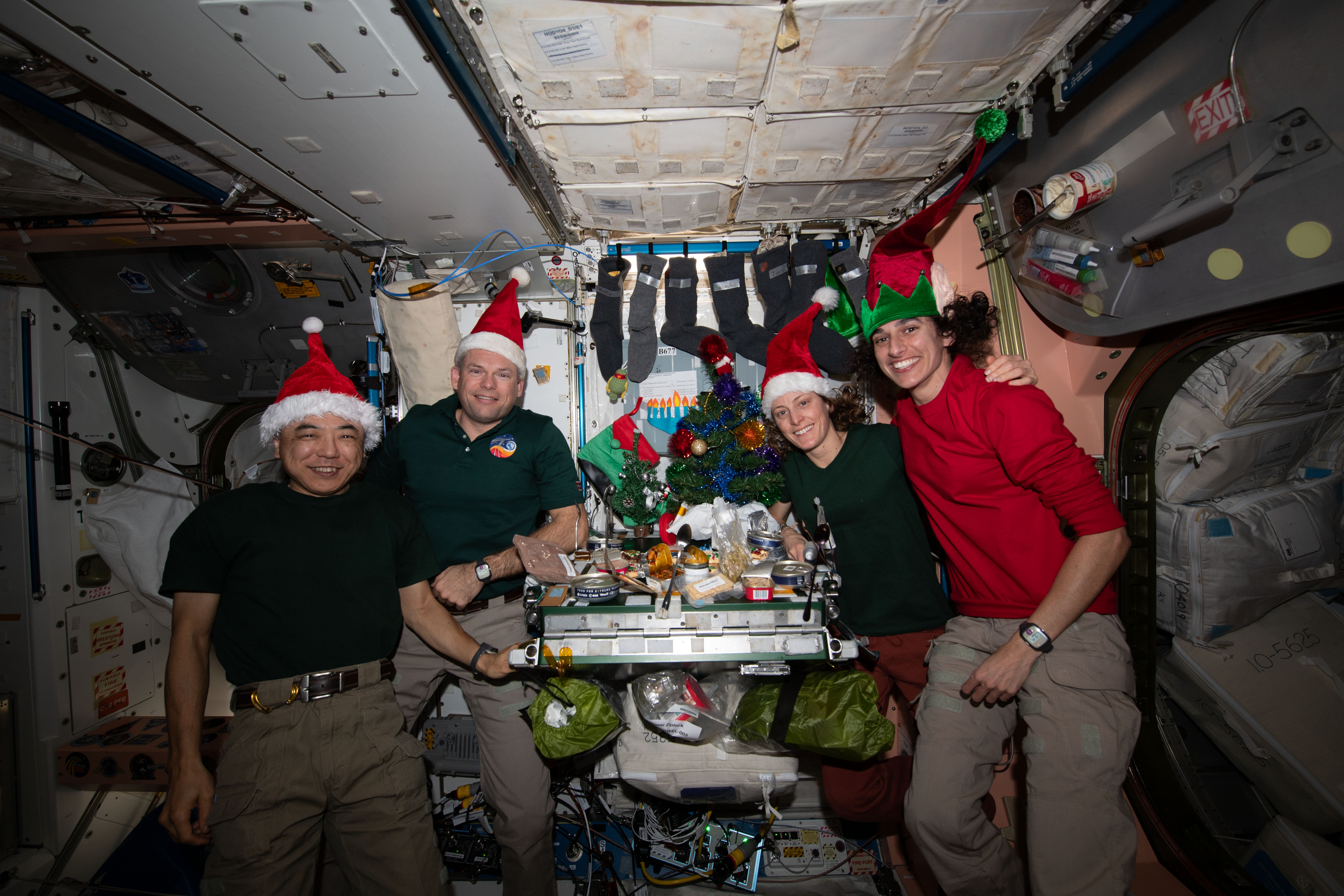
In the quarter century that humans have lived and worked aboard the International Space Station, astronauts and visitors from around the world have celebrated countless holidays more than 250 miles above Earth while traveling 17,500 miles …

On Nov. 2, 2000, the Soyuz TM-31 spacecraft docked with the Zvezda module of the International Space Station. On board were Roscosmos cosmonauts Yuri Gidzenko and Sergei Krikalev and NASA astronaut Bill Shepherd. They were known as Expedit…
Dedicated rideshare flight to a sun-synchronous orbit with dozens of small microsatellites and nanosatellites for commercial and government customers.
20 Low Earth Orbit communication satellites with Ku, Q and V band payloads for the G60 constellation operated by Shanghai Spacesail Technologies with…
A batch of 29 satellites for the Starlink mega-constellation - SpaceX's project for space-based Internet communication system. The Falcon 9 1st st…
18 Low Earth Orbit communication satellites with Ku, Q and V band payloads for the G60 constellation operated by Shanghai Spacesail Technologies with…
Contracted by NASA under the Small Business Innovation Research Phase 3 contract, Katalyst Space Technologies' LINK servicing spacecraft will rendezv…
Amazon Leo, formerly known as Project Kuiper, is a mega constellation of satellites in Low Earth Orbit that will offer broadband internet access, thi…
A batch of 24 satellites for the Starlink mega-constellation - SpaceX's project for space-based Internet communication system.
Haiyang 2E (Chinese: "Ocean"), abbreviated HY-2E, is a marine remote sensing satellite of China. The HY-2 series' primary objective is to measure oce…
SXM-11 is the 12th high-powered, digital, audio radio satellite built by Lanteris Space (ex-Maxar, Space System/Loral) for SiriusXM. The SXM-11 satel…
A batch of 24 satellites for the Starlink mega-constellation - SpaceX's project for space-based Internet communication system.