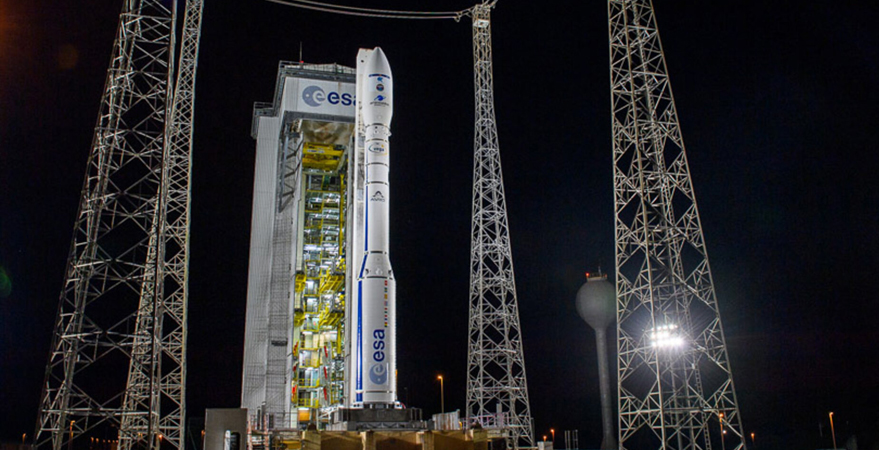
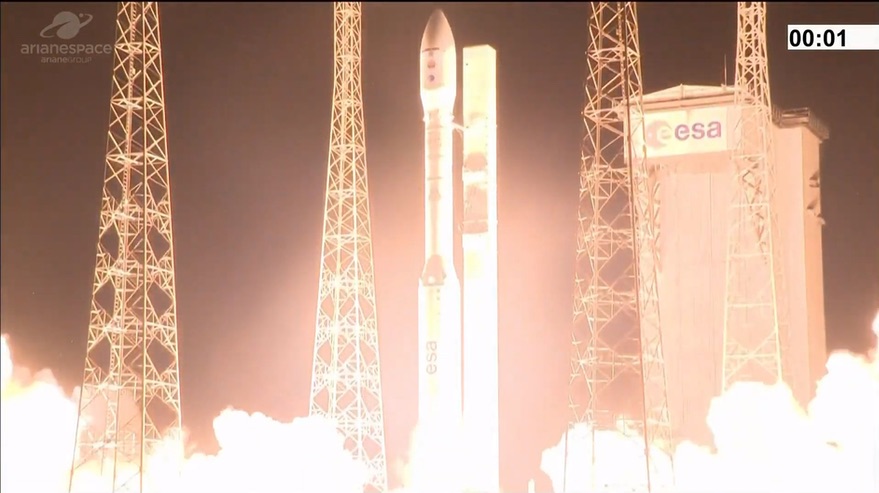
For its seventh launch of the year – and the 17th to be performed by the Vega launcher since its first liftoff from the Guiana space center in 2012 – Arianespace will orbit two satellites: SEOSAT-Ingenio for ESA, on behalf of Spain’s Center for Development of Industrial Technology (CDTI), and …
SEOSAT-Ingenio is a high-resolution optical imaging mission of Spain - the flagship mission of the Spanish space strategic plan. Its mission is devoted to ensure an even coverage of the areas of national interest, providing a large operational capability in the capture of high-resolution multi-spectral land optical images for numerous user groups, as well as supporting and optimizing the development in Spain of teledetection-based applications in Spain. The overall mission objective is to provide information for applications in cartography, land use, urban management, water management, environmental monitoring, risk management and security. TARANIS (Tool for the Analysis of RAdiation from lightNIngand Sprites), the Celtic god of thunder and lightning, is the first satellite designed to observe luminous, radiative and electromagnetic phenomena occurring at altitudes of 20 to 100 km over thunderstorms. Discovered 20 years ago, such transient luminous events (TLEs) such as red sprites, blue jets, elves, sprite halos, etc. remain shrouded in mystery. They are sometimes accompanied by terrestrial gamma-ray flashes (TGFs). The TARANIS microsatellite will fly over thousands of TLEs and TGFs for at least four years and will be capable of detecting these events and recording their luminous and radiative signatures at high resolution, as well as the electromagnetic perturbations they set off in Earth’s upper atmosphere. The payload includes numerous sensors to observe the TLEs and to perform in-situ measurements of perturbations caused on the local plasma (fields, waves and particles).
Vega is the smallest lifter in the current Arianespace family.
See DetailsAvio S.p.A. is an Italian company operating in the aerospace sector with its head office in Colleferro near Rome, Italy. Founded in 1908, it is present in Italy and abroad with different commercial offices and 10 production sites.
INFO WIKIAn independent investigation of a Vega launch failure in November confirmed that misconnected cables in the rocket’s upper stage doomed the mission and made recommendations to allow a return to flight in early 2021.
The head of Italian rocket manufacturer Avio assured customers Nov. 19 that the company was working hard to return Vega to service following the rocket’s second failure in its last three launches.
Improperly installed cables on the Vega rocket’s upper stage control system apparently caused the launcher to tumble minutes after liftoff Monday night, a failure that resulted in the loss of a Spanish Earth observation satellite and a Fre…
Arianespace executives said Nov. 17 that the failure of a Vega launch the previous day was caused when the rocket’s upper stage tumbled out of control due to incorrectly installed cables in a control system.
A European Vega rocket crashed back to Earth shortly after launching from French Guiana carrying a Spanish land imaging satellite and a French research probe with a combined value of nearly $400 million.
Note: Assignment of payloads to this launch is uncertain. The Russian Obzor-R satellite is a planned X-band radar earth observation satellite desi…
AST SpaceMobile’s Block 2 BlueBird satellites are designed to deliver up to 10 times the bandwidth capacity of the BlueBird Block 1 satellites, requi…
First test launch of CASC/SAST’s Long March 12A rocket, with a dummy payload. The rocket’s 1st stage attempted to land on a landing pad about 300 km …
Maiden orbital launch attempt for the South Korean start-up Innospace and its HANBIT-Nano small launch vehicle. Onboard this flight are five small sa…
QZSS (Quasi Zenith Satellite System) is a Japanese satellite navigation system operating from inclined, elliptical geosynchronous orbits to achieve o…
Synthetic aperture radar Earth observation satellite for Japanese Earth imaging company iQPS.
NS-37 is the 16th crewed flight for the New Shepard program and the 37th in the New Shepard program's history.
Chinese classified satellite claimed to be for communication technology test purposes. Actual mission not known.
STP-S30 is a complex mission that will deliver research experiments and technology demonstrations to orbit for the DoD and contribute to future space…
A batch of 27 satellites for the Starlink mega-constellation - SpaceX's project for space-based Internet communication system.