Upcoming Spaceflight Launches
Filter by Agency, Locations or Vehicles
Show All Launches
Falcon 9 Block 5 | Nova-C IM-4 & 2 Lunar Data Relay Satellites
SpaceX | United States of AmericaCape Canaveral SFS, FL, USA
TBD December, 2027
Falcon 9 Block 5 | Thor 8
SpaceX | United States of AmericaCape Canaveral SFS, FL, USA
TBD December, 2027
Status: To Be Determined
Mission:
Thor 8 is a multi-purpose communications satellite for Space Norway. The satellite will both replace older satellites being phased out in the coming years and provide increased capacity and service offerings that offers capacity for both data services and broadcasting, such as high power direct-to-home (DTH) television services, from the 1° West orbital position. It carries two dedicated payloads for broadcasting in Europe and the Nordics, as well as payloads for data services to commercial and governmental customers. With a launch mass of 4 metric tons, the satellite will be built on Thales Alenia Space’s Spacebus-4000B2 platform and will operate in the Ka and Ku frequency bands.
Geostationary Transfer Orbit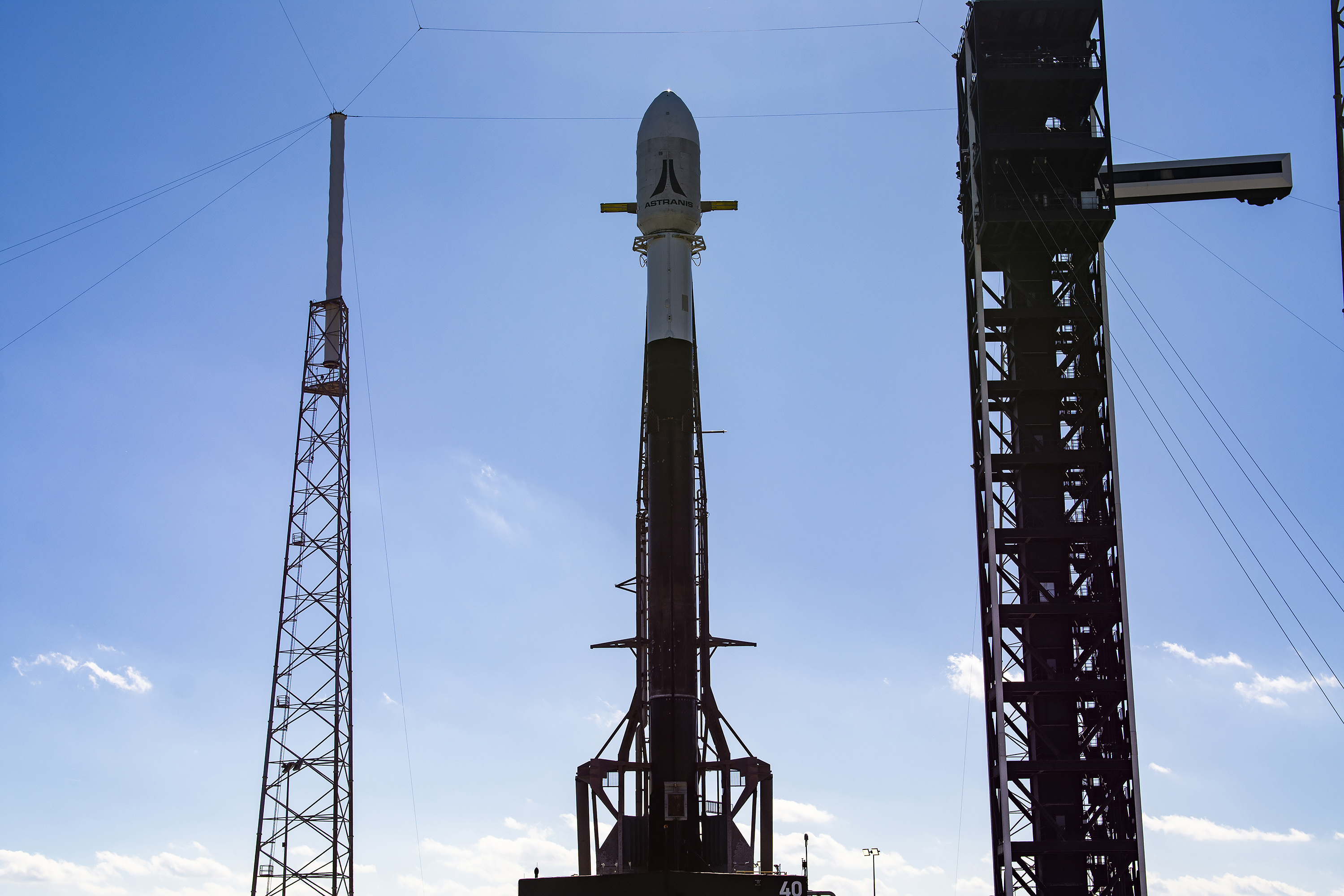
Falcon 9 Block 5 | 6x Astranis MicroGEO
SpaceX | United States of AmericaCape Canaveral SFS, FL, USA
TBD December, 2027
Status: To Be Determined
Mission:
Six Astranis MicroGEO communications satellite to be inserted into Low Earth orbit by the Falcon 9, from where the Helios upper stage provided by Impulse Space will carry the satellites to geostationary orbit within 24 hours of launch.
Geostationary OrbitFalcon 9 Block 5 | FOO Fighter (F2)
SpaceX | United States of AmericaCape Canaveral SFS, FL, USA
TBD December, 2027
Falcon 9 Block 5 | Chinggis Sat
SpaceX | United States of AmericaCape Canaveral SFS, FL, USA
TBD December, 2027
Status: To Be Determined
Mission:
Chinggis Sat is a Mongolian national geostationary orbit telecommunications satellite for the Mongolia Ministry of Digital Development and Communications. Thales Alenia Space will be responsible for construction of the high-performance Ku-Band satellite. Once launched, the satellite will make high-speed internet available throughout Mongolia, including to those in rural areas and under-served nomadic communities, enabling easier and wider access to services such as tele-medicine, e-learning, e-government services and supporting the growth of high value add sectors of the economy. It will be positioned at the 113.6° E orbital slot and will be based on the space-proven, cutting-edge SpaceBus 4000 satellite bus.
Geostationary Transfer OrbitFalcon 9 Block 5 | JSAT-32
SpaceX | United States of AmericaCape Canaveral SFS, FL, USA
TBD December, 2027
Status: To Be Determined
Mission:
JSAT-32 is a geostationary communication satellite for SKY Perfect JSAT. Operating in the Ku and Ka frequency bands, JSAT-32 will provide coverage over Japan and its surrounding seas, with newly added spot beams for mobility applications. JSAT-32 will serve as a future replacement for existing SKY Perfect JSAT satellites that provide communication and distribution services in Japan.
Geostationary Transfer OrbitFalcon 9 Block 5 | Exolaunch Exo-1
SpaceX | United States of AmericaVandenberg SFB, CA, USA
TBD December, 2027
Falcon 9 Block 5 | NEO Surveyor
SpaceX | United States of AmericaCape Canaveral SFS, FL, USA
TBD June, 2028
Status: To Be Determined
Mission:
NASA's Near-Earth Object (NEO) Surveyor mission is designed to help advance planetary defense efforts to discover and characterize most of the potentially hazardous asteroids and comets that come within 30 million miles of Earth’s orbit. These are collectively known as near-earth objects, or NEOs. NEO Surveyor consists of a single scientific instrument: a 50 centimeter (nearly 20 inch) diameter telescope that operates in two heat-sensing infrared wavelengths. It will be capable of detecting both bright and dark asteroids, which are the most difficult type to find.
Heliocentric L1Falcon 9 Block 5 | SEOPS Waymaker-1
SpaceX | United States of AmericaVandenberg SFB, CA, USA
TBD September, 2028
Falcon 9 Block 5 | WSF-M2 & BLAZE-2 (USSF-178)
SpaceX | United States of AmericaVandenberg SFB, CA, USA
TBD December, 2028
Status: To Be Determined
Mission:
Second Weather System Follow-on (WSF) satellite. WSF-M (Weather System Follow-on - Microwave) is the next-generation operational environmental satellite system for the Department of Defense (DoD), to replace the microwave wavelength weather forecasting capabilities of the DMSP satellites. Ball Aerospace has been selected in late November 2017 to be the prime contractor for 2 Low Earth Orbit (LEO) weather satellites with a passive microwave imaging radiometer instrument and hosted Government furnished energetic charged particle (ECP) sensor space weather payload developed by the Air Force Research Laboratory. The radiometer leverages the Ball-built Global Precipitation Measurement (GPM) Microwave Imager (GMI) instrument. This mission will improve weather forecasting over maritime regions by taking global measurements of the atmosphere and ocean surface. The launch will also include BLAZE-2, a launch opportunity for operational, research, development, and prototype small satellites from across the DoD.
Polar OrbitGravity-1
9 satellites
Yellow Sea (launch location 5) - Haiyang Oriental SpaceportCarried 9 satellites on a share-ride to sun-synchronous orbit. Details TBD.
Falcon 9
MRV-1
Space Launch Complex 40 - Cape Canaveral SFS, FL, USAThe Northrop Grumman/SpaceLogistics MRV-1 is a mission extension payload including a mission robotic vehicle (MRV) and multiple mission extension pod…
Falcon 9
Starlink Group 17-39
Space Launch Complex 4E - Vandenberg SFB, CA, USAA batch of 24 satellites for the Starlink mega-constellation - SpaceX's project for space-based Internet communication system.
Soyuz 2.1b
16 x Rassvet-3
Unknown Pad - Plesetsk Cosmodrome, Russian FederationNote: Payload identities uncertain. Batch of 16 Rassvet-3 Low Earth Orbit communication satellites for the Russian Byuro-1440 (Bureau 1440) conste…
Vikram-I
Demo Flight
Satish Dhawan Space Centre First Launch Pad - Satish Dhawan Space Centre, IndiaFirst launch of Skyroot Aerospace's Vikram-I launch vehicle. This first launch will carry 4 payloads: - Grahaa Space's SOLARAS S3 satellite - C…
Falcon 9
SDA Tranche 1 Transport Layer E
Space Launch Complex 4E - Vandenberg SFB, CA, USATranche 1 Transport Layer E is one of six missions by the United States Space Force Space Development Agency (SDA) for the Proliferated Warfighter Sp…
Soyuz 2.1a
Soyuz MS-29
31/6 - Baikonur Cosmodrome, Republic of KazakhstanSoyuz MS-29 will carry three cosmonauts and one astronaut to the International Space Station aboard the Soyuz spacecraft from the Baikonur Cosmodrome…
Falcon 9
Starlink Group 10-45
Space Launch Complex 40 - Cape Canaveral SFS, FL, USAA batch of 29 satellites for the Starlink mega-constellation - SpaceX's project for space-based Internet communication system.
Falcon 9
Starlink Group 15-14
Space Launch Complex 4E - Vandenberg SFB, CA, USAA batch of 27 satellites for the Starlink mega-constellation - SpaceX's project for space-based Internet communication system.
Falcon 9
Starlink Group 17-48
Space Launch Complex 4E - Vandenberg SFB, CA, USAA batch of 24 satellites for the Starlink mega-constellation - SpaceX's project for space-based Internet communication system.

