SLS Block 1 | Artemis II
Launch Successful
L - -- : -- : -- : --
Launch Window
April 1, 2026, 10:24 p.m. - April 2, 2026, 12:24 a.m.


April 1, 2026, 10:24 p.m. - April 2, 2026, 12:24 a.m.
Artemis II is the first crewed mission as part of the Artemis program. Artemis II will send a crew of 4 - 3 Americans and 1 Canadian around the moon and return them back to Earth. The mission will test the core systems of NASA's Orion spacecraft including the critical life support system, among other systems which could not be tested during Artemis I due to the lack of crew onboard.
Launch trajectory and telemetry simulations provided by Flight Club - a rocket launch simulator and orbital trajectory visualiser for all things space!

Launch success with Orion separation.
Liftoff.
New T-0.
Extending hold at T-10 minutes.
Updated launch weather.
The Space Launch System (SLS) is an American Space Shuttle-derived heavy expendable launch vehicle. It is part of NASA's deep space exploration plans including as the main launch vehicle of the Artemis program. SLS follows the cancellation of the Constellation program, and is to replace the retired Space Shuttle.
See DetailsOrion spacecraft used for Artemis 2.
Orion Details
Date of
Birth: Nov. 11, 1975
Age: 50
Date of
Birth: April 30, 1976
Age: 50
Date of
Birth: Jan. 27, 1976
Age: 50
Date of
Birth: Jan. 29, 1979
Age: 47
The National Aeronautics and Space Administration is an independent agency of the executive branch of the United States federal government responsible for the civilian space program, as well as aeronautics and aerospace research. NASA have many launch facilities but most are inactive. The most commonly used pad will be LC-39B at Kennedy Space Center in Florida.
INFO WIKI
The pilot of Artemis 2 says NASA’s return to the moon should start with human landings in less challenging equatorial regions rather than go directly to the south pole. The post Artemis 2 astronaut advocates for equatorial lunar landings …


The four Artemis II astronauts visited ESTEC, ESA’s technical centre in the Netherlands, on 13 July as the first stop in a series of post-flight visits to the European teams that made their mission possible.
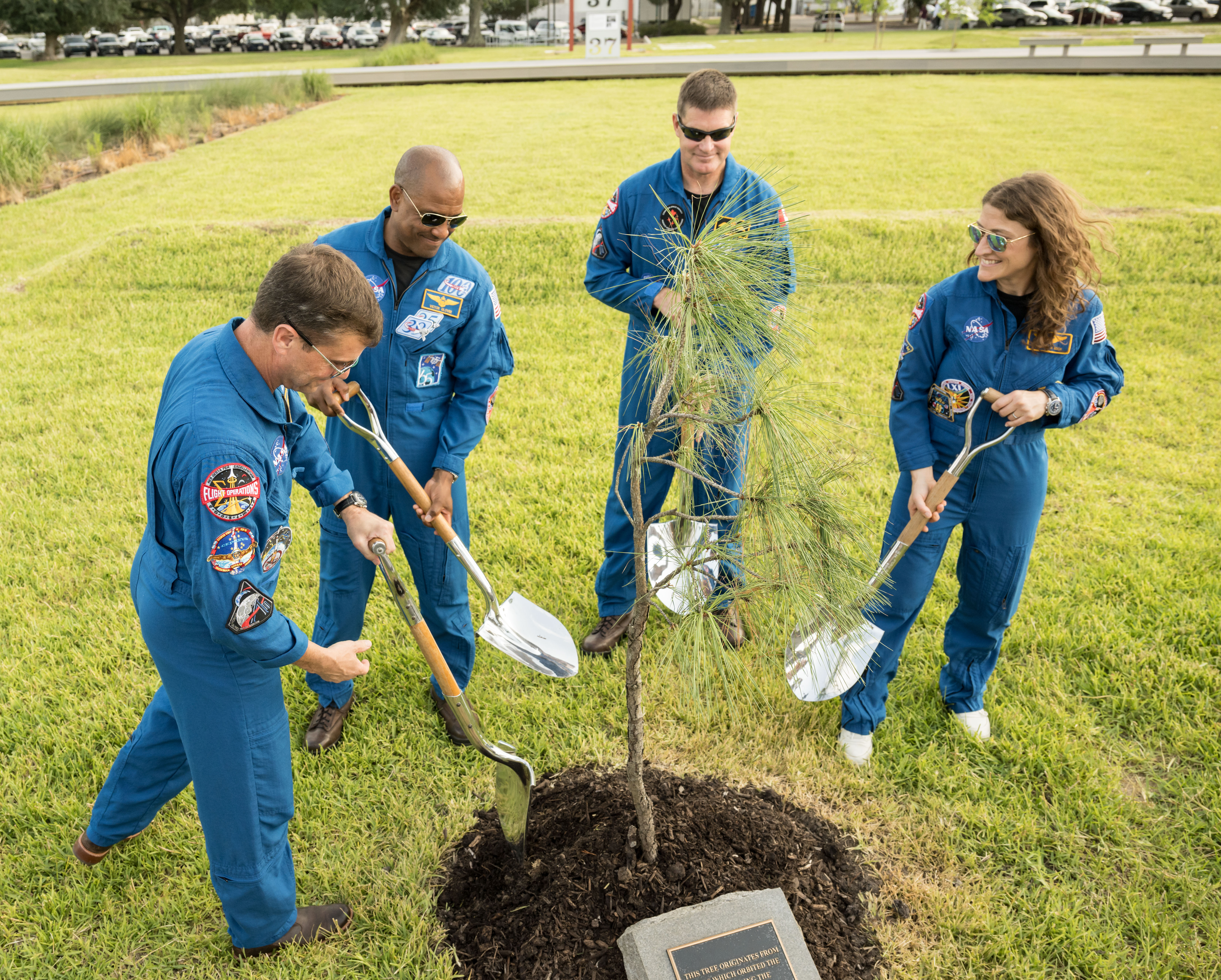
In this photograph, the Artemis II crew participates in the dedication of the Apollo 14 Moon tree at the Lunar Receiving Park at NASA’s Johnson Space Center on June 25, 2026. This tree is a second-generation Apollo Moon tree of the lobloll…

NASA’s live coverage of the Artemis II mission mission drew unprecedented public interest – including more than 149.4 million views of the launch, lunar flyby, splashdown on NASA-owned platforms, including the 24/7 streams covering the mis…
A batch of 24 satellites for the Starlink mega-constellation - SpaceX's project for space-based Internet communication system.
A batch of 29 satellites for the Starlink mega-constellation - SpaceX's project for space-based Internet communication system.
QZSS (Quasi Zenith Satellite System) is a Japanese satellite navigation system operating from inclined, elliptical geosynchronous orbits to achieve o…
Chinese communication geostationary satellite for unknown purposes.
A batch of 24 satellites for the Starlink mega-constellation - SpaceX's project for space-based Internet communication system.
Synthetic aperture radar Earth observation satellite for Japanese Earth imaging company iQPS.
AST SpaceMobile’s Block 2 BlueBird satellites are designed to deliver up to 10 times the bandwidth capacity of the BlueBird Block 1 satellites, requi…
2 hyper-spectral Earth observation satellites from Chinese company STAR.VISION. Both satellites are built in corporation with foreign customers: *…
A batch of 24 satellites for the Starlink mega-constellation - SpaceX's project for space-based Internet communication system.
A batch of 9 Low Earth Orbit communication satellites for the Chinese state owned SatNet constellation operated by the China Satellite Network Group.…


 View in Flightclub