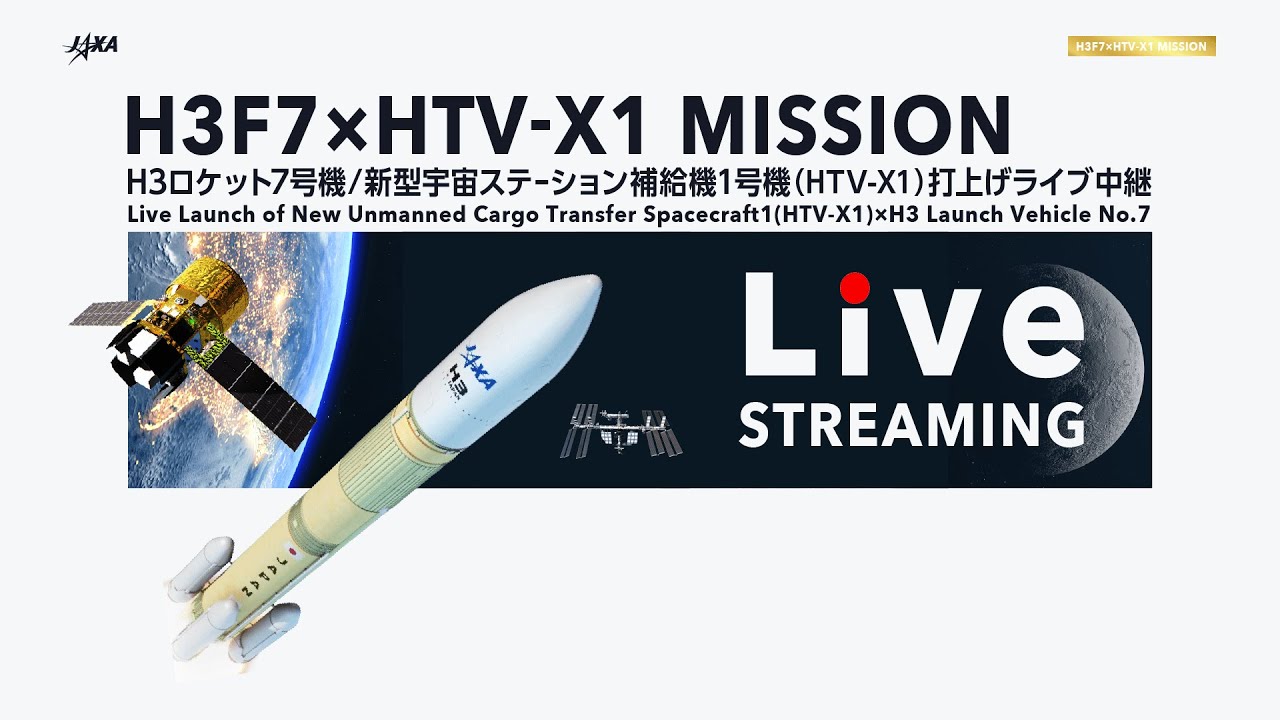
H3-24 | HTV-X1
Launch Successful
L - -- : -- : -- : --
Instantaneous launch window.
Launch Window
Oct. 26, 2025, midnight - Oct. 26, 2025, midnight


Instantaneous launch window.
Oct. 26, 2025, midnight - Oct. 26, 2025, midnight
First flight of the upgraded Japanese HTV-X spacecraft designed to resupply the International Space Station.

Launch success.
Spacecraft separation.

Official Webcast by JAXA | 宇宙航空研究開発機構 has started
Liftoff.
Official Webcast by JAXA | 宇宙航空研究開発機構 has started
The H3 Launch Vehicle is an expendable launch system in development in Japan. Each H3 booster configuration has a two-digit and a letter designation that indicates the features of that configuration. The first digit represents the number of LE-9 engines on the main stage, either "2" or "3". The second digit indicates the number of SRB-3 solid rocket boosters attached to the base of the rocket, and can be "0", "2" or "4". All layouts of solid boosters are symmetrical. The letter in the end shows the length of the payload fairing, either short "S" or long "L". For example, an H3-24L has two engines, four solid rocket boosters, and a long fairing, whereas an H3-30S has three engines, no solid rocket boosters, and a short fairing.
See DetailsSpacecraft used for the maiden flight of the HTV-X Cargo Resupply Vehicle.
HTV-X DetailsMitsubishi Heavy Industries, Ltd. is a Japanese multinational engineering, electrical equipment and electronics company headquartered in Tokyo, Japan. MHI is one of the core companies of the Mitsubishi Group. MHI's products include aerospace components, air conditioners, aircraft, automotive components, forklift trucks, hydraulic equipment, machine tools, missiles, power generation equipment, printing machines, ships and space launch vehicles. Through its defense-related activities, it is the world's 23rd-largest defense contractor measured by 2011 defense revenues and the largest based in Japan.
INFO WIKI
March was another busy month onboard the International Space Station, with the Expedition 74 crew… The post Expedition 74 sees vehicle departures and a spacewalk during March appeared first on NASASpaceFlight.com.
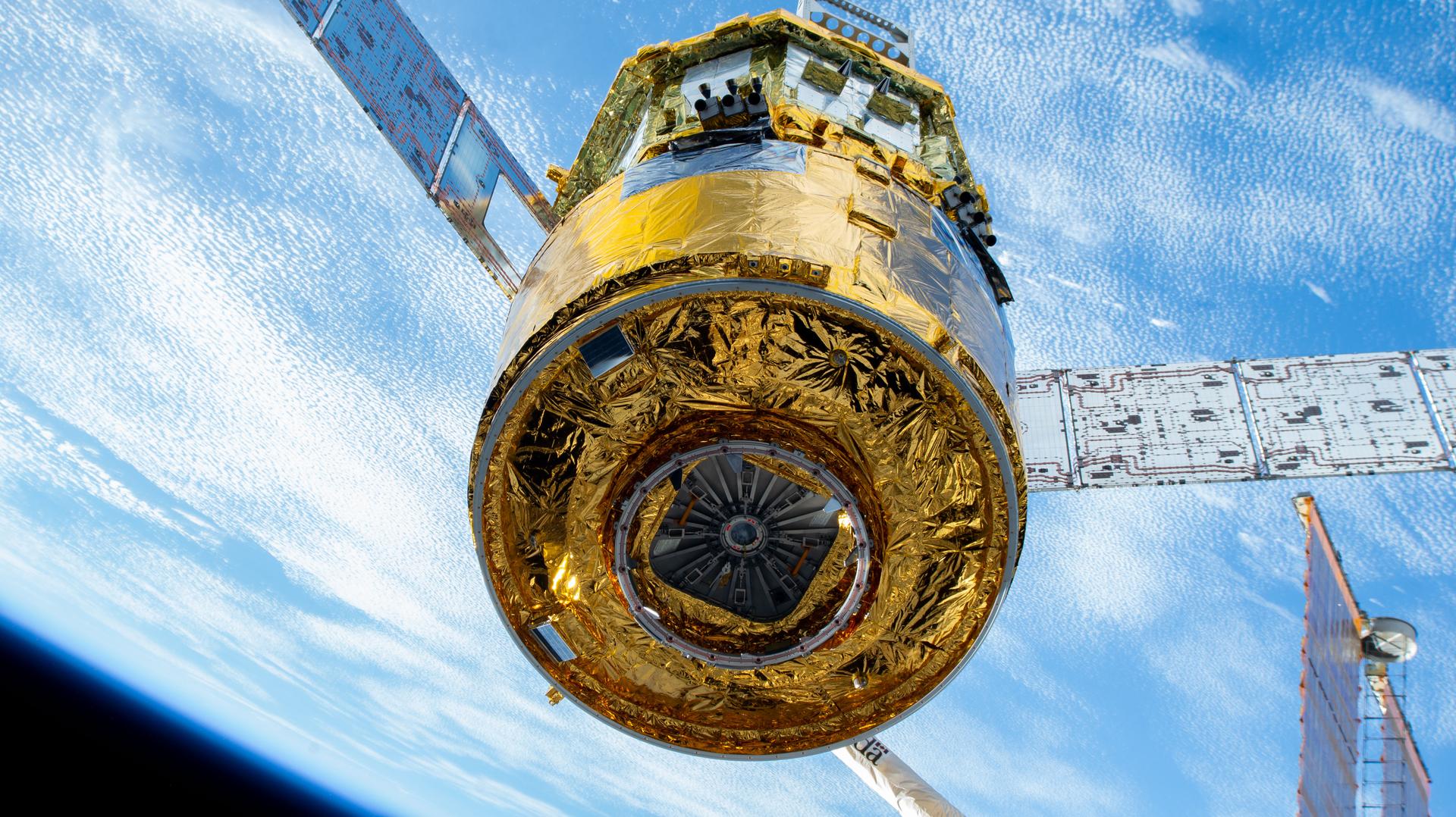
After delivering about 12,000 pounds of supplies, scientific investigations, hardware, and other cargo to the International Space Station for NASA and its international partners, JAXA’s (Japan Aerospace Exploration Agency’s) uncrewed HTV‑X…

Tokyo, Japan (SPX) Feb 16, 2026 On February 3, 2026, the Mexican CubeSat Gxiba-1 was deployed from the Japanese Experiment Module Kibo on the International Space Station, beginning its on orbit mission. The small satellite was release…

After its launch from the Yoshinobu Launch Complex at the JAXA Tanegashima Space Center on October 26th at 9:00 AM JST, Japan’s HTV-X1 resupply mission arrived at the ISS, where it was berthed at roughly 1:00 AM JST on October 30th.

The Japan Aerospace Exploration Agency (JAXA) is set to launch its advanced HTV-X1 cargo spacecraft… The post JAXA’s HTV-X1 set to launch to ISS aboard H3 Rocket appeared first on NASASpaceFlight.com.
QZSS (Quasi Zenith Satellite System) is a Japanese satellite navigation system operating from inclined, elliptical geosynchronous orbits to achieve o…
Chinese communication geostationary satellite for unknown purposes.
A batch of 24 satellites for the Starlink mega-constellation - SpaceX's project for space-based Internet communication system.
Synthetic aperture radar Earth observation satellite for Japanese Earth imaging company iQPS.
AST SpaceMobile’s Block 2 BlueBird satellites are designed to deliver up to 10 times the bandwidth capacity of the BlueBird Block 1 satellites, requi…
2 hyper-spectral Earth observation satellites from Chinese company STAR.VISION. Both satellites are built in corporation with foreign customers: *…
A batch of 24 satellites for the Starlink mega-constellation - SpaceX's project for space-based Internet communication system.
A batch of 9 Low Earth Orbit communication satellites for the Chinese state owned SatNet constellation operated by the China Satellite Network Group.…
A batch of 24 satellites for the Starlink mega-constellation - SpaceX's project for space-based Internet communication system.
Classified payload for the US National Reconnaissance Office.