Falcon 9 Block 5 | Starlink 3
Launch Successful
L - -- : -- : -- : --
Instantaneous launch window.
Launch Window
Jan. 29, 2020, 2:06 p.m. - Jan. 29, 2020, 2:06 p.m.


Instantaneous launch window.
Jan. 29, 2020, 2:06 p.m. - Jan. 29, 2020, 2:06 p.m.
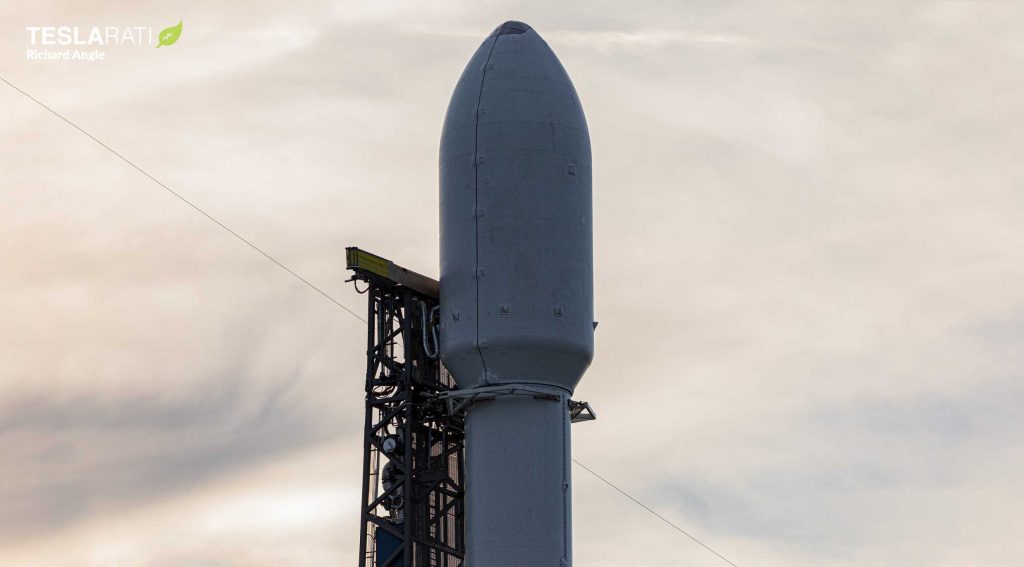
Second operational Starlink payload of 2020 and third overall. The Falcon 9 launch vehicle will carry a batch of 60 Starlink satellites that will be insterted in a Low Earth Orbit (LEO) at an altitude of 290 km (180 mi) and an inclination of 53°. They will then split into three orbital planes and raise their orbits to reach an operational altitude of 550 km (342 mi). The Starlink LEO constellation aims to provide worldwide affordable satellite internet access. 182 satellites (120 operational) have been deployed so far, the goal scheduled for the mid-2020s being 12,000 satellites in orbit, with a possible later extension to 42,000. The booster for this launch will be B1051, a Block 5 generation core which previously flew on SpaceX's Demonstration Mission 1 (first Crew Dragon test flight) and launched the Canadian Space Agency's RADARSAT Constellation.
Falcon 9 is a two-stage rocket designed and manufactured by SpaceX for the reliable and safe transport of satellites and the Dragon spacecraft into orbit. The Block 5 variant is the fifth major interval aimed at improving upon the ability for rapid reusability.
See DetailsB1051 will attempt to land on an ASDS OCISLY after the Starlink 3 launch.
Result: Successful Autonomous Spaceport Drone Ship landing at Of Course I Still Love You.Space Exploration Technologies Corp., known as SpaceX, is an American aerospace manufacturer and space transport services company headquartered in Hawthorne, California. It was founded in 2002 by entrepreneur Elon Musk with the goal of reducing space transportation costs and enabling the colonization of Mars. SpaceX operates from many pads, on the East Coast of the US they operate from SLC-40 at Cape Canaveral Space Force Station and historic LC-39A at Kennedy Space Center. They also operate from SLC-4E at Vandenberg Space Force Base, California, usually for polar launches. Another launch site is being developed at Boca Chica, Texas.
INFO WIKI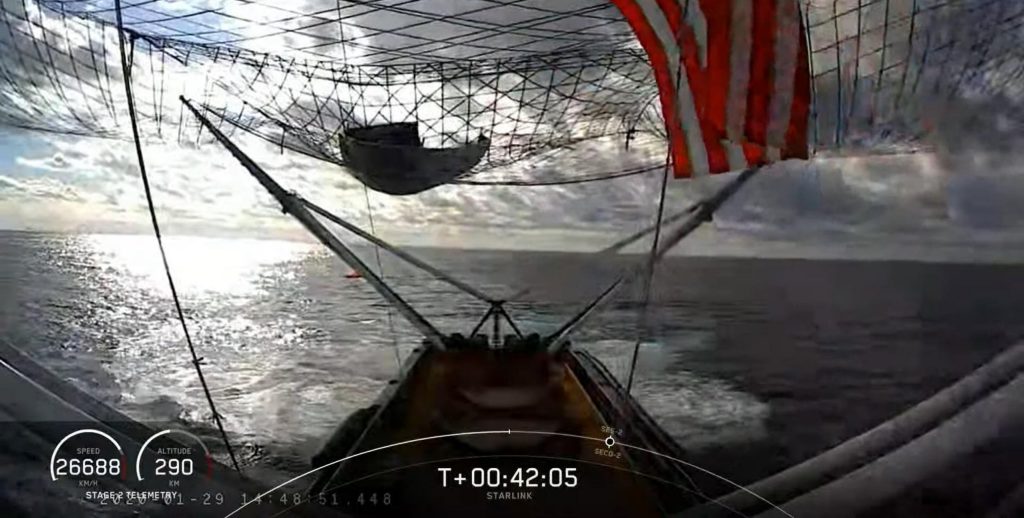



A batch of 24 satellites for the Starlink mega-constellation - SpaceX's project for space-based Internet communication system.
Classified payload for the US National Reconnaissance Office.
2 Chinese classified satellites claimed to be for communication technology test purposes. Actual mission not known.
Tianlian is a Chinese data tracking and relay communications geostationary satellite series. The TL-3 (Tian Lian 3) satellites are the 3rd generation…
A batch of 24 satellites for the Starlink mega-constellation - SpaceX's project for space-based Internet communication system.
13th test flight of the two-stage Starship launch vehicle. Second flight of Starship V3. For the first time, Starship will carry 20 V3 Starlink sa…
Share-ride of 5 commercial Earth observation and technology demonstration satellites to SSO, including SpaceTY's TY-48. Details TBD.
Tianlian is a Chinese data tracking and relay communications geostationary satellite series. The TL 2 (Tian Lian 2) satellites represent the second g…
Carried 9 satellites on a share-ride to sun-synchronous orbit. Details TBD.
The Northrop Grumman/SpaceLogistics MRV-1 is a mission extension payload including a mission robotic vehicle (MRV) and multiple mission extension pod…