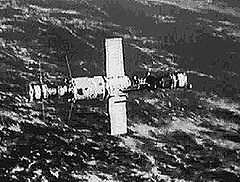
Salyut 6
Status - De-Orbited
Details
Salyut 6, also known as DOS-5, was a Soviet orbital space station, the eighth flown as part of the Salyut programme. Launched on 29 September 1977 by a Proton rocket, the station was the first of the "second-generation" type of space station. Salyut 6 possessed several revolutionary advances over the earlier Soviet space stations, which it nevertheless resembled in overall design. These included the addition of a second docking port, a new main propulsion system and the station's primary scientific instrument, the BST-1M multispectral telescope. The addition of the second docking port made crew handovers and station resupply by unmanned Progress freighters possible for the first time.
Agencies
Russian Federal Space Agency (ROSCOSMOS)
Government
Administrator: Yuri Borisov
RFSA 1992The Roscosmos State Corporation for Space Activities, commonly known as Roscosmos, is the governmental body responsible for the space science program of the Russian Federation and general aerospace research. Soyuz has many launch locations the Russian sites are Baikonur, Plesetsk and Vostochny however Ariane also purchases the vehicle and launches it from French Guiana.
Falcon 9
Starlink Group 17-52
Space Launch Complex 4E - Vandenberg SFB, CA, USAA batch of 24 satellites for the Starlink mega-constellation - SpaceX's project for space-based Internet communication system.
Falcon 9
NROL-95
Space Launch Complex 40 - Cape Canaveral SFS, FL, USAClassified payload for the US National Reconnaissance Office.
Long March 6A
TJSW-27A & B
Launch Complex 9A - Taiyuan Satellite Launch Center, People's Republic of China2 Chinese classified satellites claimed to be for communication technology test purposes. Actual mission not known.
Long March 7A
Tianlian 3-01
201 - Wenchang Space Launch Site, People's Republic of ChinaTianlian is a Chinese data tracking and relay communications geostationary satellite series. The TL-3 (Tian Lian 3) satellites are the 3rd generation…
Falcon 9
Starlink Group 17-51
Space Launch Complex 4E - Vandenberg SFB, CA, USAA batch of 24 satellites for the Starlink mega-constellation - SpaceX's project for space-based Internet communication system.

