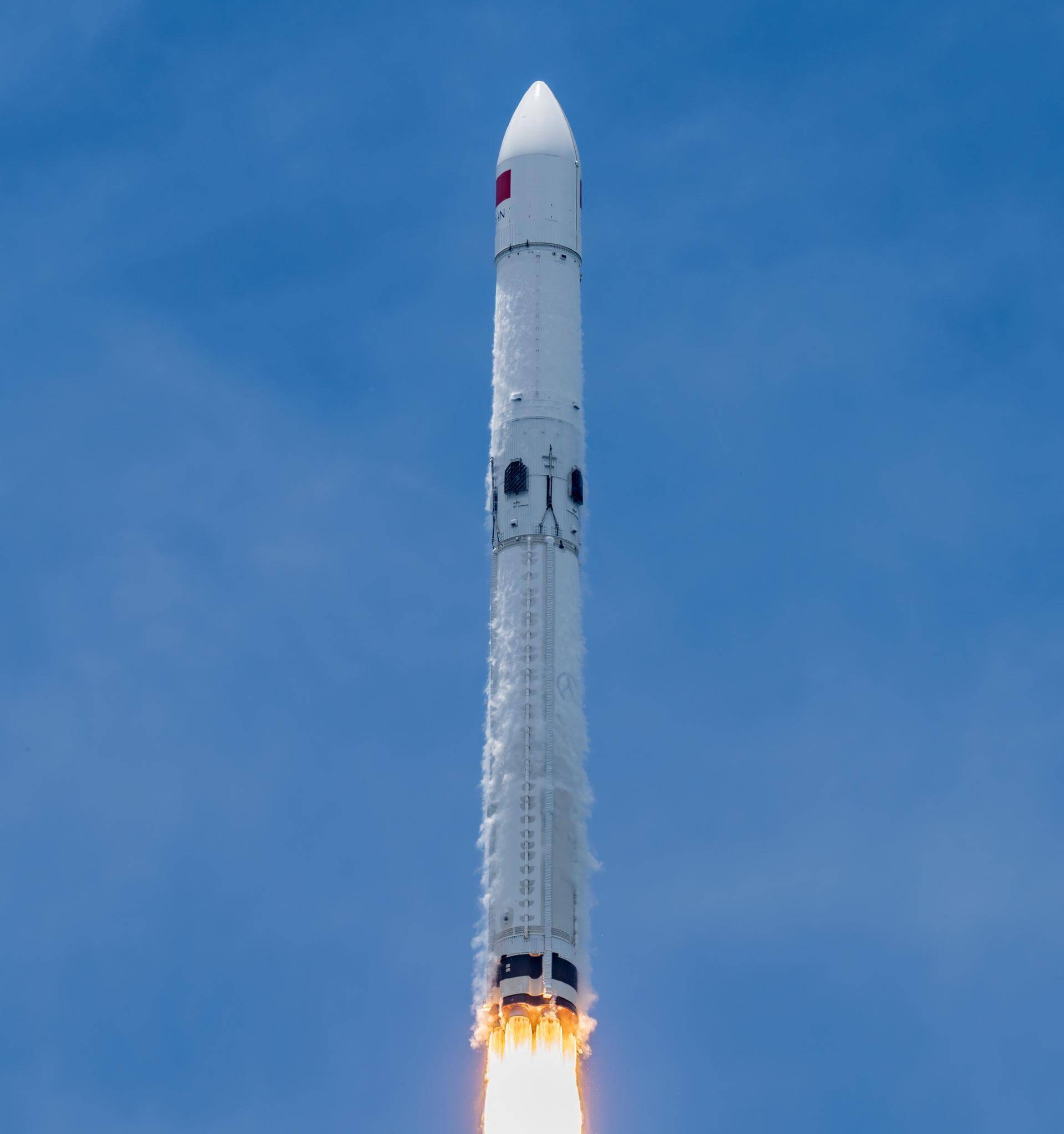
Long March 10B
Active Re-UsableChina Aerospace Science and Technology Corporation (CASC)
July 10, 2026
Description
The Long March 10B is a reusable launch vehicle based on the 1st stage of the Long March 10A, in turn derived from a single 1st stage core of the Long March 10, with 7 YF-100 series kerosene/liquid oxygen staged-combustion cycle engines on the 1st stage. Like the Long March 10A, the 10B’s 1st stage is designed to be recovered downrange by a recovery barge equipped with an arrestor net and support frame, with the 1st stage landing on the net’s cables using its grid fins. The 2nd stage, however, uses a single YF-219 gas generator cycle methane/liquid oxygen engine with 140 tonnes of thrust. The Long March 10B became China's first orbital launch vehicle with its first stage booster being recovered, during its first launch on 10 July 2026.
Specifications
-
Stages
2 -
Length
63.0 m -
Diameter
5.0 m -
Fairing Diameter
5.0 m -
Launch Mass
760.0 T -
Thrust
8728.0 kN
Family
-
Name
Long March 10B -
Family
― -
Variant
― -
Alias
CZ-10B -
Full Name
Long March 10B
Payload Capacity
-
Launch Cost
― -
Low Earth Orbit
16000.0 kg -
Geostationary Transfer
Orbit
― -
Direct Geostationary
― -
Sun-Synchronous Capacity
―
China Aerospace Science and Technology Corporation
Government
Chairman & President: Lei Fanpei
CASC 1999The China Aerospace Science and Technology Corporation (CASC) is the main contractor for the Chinese space program. It is state-owned and has a number of subordinate entities which design, develop and manufacture a range of spacecraft, launch vehicles, strategic and tactical missile systems, and ground equipment. It was officially established in July 1999 as part of a Chinese government reform drive, having previously been one part of the former China Aerospace Corporation. Various incarnations of the program date back to 1956.
Long March 10B | Demo Flight
China Aerospace Science and Technology Corporation | ChinaWenchang Space Launch Site, People's Republic of China
July 10, 2026, 4:15 a.m.
Falcon 9
NROL-95
Space Launch Complex 40 - Cape Canaveral SFS, FL, USAClassified payload for the US National Reconnaissance Office.
Long March 6A
TJSW-27A & B
Launch Complex 9A - Taiyuan Satellite Launch Center, People's Republic of China2 Chinese classified satellites claimed to be for communication technology test purposes. Actual mission not known.
Long March 7A
Tianlian 3-01
201 - Wenchang Space Launch Site, People's Republic of ChinaTianlian is a Chinese data tracking and relay communications geostationary satellite series. The TL-3 (Tian Lian 3) satellites are the 3rd generation…
Falcon 9
Starlink Group 17-51
Space Launch Complex 4E - Vandenberg SFB, CA, USAA batch of 24 satellites for the Starlink mega-constellation - SpaceX's project for space-based Internet communication system.
Starship
Flight 13
Orbital Launch Pad 2 - SpaceX Starbase, TX, USA13th test flight of the two-stage Starship launch vehicle. Second flight of Starship V3. For the first time, Starship will carry 20 V3 Starlink sa…

