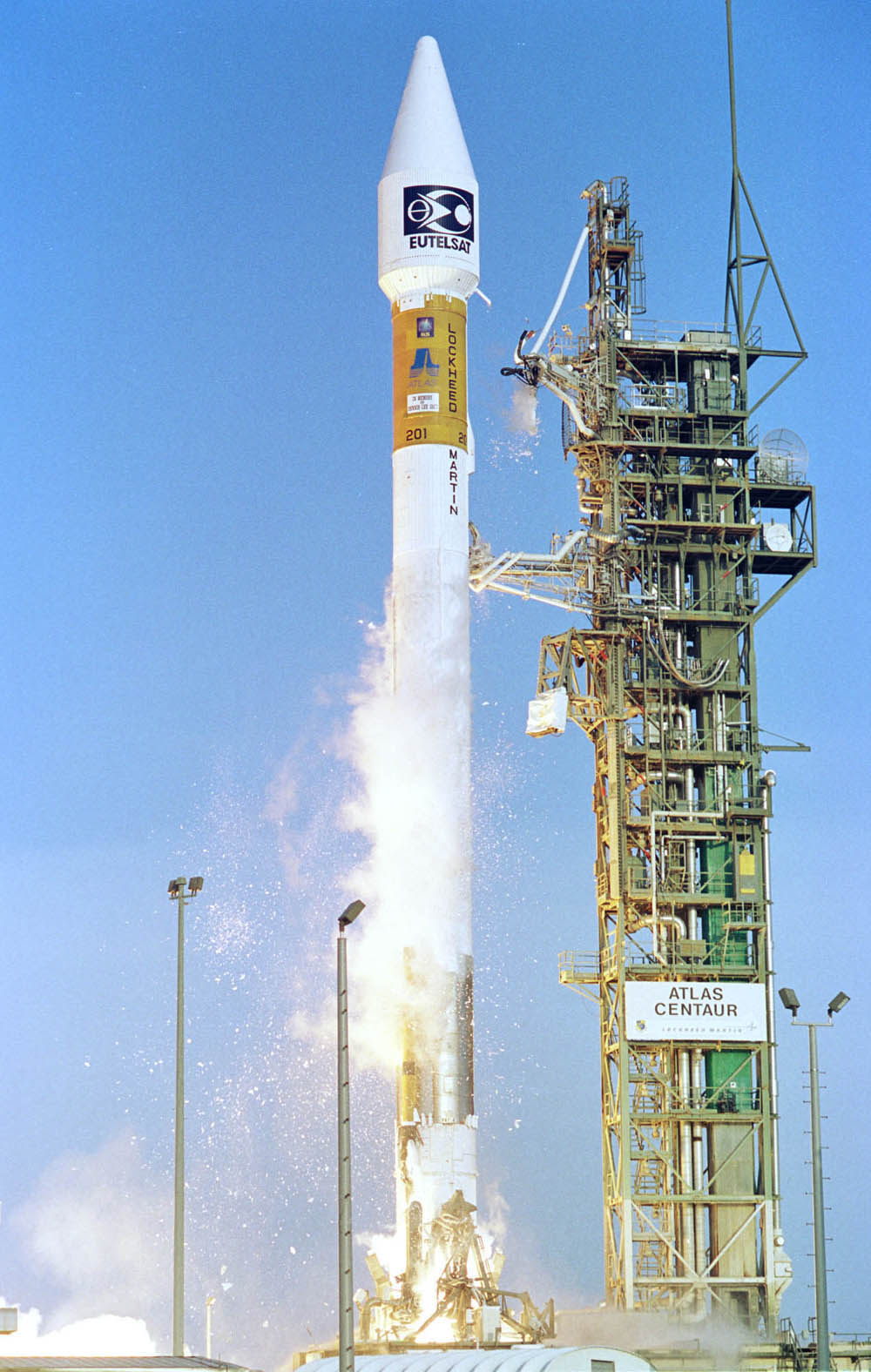
Atlas IIIA
In-activeLockheed Martin (LMT)
May 24, 2000
Description
American orbital launch vehicle used between 2000 and 2005.
Specifications
-
Stages
2 -
Length
52.8 m -
Diameter
3.05 m -
Fairing Diameter
― -
Launch Mass
214.0 T -
Thrust
4149.0 kN
Family
-
Name
Atlas IIIA -
Family
― -
Variant
IIIA -
Alias
― -
Full Name
Atlas IIIA
Payload Capacity
-
Launch Cost
― -
Low Earth Orbit
8640.0 kg -
Geostationary Transfer
Orbit
4055.0 kg -
Direct Geostationary
― -
Sun-Synchronous Capacity
―
Lockheed Martin
Commercial
None
LMT 1953Lockheed Martin's Space Division started in the production of missiles and later ICBM's in the 1950s. Their TITAN missile system was used for 12 Gemini spacecraft and the Voyager probes. They have worked largely in collaboration with NASA on many of their probes, landers, and spacecraft, and hope to play a key role in NASA's return to the moon in 2024.
Atlas Agena B | MBSAT
Lockheed Martin | United States of AmericaCape Canaveral SFS, FL, USA
March 13, 2004, 5:40 a.m.
Atlas Agena B | Eutelsat W4
Lockheed Martin | United States of AmericaCape Canaveral SFS, FL, USA
May 24, 2000, 11:10 p.m.
Status: Launch Successful
Mission:
The W satellites are designed to provide telecommunications services primarily over Europe (W1, W2, W3, W3A and W5) and communication services over Russia and Africa (W4). Eutelsat W4 is designed to provide 31 transponders at saturation. The W satellites have a minimum operational lifetime of 12 years. The spacecraft is based on the Spacebus-3000B2 platform.
Geostationary OrbitFalcon 9
Starlink Group 17-38
Space Launch Complex 4E - Vandenberg SFB, CA, USAA batch of 24 satellites for the Starlink mega-constellation - SpaceX's project for space-based Internet communication system.
Electron
The Grain Goddess Provides (iQPS Launch 7)
Rocket Lab Launch Complex 1A - Rocket Lab Launch Complex 1, Mahia Peninsula, New ZealandSynthetic aperture radar Earth observation satellite for Japanese Earth imaging company iQPS.
Falcon 9
BlueBird 11-13 (Block 2 #6-8)
Space Launch Complex 40 - Cape Canaveral SFS, FL, USAAST SpaceMobile’s Block 2 BlueBird satellites are designed to deliver up to 10 times the bandwidth capacity of the BlueBird Block 1 satellites, requi…
Smart Dragon 3
OSE HS-01 & 02
Haiyang offshore launch location - Haiyang Oriental Spaceport2 hyper-spectral Earth observation satellites from Chinese company STAR.VISION. Both satellites are built in corporation with foreign customers: *…
Falcon 9
Starlink Group 17-53
Space Launch Complex 4E - Vandenberg SFB, CA, USAA batch of 24 satellites for the Starlink mega-constellation - SpaceX's project for space-based Internet communication system.

