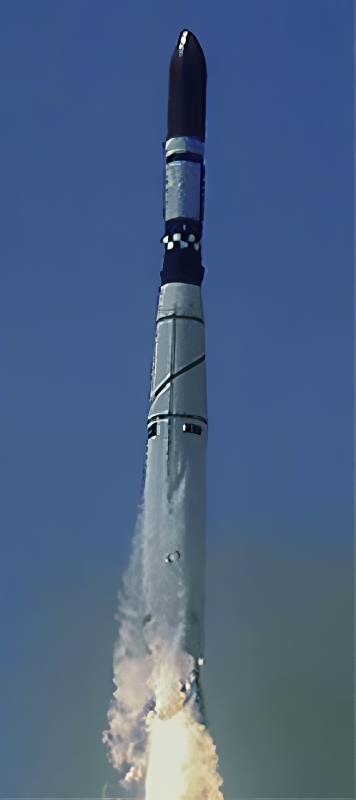
Thor SLV-2 Agena D
In-activeMcDonnell Douglas (MDC)
May 31, 1967
Description
Thor-Agena was a series of orbital launch vehicles. The rockets used Thor first stages and Agena second stages. They are thus cousins of the more-famous Thor-Deltas, which founded the Delta rocket family.
Specifications
-
Stages
2 -
Length
27.2 m -
Diameter
2.44 m -
Fairing Diameter
2.44 m -
Launch Mass
56.0 T -
Thrust
756.0 kN
Family
-
Name
Thor SLV-2 Agena D -
Family
― -
Variant
SLV-2 Agena D -
Alias
― -
Full Name
Thor SLV-2 Agena D
Payload Capacity
-
Launch Cost
$19560000 -
Low Earth Orbit
― -
Geostationary Transfer
Orbit
― -
Direct Geostationary
― -
Sun-Synchronous Capacity
―
McDonnell Douglas
Commercial
None
MDCNone
Thor SLV-2 Agena D | Poppy 7A,B,C,D
McDonnell Douglas | United States of AmericaVandenberg SFB, CA, USA
May 31, 1967, 9:30 a.m.
Thor SLV-2 Agena D | MRPV
McDonnell Douglas | United States of AmericaVandenberg SFB, CA, USA
Sept. 2, 1965, 8 p.m.
Thor SLV-2 Agena D | Poppy 6A,B,C,D
McDonnell Douglas | United States of AmericaVandenberg SFB, CA, USA
March 9, 1965, 6:29 p.m.
Thor SLV-2 Agena D | DSAP-1 F8 & F9
McDonnell Douglas | United States of AmericaVandenberg SFB, CA, USA
June 18, 1964, 4:56 a.m.
Thor SLV-2 Agena D | DSAP-1 F6 & F7
McDonnell Douglas | United States of AmericaVandenberg SFB, CA, USA
Jan. 19, 1964, 10:59 a.m.
Thor SLV-2 Agena D | KH-4 25
McDonnell Douglas | United States of AmericaVandenberg SFB, CA, USA
Nov. 27, 1963, 9:15 p.m.
Thor SLV-2 Agena D | KH-4 24 & RM 5
McDonnell Douglas | United States of AmericaVandenberg SFB, CA, USA
Nov. 9, 1963, 8:27 p.m.
Falcon 9
NROL-95
Space Launch Complex 40 - Cape Canaveral SFS, FL, USAClassified payload for the US National Reconnaissance Office.
Long March 6A
TJSW-27A & B
Launch Complex 9A - Taiyuan Satellite Launch Center, People's Republic of China2 Chinese classified satellites claimed to be for communication technology test purposes. Actual mission not known.
Long March 7A
Tianlian 3-01
201 - Wenchang Space Launch Site, People's Republic of ChinaTianlian is a Chinese data tracking and relay communications geostationary satellite series. The TL-3 (Tian Lian 3) satellites are the 3rd generation…
Falcon 9
Starlink Group 17-51
Space Launch Complex 4E - Vandenberg SFB, CA, USAA batch of 24 satellites for the Starlink mega-constellation - SpaceX's project for space-based Internet communication system.
Starship
Flight 13
Orbital Launch Pad 2 - SpaceX Starbase, TX, USA13th test flight of the two-stage Starship launch vehicle. Second flight of Starship V3. For the first time, Starship will carry 20 V3 Starlink sa…

