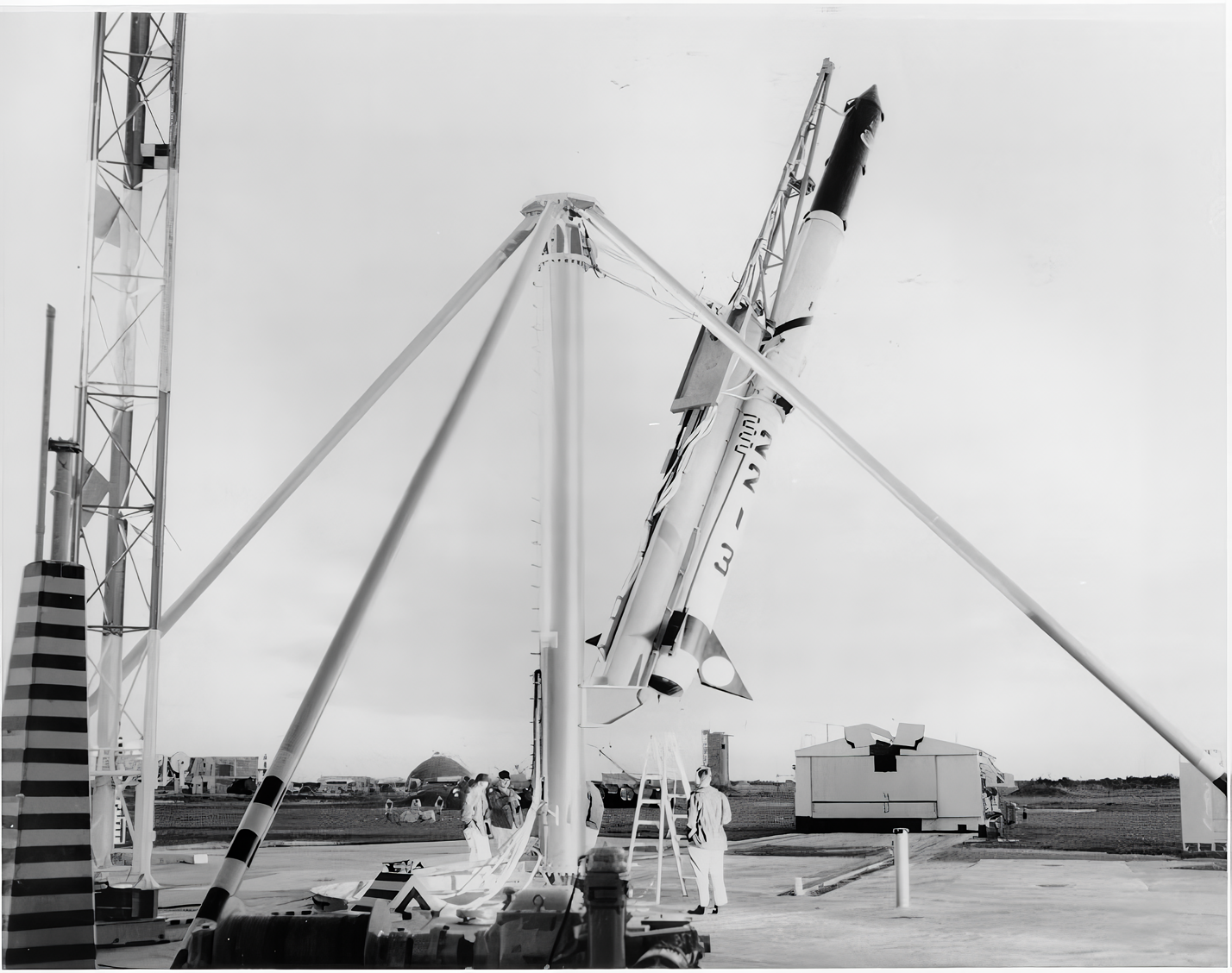
Blue Scout Jr
In-activeVought ()
Sept. 21, 1960
Description
The XRM-91 Blue Scout Junior (sometimes called Journeyman B) was a rocket of the U.S. Air Force's System 609A Blue Scout family.
Specifications
-
Stages
4 -
Length
12.4 m -
Diameter
0.79 m -
Fairing Diameter
0.79 m -
Launch Mass
5.0 T -
Thrust
222.0 kN
Family
-
Name
Blue Scout Jr -
Family
― -
Variant
Jr -
Alias
― -
Full Name
Blue Scout Jr
Payload Capacity
-
Launch Cost
― -
Low Earth Orbit
― -
Geostationary Transfer
Orbit
― -
Direct Geostationary
― -
Sun-Synchronous Capacity
―
Vought
Commercial
None
1917Vought was the name of several related American aerospace firms. These have included, in the past, Lewis and Vought Corporation, Chance Vought, Vought-Sikorsky, LTV Aerospace (part of Ling-Temco-Vought), Vought Aircraft Companies, and Vought Aircraft Industries. The first incarnation of Vought was established by Chance M. Vought and Birdseye Lewis in 1917. In 1928, it was acquired by United Aircraft and Transport Corporation, which a few years later became United Aircraft Corporation; this was the first of many reorganizations and buyouts. During the 1920s and 1930s, Vought Aircraft and Chance Vought specialized in carrier-based aircraft for the United States Navy, by far its biggest customer. Chance Vought produced thousands of planes during World War II, including the F4U Corsair. Vought became independent again in 1954, and was purchased by Ling-Temco-Vought in 1961. The company designed and produced a variety of planes and missiles throughout the Cold War. Vought was sold from LTV and owned in various degrees by the Carlyle Group and Northrop Grumman in the early 1990s. It was then fully bought by Carlyle, renamed Vought Aircraft Industries, with headquarters in Dallas, Texas. In June 2010, the Carlyle Group sold Vought to the Triumph Group.
Blue Scout Jr | OAR 22-5
Vought | United States of AmericaCape Canaveral SFS, FL, USA
June 9, 1965, 4:26 p.m.
Blue Scout Jr | OAR 22-8
Vought | United States of AmericaCape Canaveral SFS, FL, USA
May 12, 1965, 4:02 p.m.
Blue Scout Jr | OAR 22-9
Vought | United States of AmericaCape Canaveral SFS, FL, USA
April 9, 1965, 6:10 p.m.
Blue Scout Jr | OAR 22-4
Vought | United States of AmericaCape Canaveral SFS, FL, USA
March 30, 1965, 4:09 p.m.
Blue Scout Jr | OAR 22-1
Vought | United States of AmericaCape Canaveral SFS, FL, USA
July 30, 1963, 4:16 p.m.
Blue Scout Jr | Blue Scout Jr. O-2
Vought | United States of AmericaVandenberg SFB, CA, USA
Dec. 4, 1961, 4 a.m.
Blue Scout Jr | O-1
Vought | United States of AmericaCape Canaveral SFS, FL, USA
Aug. 17, 1961, 2:29 p.m.
Blue Scout Jr | Blue Scout D-1
Vought | United States of AmericaCape Canaveral SFS, FL, USA
Sept. 21, 1960, 1:01 p.m.
Falcon 9
NROL-95
Space Launch Complex 40 - Cape Canaveral SFS, FL, USAClassified payload for the US National Reconnaissance Office.
Long March 6A
TJSW-27A & B
Launch Complex 9A - Taiyuan Satellite Launch Center, People's Republic of China2 Chinese classified satellites claimed to be for communication technology test purposes. Actual mission not known.
Long March 7A
Tianlian 3-01
201 - Wenchang Space Launch Site, People's Republic of ChinaTianlian is a Chinese data tracking and relay communications geostationary satellite series. The TL-3 (Tian Lian 3) satellites are the 3rd generation…
Falcon 9
Starlink Group 17-51
Space Launch Complex 4E - Vandenberg SFB, CA, USAA batch of 24 satellites for the Starlink mega-constellation - SpaceX's project for space-based Internet communication system.
Starship
Flight 13
Orbital Launch Pad 2 - SpaceX Starbase, TX, USA13th test flight of the two-stage Starship launch vehicle. Second flight of Starship V3. For the first time, Starship will carry 20 V3 Starlink sa…

