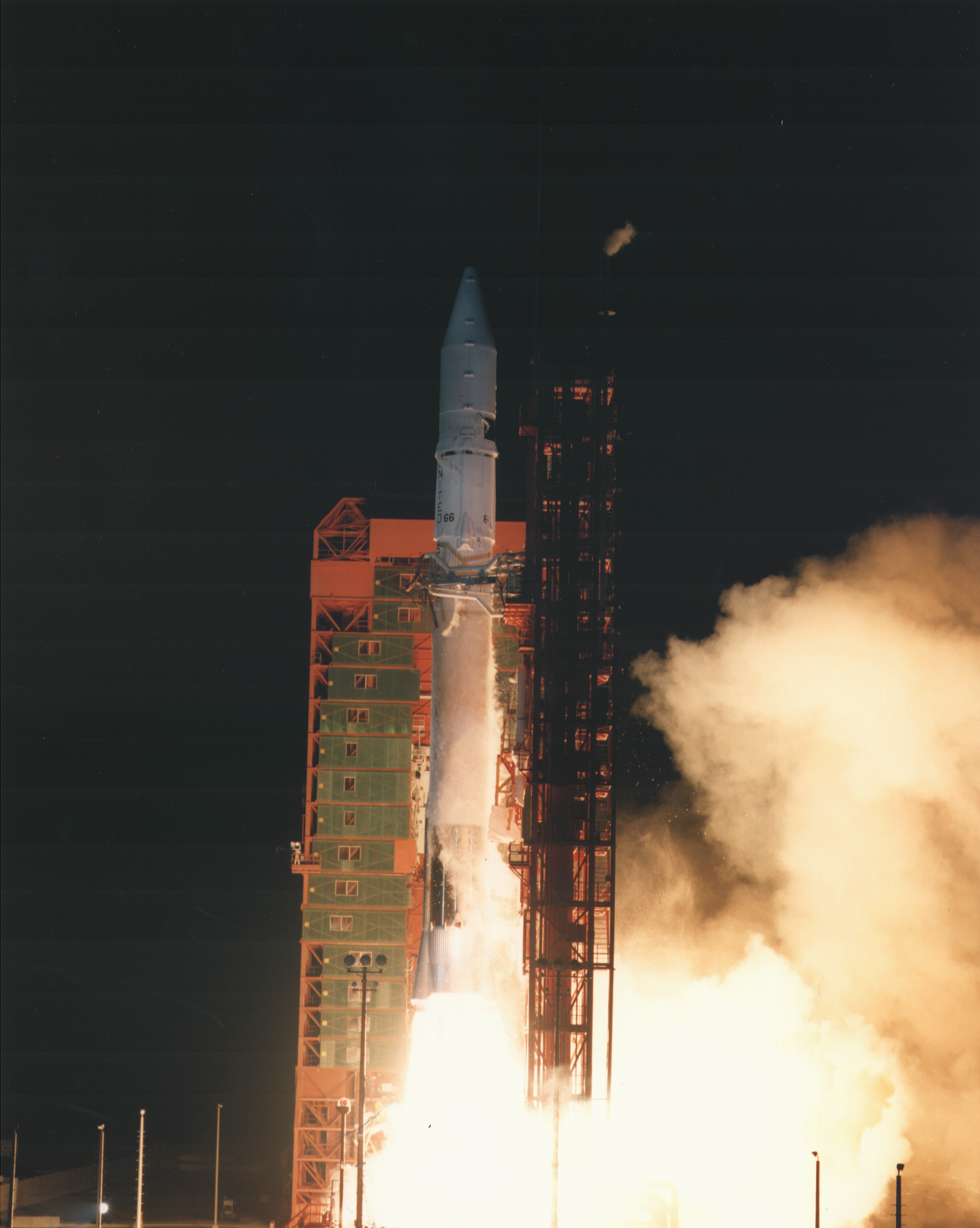
Atlas G Centaur
In-activeConvair ()
June 9, 1984
Description
The Atlas G, also known as Atlas G Centaur-D1AR was an American expendable launch system derived from the Atlas-Centaur. It was a member of the Atlas family of rockets, and was used to launch seven communication satellites during the mid to late 1980s. Atlas G consisted of an improved Atlas core with modernized avionics and stretched propellant tanks. The Centaur stage also had several updated components and other technical improvements. It was replaced by the Atlas I, which had an improved guidance system.
Specifications
-
Stages
2 -
Length
38.0 m -
Diameter
3.05 m -
Fairing Diameter
3.05 m -
Launch Mass
166.0 T -
Thrust
1896.0 kN
Family
-
Name
Atlas G Centaur -
Family
― -
Variant
G Centaur -
Alias
― -
Full Name
Atlas G Centaur
Payload Capacity
-
Launch Cost
― -
Low Earth Orbit
3630.0 kg -
Geostationary Transfer
Orbit
― -
Direct Geostationary
― -
Sun-Synchronous Capacity
―
Convair
Commercial
None
1943Convair, previously Consolidated Vultee, was an American aircraft manufacturing company that later expanded into rockets and spacecraft. The company was formed in 1943 by the merger of Consolidated Aircraft and Vultee Aircraft. In 1953 it was purchased by General Dynamics, and operated as their Convair Division for most of its corporate history.
Atlas G Centaur | FLTSATCOM F8
Convair | United States of AmericaCape Canaveral SFS, FL, USA
Sept. 25, 1989, 8:56 a.m.
Atlas G Centaur | FLTSATCOM F6
Convair | United States of AmericaCape Canaveral SFS, FL, USA
March 26, 1987, 9:22 p.m.
Atlas G Centaur | FLTSATCOM F7
Convair | United States of AmericaCape Canaveral SFS, FL, USA
Dec. 5, 1986, 2:30 a.m.
Atlas G Centaur | Intelsat 512
Convair | United States of AmericaCape Canaveral SFS, FL, USA
Sept. 28, 1985, 11:17 p.m.
Atlas G Centaur | Intelsat 511
Convair | United States of AmericaCape Canaveral SFS, FL, USA
June 30, 1985, 12:44 a.m.
Atlas G Centaur | Intelsat 510
Convair | United States of AmericaCape Canaveral SFS, FL, USA
March 22, 1985, 11:55 p.m.
Falcon 9
NROL-95
Space Launch Complex 40 - Cape Canaveral SFS, FL, USAClassified payload for the US National Reconnaissance Office.
Long March 6A
TJSW-27A & B
Launch Complex 9A - Taiyuan Satellite Launch Center, People's Republic of China2 Chinese classified satellites claimed to be for communication technology test purposes. Actual mission not known.
Long March 7A
Tianlian 3-01
201 - Wenchang Space Launch Site, People's Republic of ChinaTianlian is a Chinese data tracking and relay communications geostationary satellite series. The TL-3 (Tian Lian 3) satellites are the 3rd generation…
Falcon 9
Starlink Group 17-51
Space Launch Complex 4E - Vandenberg SFB, CA, USAA batch of 24 satellites for the Starlink mega-constellation - SpaceX's project for space-based Internet communication system.
Starship
Flight 13
Orbital Launch Pad 2 - SpaceX Starbase, TX, USA13th test flight of the two-stage Starship launch vehicle. Second flight of Starship V3. For the first time, Starship will carry 20 V3 Starlink sa…

