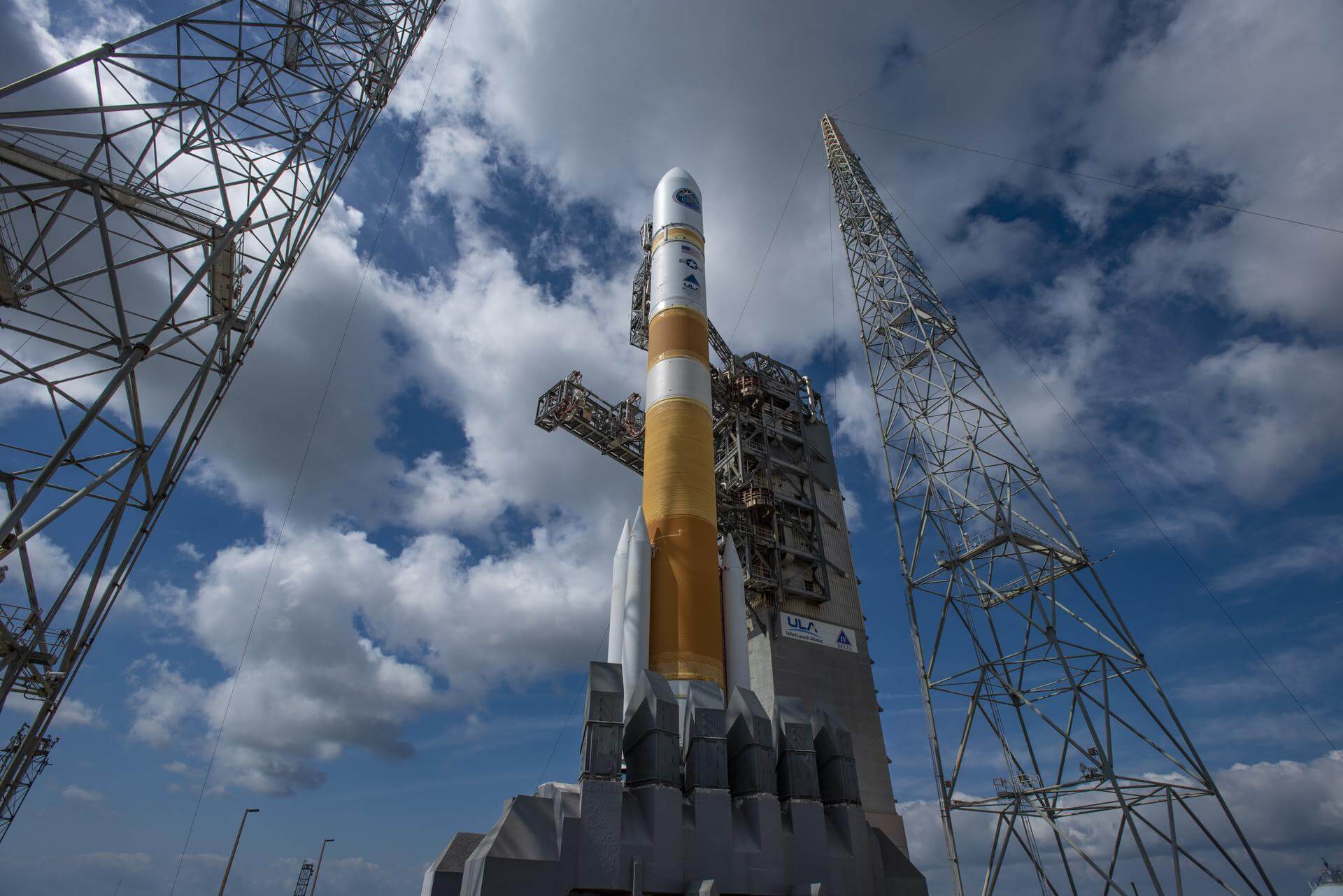
Delta IV M+(5,4)
In-activeUnited Launch Alliance (ULA)
Dec. 6, 2009
Description
description
Specifications
-
Stages
2 -
Length
70.7 m -
Diameter
5.0 m -
Fairing Diameter
― -
Launch Mass
404.0 T -
Thrust
5860.0 kN -
Apogee (Sub-Orbital)
40000.0 km
Family
-
Name
Delta IV M+(5,4) -
Family
― -
Variant
M+(5,4) -
Alias
― -
Full Name
Delta IV M+(5,4)
Payload Capacity
-
Launch Cost
― -
Low Earth Orbit
13730.0 kg -
Geostationary Transfer
Orbit
6890.0 kg -
Direct Geostationary
2710.0 kg -
Sun-Synchronous Capacity
―
United Launch Alliance
Commercial
Interim CEO: John Elbon
ULA 2006United Launch Alliance (ULA) is a joint venture of Lockheed Martin Space Systems and Boeing Defense, Space & Security. ULA was formed in December 2006 by combining the teams at these companies which provide spacecraft launch services to the government of the United States. ULA launches from both coasts of the US. They launch their Atlas V vehicle from LC-41 in Cape Canaveral and LC-3E at Vandeberg. Their Delta IV launches from LC-37 at Cape Canaveral and LC-6 at Vandenberg.
Delta IV M+(5,4) | WGS-10
United Launch Alliance | United States of AmericaCape Canaveral SFS, FL, USA
March 16, 2019, 12:26 a.m.
Status: Launch Successful
Mission:
WGS-10 is the tenth and final satellite in Wideband Global Satcom constellation. These are high-capacity military communications satellites providing vital service for tactical forces who rely on WGS for connectivity to the Defence Information Systems Network (DISN).
Geostationary Transfer Orbit #WGS10Delta IV M+(5,4) | WGS-9 (USA-275)
United Launch Alliance | United States of AmericaCape Canaveral SFS, FL, USA
March 19, 2017, 12:18 a.m.
Delta IV M+(5,4) | WGS-8 (USA-272)
United Launch Alliance | United States of AmericaCape Canaveral SFS, FL, USA
Dec. 7, 2016, 11:53 p.m.
Delta IV M+(5,4) | WGS-7 (USA-263)
United Launch Alliance | United States of AmericaCape Canaveral SFS, FL, USA
July 24, 2015, 12:07 a.m.
Delta IV M+(5,4) | WGS-6 (USA-244)
United Launch Alliance | United States of AmericaCape Canaveral SFS, FL, USA
Aug. 8, 2013, 12:29 a.m.
Status: Launch Successful
Mission:
The United Launch Alliance Delta 4 rocket will launch the sixth Wideband Global SATCOM spacecraft, formerly known as the Wideband Gapfiller Satellite. Built by Boeing, this geostationary communications spacecraft will serve U.S. military forces.
Geostationary Transfer OrbitDelta IV M+(5,4) | WGS-5 (USA-243)
United Launch Alliance | United States of AmericaCape Canaveral SFS, FL, USA
May 25, 2013, 12:27 a.m.
Delta IV M+(5,4) | WGS-4 (USA-233)
United Launch Alliance | United States of AmericaCape Canaveral SFS, FL, USA
Jan. 20, 2012, 12:38 a.m.
Status: Launch Successful
Mission:
The United Launch Alliance Delta 4 rocket launched the fourth Wideband Global SATCOM spacecraft, formerly known as the Wideband Gapfiller Satellite. Built by Boeing, this geostationary communications spacecraft serves U.S. military forces.
Geostationary Transfer OrbitDelta IV M+(5,4) | WGS-3 (USA-211)
United Launch Alliance | United States of AmericaCape Canaveral SFS, FL, USA
Dec. 6, 2009, 1:47 a.m.
Falcon 9
Starlink Group 17-38
Space Launch Complex 4E - Vandenberg SFB, CA, USAA batch of 24 satellites for the Starlink mega-constellation - SpaceX's project for space-based Internet communication system.
Electron
The Grain Goddess Provides (iQPS Launch 7)
Rocket Lab Launch Complex 1A - Rocket Lab Launch Complex 1, Mahia Peninsula, New ZealandSynthetic aperture radar Earth observation satellite for Japanese Earth imaging company iQPS.
Falcon 9
BlueBird 11-13 (Block 2 #6-8)
Space Launch Complex 40 - Cape Canaveral SFS, FL, USAAST SpaceMobile’s Block 2 BlueBird satellites are designed to deliver up to 10 times the bandwidth capacity of the BlueBird Block 1 satellites, requi…
Smart Dragon 3
OSE HS-01 & 02
Haiyang offshore launch location - Haiyang Oriental Spaceport2 hyper-spectral Earth observation satellites from Chinese company STAR.VISION. Both satellites are built in corporation with foreign customers: *…
Falcon 9
Starlink Group 17-53
Space Launch Complex 4E - Vandenberg SFB, CA, USAA batch of 24 satellites for the Starlink mega-constellation - SpaceX's project for space-based Internet communication system.

