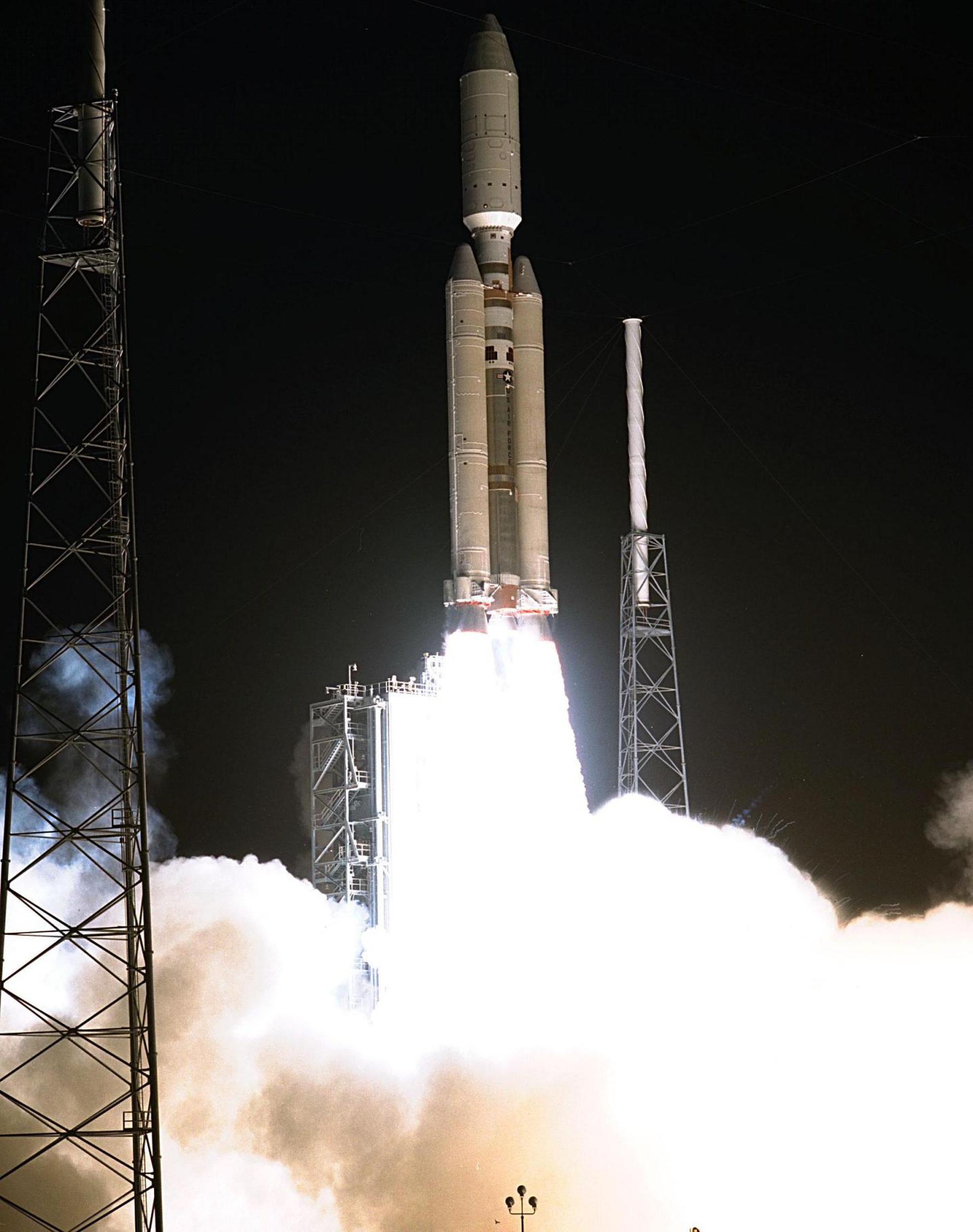
Titan IVB
In-activeLockheed Martin (LMT)
Oct. 15, 1997
Description
Specifications
-
Length
― -
Diameter
― -
Fairing Diameter
― -
Launch Mass
― -
Thrust
―
Family
-
Name
Titan IVB -
Family
― -
Variant
Centaur -
Alias
― -
Full Name
Titan IVB/Centaur
Payload Capacity
-
Launch Cost
― -
Low Earth Orbit
― -
Geostationary Transfer
Orbit
― -
Direct Geostationary
― -
Sun-Synchronous Capacity
―
Lockheed Martin
Commercial
None
LMT 1953Lockheed Martin's Space Division started in the production of missiles and later ICBM's in the 1950s. Their TITAN missile system was used for 12 Gemini spacecraft and the Voyager probes. They have worked largely in collaboration with NASA on many of their probes, landers, and spacecraft, and hope to play a key role in NASA's return to the moon in 2024.
Titan IVB | NROL-19
Lockheed Martin | United States of AmericaCape Canaveral SFS, FL, USA
Sept. 9, 2003, 4:29 a.m.
Titan IVB | Milstar 6
Lockheed Martin | United States of AmericaCape Canaveral SFS, FL, USA
April 8, 2003, 1:43 p.m.
Titan IVB | Milstar 5
Lockheed Martin | United States of AmericaCape Canaveral SFS, FL, USA
Jan. 16, 2002, 12:30 a.m.
Status: Launch Successful
Mission:
Milstar (Military Strategic & Tactical Relay) is the tactical and strategic multiservice satellite system designed to provide survivable communications for U.S. forces worldwide. The program is managed by the U.S. Air Force Space and Missile Center.
Geosynchronous OrbitTitan IVB | Milstar 4
Lockheed Martin | United States of AmericaCape Canaveral SFS, FL, USA
Feb. 27, 2001, 9:20 p.m.
Titan IVB | Milstar 3
Lockheed Martin | United States of AmericaCape Canaveral SFS, FL, USA
April 30, 1999, 4:30 p.m.
Titan IVB | NROL-6
Lockheed Martin | United States of AmericaCape Canaveral SFS, FL, USA
May 9, 1998, 1:38 a.m.
Status: Launch Successful
Mission:
The Orion 3 and 4 (RIO 3, 4) satellites, which are generally known as 'Advanced Orion' or 'Mentor', are geostationary signals intelligence satellites, which replaced the Magnum / Orion series. Their purpose is to intercept missile telemetry from Russia and China and the COMINT capability of the Mercury satellites was merged into this series. These satellites are launched under the designation Program 7600.
Geostationary OrbitFalcon 9
Starlink Group 17-52
Space Launch Complex 4E - Vandenberg SFB, CA, USAA batch of 24 satellites for the Starlink mega-constellation - SpaceX's project for space-based Internet communication system.
Falcon 9
NROL-95
Space Launch Complex 40 - Cape Canaveral SFS, FL, USAClassified payload for the US National Reconnaissance Office.
Long March 6A
TJSW-27A & B
Launch Complex 9A - Taiyuan Satellite Launch Center, People's Republic of China2 Chinese classified satellites claimed to be for communication technology test purposes. Actual mission not known.
Long March 7A
Tianlian 3-01
201 - Wenchang Space Launch Site, People's Republic of ChinaTianlian is a Chinese data tracking and relay communications geostationary satellite series. The TL-3 (Tian Lian 3) satellites are the 3rd generation…
Falcon 9
Starlink Group 17-51
Space Launch Complex 4E - Vandenberg SFB, CA, USAA batch of 24 satellites for the Starlink mega-constellation - SpaceX's project for space-based Internet communication system.

