Vega-C
ActiveAvio S.p.A (Avio)
July 13, 2022
Description
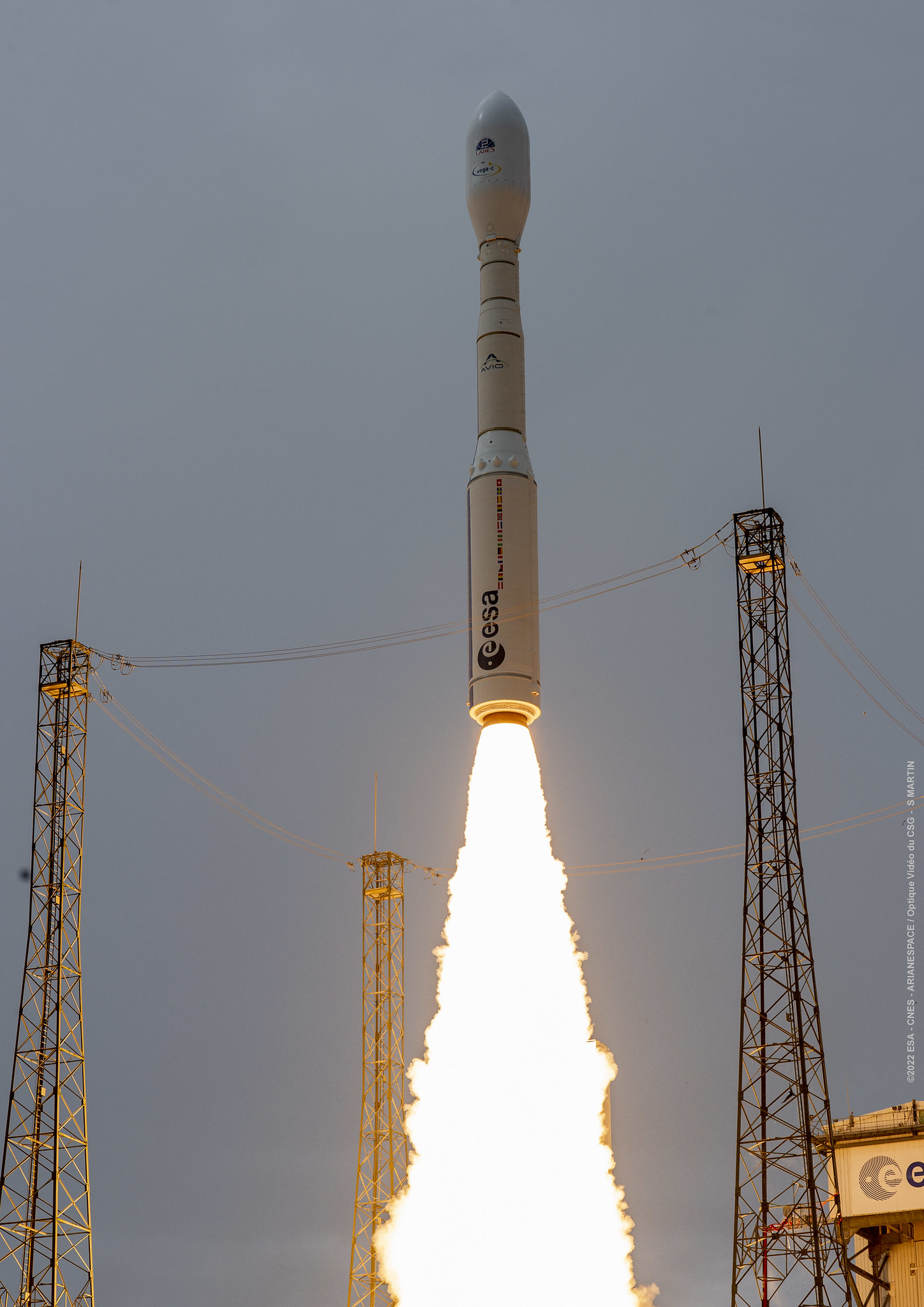
Vega-C is a single-body rocket nearly 35 m high with that weighs 210 tonnes on the launch pad. As with Vega, its main elements are three solid-propellant stages, an upper stage powered by a reignitable liquid-propellant engine and a payload fairing. Vega-C's P120C first stage replaces Vega’s smaller P80 to provide a significant increase in thrust at liftoff. It is also used as boosters (2 or 4) for the Ariane 6 rocket.
Specifications
-
Stages
4 -
Length
34.8 m -
Diameter
3.0 m -
Fairing Diameter
3.3 m -
Launch Mass
210.0 T -
Thrust
2974.0 kN
Family
-
Name
Vega-C -
Family
― -
Variant
― -
Alias
― -
Full Name
Vega-C
Payload Capacity
-
Launch Cost
$48000000 -
Low Earth Orbit
3300.0 kg -
Geostationary Transfer
Orbit
― -
Direct Geostationary
― -
Sun-Synchronous Capacity
2230.0 kg
Avio S.p.A
Commercial
CEO: Giulio Ranzo
Avio 1908Avio S.p.A. is an Italian company operating in the aerospace sector with its head office in Colleferro near Rome, Italy. Founded in 1908, it is present in Italy and abroad with different commercial offices and 10 production sites.
Upcoming Spaceflights
Vega-C | Sentinel-3C & FLEX
Avio S.p.A | ItalyGuiana Space Centre, French Guiana
TBD September, 2026
Status: To Be Determined
Mission:
Sentinel-3C is the third satellite in the Sentinel-3 constellation, which provides high-accuracy optical, radar and altimetry data for marine and land services. The Fluorescence Explorer (FLEX) satellite is a part of ESA's Earth Explorer program. The satellite will map vegetation fluorescence to quantify photosynthetic activity.
Sun-Synchronous Orbit VV30Vega-C | IRIDE 2
Avio S.p.A | ItalyGuiana Space Centre, French Guiana
TBD December, 2026
Vega-C | IRIDE 1
Avio S.p.A | ItalyGuiana Space Centre, French Guiana
TBD December, 2026
Vega-C | PLATiNO 2
Avio S.p.A | ItalyGuiana Space Centre, French Guiana
TBD June, 2027
Vega-C | CSG-4
Avio S.p.A | ItalyGuiana Space Centre, French Guiana
TBD June, 2027
Vega-C | KOMPSAT-6 & PLATiNO 1
Avio S.p.A | ItalyGuiana Space Centre, French Guiana
TBD June, 2027
Status: To Be Determined
Mission:
Korean Multi-purpose Satellite 6 (KOMPSAT-6) is the sixth South Korean Earth observation satellite of the KOMPSAT series. It is equipped with a synthetic aperture radar with a ground resolution between 0.5 and 20 meters. PLATiNO 1 is an experimental X-band SAR earth observation satellite project by the Italian Space Agency (ASI), with a radar payload from Thales Alenia Space Italia. The X-band SAR will first operate in passive mode at 619 km altitude, then in active mode after the satellites moves lower to a 410 km orbit.
Sun-Synchronous OrbitVega-C | Sentinel CO2M-A
Avio S.p.A | ItalyGuiana Space Centre, French Guiana
TBD November, 2027
Status: To Be Determined
Mission:
Sentinel CO2M-A carries a near-infrared and shortwave-infrared spectrometer to measure atmospheric carbon dioxide produced by human activity, providing the EU with a unique and independent source of information, to assess the effectiveness of policy measures, and to track their impact towards decarbonizing Europe and meeting national emission reduction targets.
Sun-Synchronous OrbitVega-C | FORMOSAT-8C
Avio S.p.A | ItalyGuiana Space Centre, French Guiana
TBD December, 2027
Vega-C | FORUM
Avio S.p.A | ItalyGuiana Space Centre, French Guiana
TBD December, 2027
Vega-C | Amazonia-1B
Avio S.p.A | ItalyGuiana Space Centre, French Guiana
TBD December, 2027
Vega-C | EAGLE-1
Avio S.p.A | ItalyGuiana Space Centre, French Guiana
TBD December, 2027
Vega-C | Sentinel CO2M-B
Avio S.p.A | ItalyGuiana Space Centre, French Guiana
TBD March, 2028
Status: To Be Determined
Mission:
Sentinel CO2M-B carries a near-infrared and shortwave-infrared spectrometer to measure atmospheric carbon dioxide produced by human activity, providing the EU with a unique and independent source of information, to assess the effectiveness of policy measures, and to track their impact towards decarbonizing Europe and meeting national emission reduction targets.
Sun-Synchronous OrbitVega-C | Pléiades Neo Next 1
Avio S.p.A | ItalyGuiana Space Centre, French Guiana
TBD March, 2028
Vega-C | FORMOSAT-9A
Avio S.p.A | ItalyGuiana Space Centre, French Guiana
TBD December, 2028
Vega-C | Sentinel-3D
Avio S.p.A | ItalyGuiana Space Centre, French Guiana
TBD December, 2028
Vega-C | FORMOSAT-8D
Avio S.p.A | ItalyGuiana Space Centre, French Guiana
TBD December, 2028
Vega-C | Altius
Avio S.p.A | ItalyGuiana Space Centre, French Guiana
TBD December, 2028
Vega-C | ClearSpace-1
Avio S.p.A | ItalyGuiana Space Centre, French Guiana
TBD December, 2029
Vega-C | Harmony
Avio S.p.A | ItalyGuiana Space Centre, French Guiana
TBD December, 2029
Status: To Be Determined
Mission:
Harmony, ESA's 10th Earth Explorer mission, consists of 2 satellites that will orbit Earth in tandem with a Copernicus Sentinel-1 satellite in various configurations. The Harmony satellites’ synthetic aperture radar instruments will receive the Sentinel-1 satellite's radar signals that bounce back, or ‘backscatter’, from Earth’s surface. At the same time, Harmony’s thermal-infrared instruments provide complementary observations of the sea surface as well as the position and motion of clouds above it.
Sun-Synchronous OrbitVega-C | SBG-TIR
Avio S.p.A | ItalyGuiana Space Centre, French Guiana
TBD December, 2029
Status: To Be Determined
Mission:
The Surface Biology and Geology - Thermal Infrared (SBG-TIR) Earth Observation mission aims to provide radiometric and multispectral measurements of terrestrial and aquatic emissions for climate, ecological, and geological analyses, and to support practical applications such as food security and water management. The thermal infrared (TIR) radiometer is provided by NASA, while the VIS-NIR camera is provided by ASI. Their combination ensures high-quality observations, enabling the investigation of terrestrial and marine ecosystems, monitoring of water resources, and phenomena related to high temperatures such as wildfires and volcanic eruptions.
Sun-Synchronous OrbitVega-C | FORMOSAT-9B
Avio S.p.A | ItalyGuiana Space Centre, French Guiana
TBD December, 2030
Vega-C | TRUTHS
Avio S.p.A | ItalyGuiana Space Centre, French Guiana
TBD December, 2030
Status: To Be Determined
Mission:
TRUTHS (Traceable Radiometry Underpinning Terrestrial- and Helio-Studies) is a a ‘standards laboratory in space’, setting the ‘gold standard’ reference for climate measurements. Carrying a cryogenic solar absolute radiometer and a hyperspectral imaging spectrometer as well as a novel onboard calibration system, TRUTHS is designed to make continuous measurements of incoming solar radiation and reflected radiation to evaluate Earth’s energy-in to energy-out ratio.
Sun-Synchronous OrbitVega-C | Solar wind Magnetosphere Ionosphere Link Explorer (SMILE)
Avio S.p.A | ItalyGuiana Space Centre, French Guiana
May 19, 2026, 3:52 a.m.
Vega-C | KOMPSAT-7
Avio S.p.A | ItalyGuiana Space Centre, French Guiana
Dec. 1, 2025, 5:21 p.m.
Vega-C | CO3D & MicroCarb
Avio S.p.A | ItalyGuiana Space Centre, French Guiana
July 26, 2025, 2:03 a.m.
Status: Launch Successful
Mission:
CO3D is a CNES-Airbus Defence & Space constellation of four small satellites designed to map the globe in 3D from low Earth to serve public and private sector needs. Microcarb is a small satellite designed to map sources and sinks of carbon dioxide (CO2)—the most important greenhouse gas — on a global scale.
Sun-Synchronous OrbitVega-C | Biomass
Avio S.p.A | ItalyGuiana Space Centre, French Guiana
April 29, 2025, 9:15 a.m.
Status: Launch Successful
Mission:
Biomass is an European Space Agency mission designed to measure the density of carbon stored in the world's forests. The spacecraft, built by Airbus Defence and Space, features the first civilian P-band synthetic aperture radar as well as a 12m-diameter deployable reflector from L3Harris made of over 900 km of gold-coated molybdenum 25µm wire. With a minimum operational lifetime of 5 years in its 666km 6am/6pm sun-synchronous orbit, the global coverage achieved every 9 months allows to precisely monitor the evolution of forests over time.
Sun-Synchronous Orbit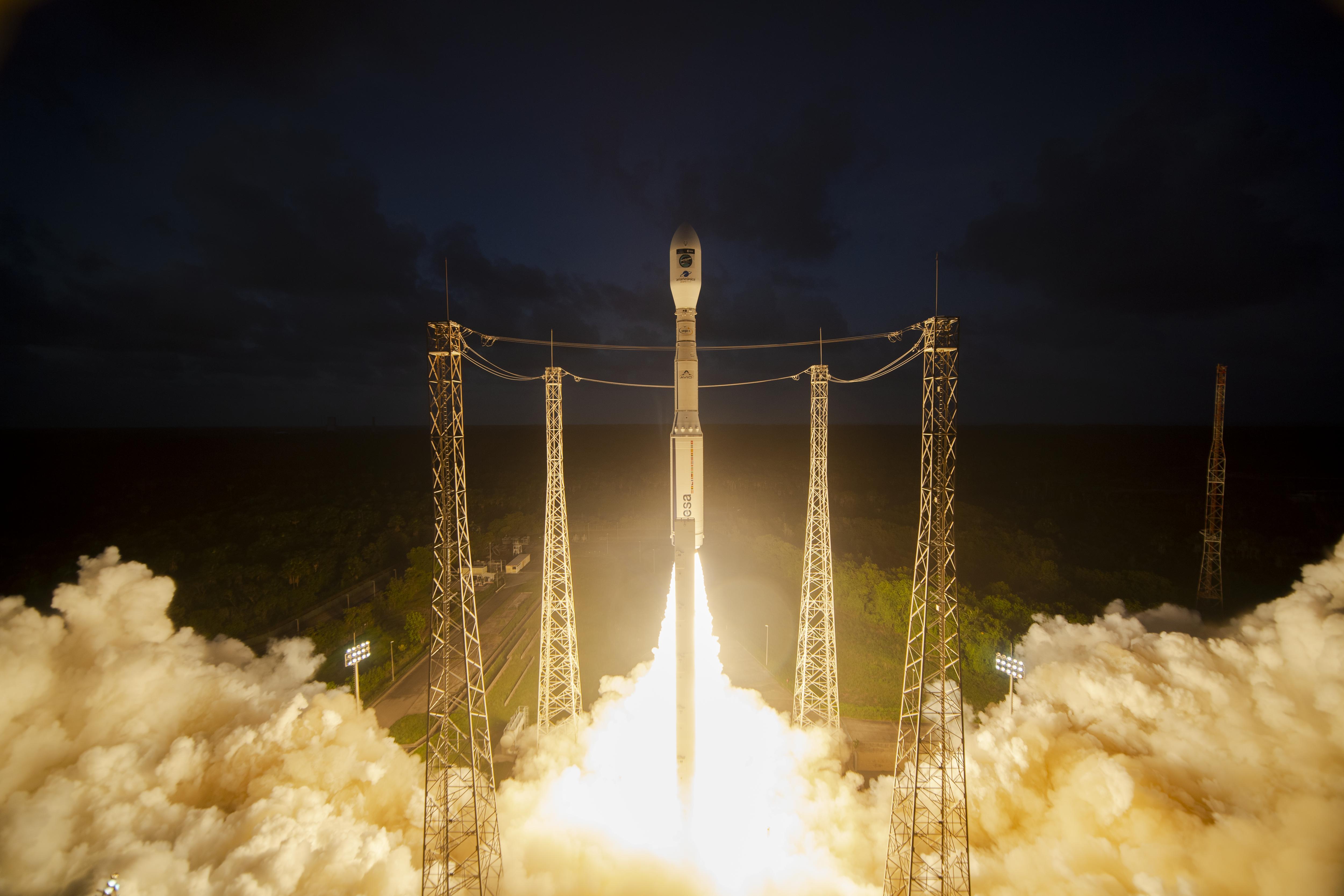
Vega-C | Sentinel-1C
Avio S.p.A | ItalyGuiana Space Centre, French Guiana
Dec. 5, 2024, 9:20 p.m.
Status: Launch Successful
Mission:
Sentinel-1C carries an advanced radar technology to provide an all-weather, day-and-night supply of imagery of Earth’s surface. It is a replacement satellite to complete the Sentinel-1 duo after Sentinel-1B suffered a technical anomaly.
Sun-Synchronous OrbitVega-C | Pléiades Neo 5 & 6
Avio S.p.A | ItalyGuiana Space Centre, French Guiana
Dec. 21, 2022, 1:47 a.m.
Vega-C | LARES-2 (Maiden flight)
Avio S.p.A | ItalyGuiana Space Centre, French Guiana
July 13, 2022, 1:13 p.m.
Status: Launch Successful
Mission:
Maiden flight of the Vega-C launch vehicle, carrying the LARES-2 passive satellite. It is a 40 cm diameter sphere with laser mirrors to study the Earth gravitational field and relativistic effects. Also onboard are six European research cubesats.
Medium Earth OrbitSoyuz 2.1b
16 x Rassvet-3
Unknown Pad - Plesetsk Cosmodrome, Russian FederationNote: Payload identities uncertain. Batch of 16 Rassvet-3 Low Earth Orbit communication satellites for the Russian Byuro-1440 (Bureau 1440) conste…
Vikram-I
Demo Flight
Satish Dhawan Space Centre First Launch Pad - Satish Dhawan Space Centre, IndiaFirst launch of Skyroot Aerospace's Vikram-I launch vehicle. This first launch will carry 4 payloads: - Grahaa Space's SOLARAS S3 satellite - C…
Falcon 9
SDA Tranche 1 Transport Layer E
Space Launch Complex 4E - Vandenberg SFB, CA, USATranche 1 Transport Layer E is one of six missions by the United States Space Force Space Development Agency (SDA) for the Proliferated Warfighter Sp…
Soyuz 2.1a
Soyuz MS-29
31/6 - Baikonur Cosmodrome, Republic of KazakhstanSoyuz MS-29 will carry three cosmonauts and one astronaut to the International Space Station aboard the Soyuz spacecraft from the Baikonur Cosmodrome…
Falcon 9
Starlink Group 10-45
Space Launch Complex 40 - Cape Canaveral SFS, FL, USAA batch of 29 satellites for the Starlink mega-constellation - SpaceX's project for space-based Internet communication system.

