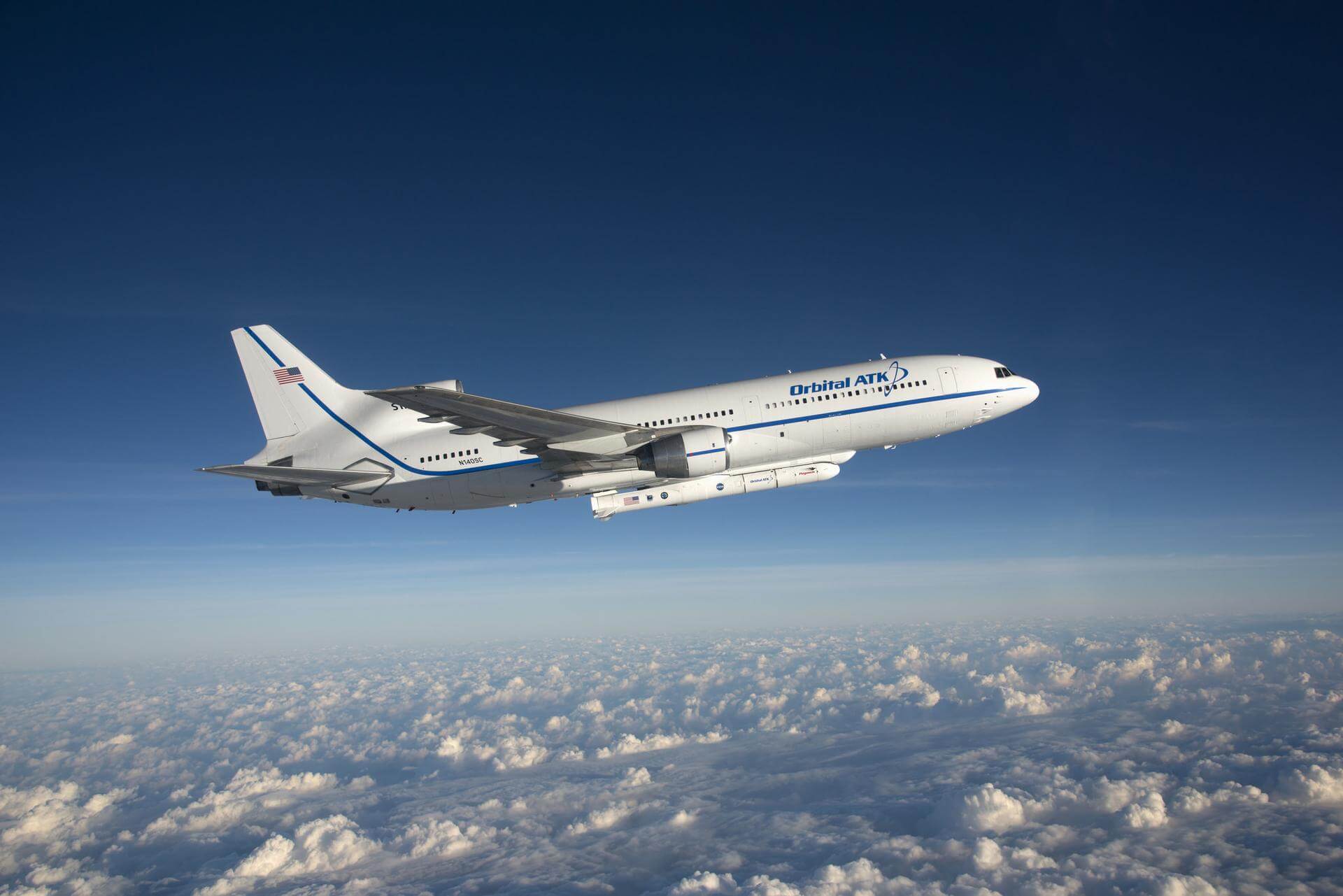
Pegasus XL HAPS
ActiveOrbital Sciences Corporation (OSC)
Dec. 23, 1997
Description
The Pegasus is an air-launched rocket developed by Orbital Sciences Corporation (now part of Northrop Grumman Innovation Systems). Capable of carrying small payloads of up to 443 kilograms (977 lb) into low Earth orbit, the vehicle consists of three solid propellant stages and an optional monopropellant fourth stage. Pegasus is released from its carrier aircraft at approximately 40,000 ft (12,000 m), and its first stage has a wing and a tail to provide lift and attitude control while in the atmosphere. The HAPS variant adds a Hydrazine Auxiliary Propulsion System maneuvering stage.
Specifications
-
Max Stage
4 -
Length
17.6 m -
Diameter
1.27 m -
Fairing Diameter
― -
Launch Mass
23.0 T -
Thrust
580.0 kN -
Apogee (Sub-Orbital)
4000.0 km
Family
-
Name
Pegasus XL HAPS -
Family
― -
Variant
HAPS -
Alias
― -
Full Name
Pegasus XL HAPS
Payload Capacity
-
Launch Cost
$40000000 -
Low Earth Orbit
443.0 kg -
Geostationary Transfer
Orbit
― -
Direct Geostationary
― -
Sun-Synchronous Capacity
―
Orbital Sciences Corporation
Commercial
None
OSCPegasus XL HAPS | Orbcomm-D2 - D8
Orbital Sciences Corporation | United States of AmericaAir launch to orbit
Dec. 4, 1999, 6:53 p.m.
Pegasus XL HAPS | MUBLCOM & TERRIERS
Orbital Sciences Corporation | United States of AmericaAir launch to orbit
May 18, 1999, 5:09 a.m.
Pegasus XL HAPS | Orbcomm-C1 - C8
Orbital Sciences Corporation | United States of AmericaAir launch to orbit
Sept. 23, 1998, 5:06 a.m.
Pegasus XL HAPS | Orbcomm-B1 - B8
Orbital Sciences Corporation | United States of AmericaAir launch to orbit
Aug. 2, 1998, 4:24 p.m.
Falcon 9
NROL-95
Space Launch Complex 40 - Cape Canaveral SFS, FL, USAClassified payload for the US National Reconnaissance Office.
Long March 6A
TJSW-27A & B
Launch Complex 9A - Taiyuan Satellite Launch Center, People's Republic of China2 Chinese classified satellites claimed to be for communication technology test purposes. Actual mission not known.
Long March 7A
Tianlian 3-01
201 - Wenchang Space Launch Site, People's Republic of ChinaTianlian is a Chinese data tracking and relay communications geostationary satellite series. The TL-3 (Tian Lian 3) satellites are the 3rd generation…
Falcon 9
Starlink Group 17-51
Space Launch Complex 4E - Vandenberg SFB, CA, USAA batch of 24 satellites for the Starlink mega-constellation - SpaceX's project for space-based Internet communication system.
Starship
Flight 13
Orbital Launch Pad 2 - SpaceX Starbase, TX, USA13th test flight of the two-stage Starship launch vehicle. Second flight of Starship V3. For the first time, Starship will carry 20 V3 Starlink sa…

