Vulcan VC2S | Peregrine lunar lander (Maiden flight)
Launch Successful
L - -- : -- : -- : --
Launch Window
Jan. 8, 2024, 7:18 a.m. - Jan. 8, 2024, 8:03 a.m.


Jan. 8, 2024, 7:18 a.m. - Jan. 8, 2024, 8:03 a.m.

A United Launch Alliance (ULA) Vulcan VC2S rocket will launch the first certification mission from Space Launch Complex-41 at Cape Canaveral Space Force Station, Florida. The Cert-1 flight test includes two payloads. The first is the Peregrine Lunar Lander, Peregrine Mission One (PM1) for Astrobotic...
Maiden flight of ULA's Vulcan launch vehicle carrying the Peregrine lunar lander developed by Astrobotic Technology. Astrobotic was selected by NASA’s Commercial Lunar Payload Services (CLPS) program to deliver up to 14 NASA payloads to the Moon on its Peregrine lunar lander in 2022.
Launch trajectory and telemetry simulations provided by Flight Club - a rocket launch simulator and orbital trajectory visualiser for all things space!

Launch success, Peregrine in contact.
Liftoff.

Livestream has started
Tweaked T-0 to the second.
Weather 85% GO.
Vulcan Centaur is a two-stage-to-orbit, heavy-lift launch vehicle under development by United Launch Alliance (ULA) since 2014. It is principally designed to meet launch demands for the U.S. government's National Security Space Launch (NSSL) program for use by the United States Space Force and U.S. intelligence agencies for national security satellite launches. It will replace both of ULA's existing launchers (Atlas V and Delta IV Heavy) in this role, as these launchers are retiring.
See DetailsUnited Launch Alliance (ULA) is a joint venture of Lockheed Martin Space Systems and Boeing Defense, Space & Security. ULA was formed in December 2006 by combining the teams at these companies which provide spacecraft launch services to the government of the United States. ULA launches from both coasts of the US. They launch their Atlas V vehicle from LC-41 in Cape Canaveral and LC-3E at Vandeberg. Their Delta IV launches from LC-37 at Cape Canaveral and LC-6 at Vandenberg.
INFO WIKI
Astrobotic’s Peregrine lunar lander was unable to make it to the moon because of a failure of a single valve, leading to work to redesign the valve and overall propulsion system on the company’s larger Griffin lander.
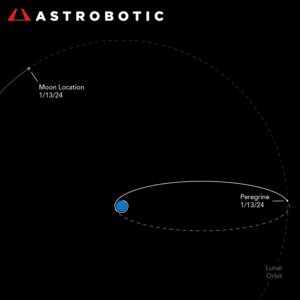
An independent review of the January failure of Astrobotic’s Peregrine-1 lunar lander has confirmed that a single bad valve doomed the mission. While designated a risk before launch because of […]
Despite not making it to the moon, NASA and others flying payloads on Astrobotic’s Peregrine lunar lander say they still got useful data from the mission.

As rumors of a potential sale of United Launch Alliance reach a crescendo, the company’s chief executive argues the successful inaugural launch of its Vulcan rocket is a vindication of both the company’s technology and its transformation.

Astrobotic’s Peregrine lunar lander re-entered the Earth’s atmosphere on January 18th, 2024, ending its mission after a 10 day, tumultuous journey through cislunar space. While its launch was fully successful, riding atop the first United …
A batch of 24 satellites for the Starlink mega-constellation - SpaceX's project for space-based Internet communication system.
Classified payload for the US National Reconnaissance Office.
2 Chinese classified satellites claimed to be for communication technology test purposes. Actual mission not known.
Tianlian is a Chinese data tracking and relay communications geostationary satellite series. The TL-3 (Tian Lian 3) satellites are the 3rd generation…
A batch of 24 satellites for the Starlink mega-constellation - SpaceX's project for space-based Internet communication system.
13th test flight of the two-stage Starship launch vehicle. Second flight of Starship V3. For the first time, Starship will carry 20 V3 Starlink sa…
Share-ride of 5 commercial Earth observation and technology demonstration satellites to SSO, including SpaceTY's TY-48. Details TBD.
Tianlian is a Chinese data tracking and relay communications geostationary satellite series. The TL 2 (Tian Lian 2) satellites represent the second g…
Carried 9 satellites on a share-ride to sun-synchronous orbit. Details TBD.
The Northrop Grumman/SpaceLogistics MRV-1 is a mission extension payload including a mission robotic vehicle (MRV) and multiple mission extension pod…

 View in Flightclub