Soyuz STB/Fregat-MT | Gaia
Launch Successful
L - -- : -- : -- : --
Instantaneous launch window.
Launch Window
Dec. 19, 2013, 9:12 a.m. - Dec. 19, 2013, 9:12 a.m.


Instantaneous launch window.
Dec. 19, 2013, 9:12 a.m. - Dec. 19, 2013, 9:12 a.m.
Gaia's ambitious mission is to chart a three-dimensional map of the Milky Way, in process revealing the composition, formation and evolution of our galaxy.
The 2.1b version adds an upgraded engine (RD-0124) with improved performance to the second stage. First launch took place from Plesetsk Cosmodrome Site 43 on 26 July 2008 with a classified military payload. The 2.1b/ST version is sometimes called Soyuz ST-B.
Progress Rocket Space Centre, formerly known as TsSKB-Progress, is a space science and aerospace research company which is known for manufacturing launch vehicles and satellites. Most notably, Progress Rocket Space Centre is the manufacturer of Soyuz launch vehicles.
INFO WIKI
Our Milky Way galaxy never sits still: it rotates and wobbles. And now, data from the European Space Agency’s Gaia space telescope reveal that our galaxy also has a giant wave rippling outwards from its centre.

Scientists created the most accurate three-dimensional map of star-formation regions in our Milky Way galaxy, based on data from the European Space Agency’s Gaia space telescope. This map will teach us more about these obscure cloudy areas…

Scientists created the most accurate three-dimensional map of star-formation regions in our Milky Way galaxy, based on data from the European Space Agency’s Gaia space telescope. This map will teach us more about these obscure cloudy areas…
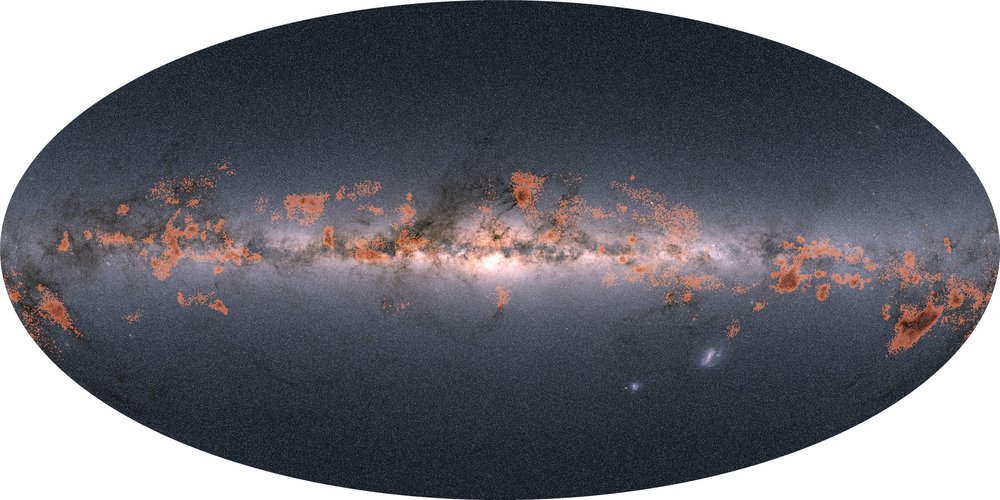
In the past decade, the European Space Agency’s Gaia mission has revealed the nature, history, and behaviour of billions of stars. Our pioneering stargazer has reshaped our view of the skies around us like no other, revealing that star clu…

Over a decade’s worth of NASA/ESA Hubble Space Telescope data was used to re-examine the long-held prediction that the Milky Way galaxy will collide with the Andromeda galaxy in about 4.5 billion years. The astronomers found that, based on…
A batch of 24 satellites for the Starlink mega-constellation - SpaceX's project for space-based Internet communication system.
Synthetic aperture radar Earth observation satellite for Japanese Earth imaging company iQPS.
AST SpaceMobile’s Block 2 BlueBird satellites are designed to deliver up to 10 times the bandwidth capacity of the BlueBird Block 1 satellites, requi…
2 hyper-spectral Earth observation satellites from Chinese company STAR.VISION. Both satellites are built in corporation with foreign customers: *…
A batch of 24 satellites for the Starlink mega-constellation - SpaceX's project for space-based Internet communication system.
A batch of 9 Low Earth Orbit communication satellites for the Chinese state owned SatNet constellation operated by the China Satellite Network Group.…
A batch of 24 satellites for the Starlink mega-constellation - SpaceX's project for space-based Internet communication system.
Classified payload for the US National Reconnaissance Office.
2 Chinese classified satellites claimed to be for communication technology test purposes. Actual mission not known.
Tianlian is a Chinese data tracking and relay communications geostationary satellite series. The TL-3 (Tian Lian 3) satellites are the 3rd generation…