Soyuz 2.1b/Fregat-M | OneWeb 7
Launch Successful
L - -- : -- : -- : --
Instantaneous launch window.
Launch Window
May 28, 2021, 5:38 p.m. - May 28, 2021, 5:38 p.m.


Instantaneous launch window.
May 28, 2021, 5:38 p.m. - May 28, 2021, 5:38 p.m.
A batch of 36 satellites for the OneWeb satellite constellation, which is intended to provide global Internet broadband service for individual consumers. The constellation is planned to have around 648 microsatellites (of which 60 are spares), around 150 kg each, operating in Ku-band from low Earth orbit.
Marking success after acquisition confirmed!

Updated T-0
Launch is postponed

GO per Roscosmos and Arianespace

Added launch time.
Soyuz-2, GRAU index 14A14, is the collective designation for the 21st-century version of the Russian Soyuz rocket. In its basic form, it is a three-stage carrier rocket for placing payloads into low Earth orbit. The first-stage boosters and two core stages feature uprated engines with improved injection systems, compared to the previous versions of the Soyuz. Digital flight control and telemetry systems allow the rocket to be launched from a fixed launch platform, whereas the launch platforms for earlier Soyuz rockets had to be rotated as the rocket could not perform a roll to change its heading in flight.
Progress Rocket Space Centre, formerly known as TsSKB-Progress, is a space science and aerospace research company which is known for manufacturing launch vehicles and satellites. Most notably, Progress Rocket Space Centre is the manufacturer of Soyuz launch vehicles.
INFO WIKI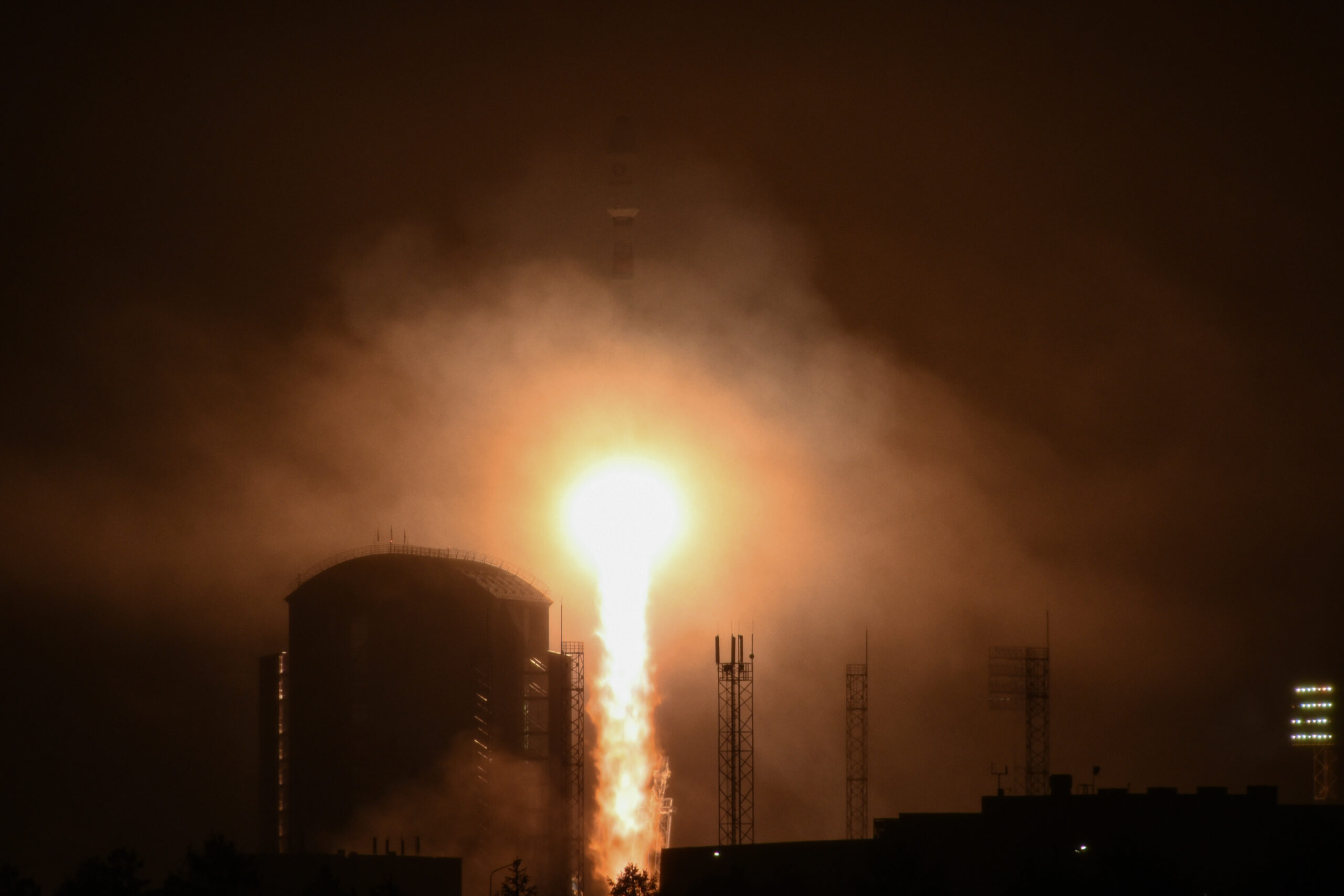
OneWeb’s broadband constellation is set to pass the 200th mark after Arianespace successfully launched its latest batch of satellites May 28.

The seventh batch of OneWeb satellites were successfully launched on a Soyuz 2.1b rocket from the Vostochny Cosmodrome in Russia on Friday, May 28, with liftoff occurring at 17:38 UTC. After an initial attempt on Thursday, the launch was d…

A Russian Soyuz booster and Fregat upper stage rode a specialized rail car to a launch pad at the Vostochny Cosmodrome Monday, moving into position for liftoff Thursday with the next 36 satellites for OneWeb’s growing global internet netwo…
A batch of 24 satellites for the Starlink mega-constellation - SpaceX's project for space-based Internet communication system.
Synthetic aperture radar Earth observation satellite for Japanese Earth imaging company iQPS.
AST SpaceMobile’s Block 2 BlueBird satellites are designed to deliver up to 10 times the bandwidth capacity of the BlueBird Block 1 satellites, requi…
2 hyper-spectral Earth observation satellites from Chinese company STAR.VISION. Both satellites are built in corporation with foreign customers: *…
A batch of 24 satellites for the Starlink mega-constellation - SpaceX's project for space-based Internet communication system.
A batch of 9 Low Earth Orbit communication satellites for the Chinese state owned SatNet constellation operated by the China Satellite Network Group.…
A batch of 24 satellites for the Starlink mega-constellation - SpaceX's project for space-based Internet communication system.
Classified payload for the US National Reconnaissance Office.
2 Chinese classified satellites claimed to be for communication technology test purposes. Actual mission not known.
Tianlian is a Chinese data tracking and relay communications geostationary satellite series. The TL-3 (Tian Lian 3) satellites are the 3rd generation…