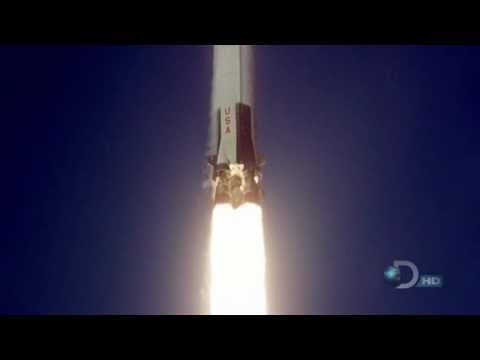
Saturn V | Apollo 8
Launch Successful
L - -- : -- : -- : --
Instantaneous launch window.
Launch Window
Dec. 21, 1968, 12:51 p.m. - Dec. 21, 1968, 12:51 p.m.


Instantaneous launch window.
Dec. 21, 1968, 12:51 p.m. - Dec. 21, 1968, 12:51 p.m.

First crewed space mission to orbit the Moon Apollo 8 (December 21–27, 1968) was the first crewed spacecraft to leave Earth's gravitational sphere of influence, and the first human spaceflight to reach the Moon. The crew orbited the Moon ten times without landing and then returned to Earth.[1][2][3...
Apollo 8 was the first flight of the mighty Saturn V launch vehicle key to human exploration of the moon. The three-astronaut crew — Commander Frank Borman, Command Module Pilot James Lovell, and Lunar Module Pilot William Anders. This Mission was the first manned spacecraft to orbit the moon.
The Saturn V was a human-rated expendable rocket used by NASA between 1967 and 1973. Most notably, the Saturn V took the Apollo program to the Moon. It still remains the world's tallest, heaviest, and most powerful rocket ever brought to operational status and is the only launch vehicle to take humans beyond LEO.
CSM-103 was an Apollo Command & Service Module used in the Apollo 8 mission.
Apollo Command/Service Module Details
Date of
Birth: March 14, 1928
Date of Death:
Nov. 7, 2023
Date of
Birth: March 25, 1928
Date of Death:
Aug. 7, 2025
Date of
Birth: Oct. 17, 1933
Date of Death:
June 7, 2024
The National Aeronautics and Space Administration is an independent agency of the executive branch of the United States federal government responsible for the civilian space program, as well as aeronautics and aerospace research. NASA have many launch facilities but most are inactive. The most commonly used pad will be LC-39B at Kennedy Space Center in Florida.
INFO WIKIA batch of 29 satellites for the Starlink mega-constellation - SpaceX's project for space-based Internet communication system.
Test flight of the H3-30 variant of the H3 launch vehicle with 3 LE-9 engines in the first stage and no SRBs. The flight will carry a dummy main payl…
A batch of 24 satellites for the Starlink mega-constellation - SpaceX's project for space-based Internet communication system.
Sub-orbital launch under Rocket Lab’s Hypersonic Accelerator Suborbital Test Electron (HASTE) program, details TBD.
Chinese classified satellite claimed to be for communication technology test purposes. Actual mission not known.
A pair of demonstration satellites for Direct-To-Cell (DTC) communications from Low Earth Orbit for SpaceSail and China Mobile: * SpaceSail DTC 01…
A batch of 29 satellites for the Starlink mega-constellation - SpaceX's project for space-based Internet communication system.
A batch of 21 satellites for the Starlink mega-constellation - SpaceX's project for space-based Internet communication system. 2 US military Stars…
18 Low Earth Orbit communication satellites with Ku, Q and V band payloads for the G60 constellation operated by Shanghai Spacesail Technologies with…
18 Low Earth Orbit communication satellites with Ku, Q and V band payloads for the G60 constellation operated by Shanghai Spacesail Technologies with…