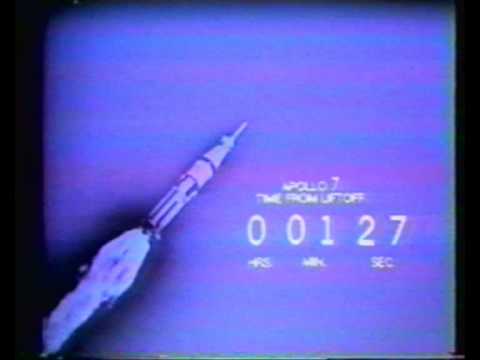
Saturn IB | Apollo 7
Launch Successful
L - -- : -- : -- : --
Instantaneous launch window.
Launch Window
Oct. 11, 1968, 3:02 p.m. - Oct. 11, 1968, 3:02 p.m.


Instantaneous launch window.
Oct. 11, 1968, 3:02 p.m. - Oct. 11, 1968, 3:02 p.m.

First crewed mission of the Apollo space program Apollo 7 was an October 1968 human spaceflight mission carried out by the United States. It was the first mission in the United States' Apollo program to carry a crew into space. It was also the first U.S. spaceflight to carry astronauts …
The Apollo 7 crew was commanded by Walter M. Schirra, with Command Module Pilot Donn F. Eisele, and Lunar Module Pilot R. Walter Cunningham. Their mission was Apollo's 'C' mission, an 11-day Earth-orbital test flight to check out the redesigned Block II Apollo Command/Service Module (CSM) with a crew on board.
The Saturn IB (pronounced "one B", also known as the Uprated Saturn I) was an American launch vehicle commissioned by the National Aeronautics and Space Administration (NASA) for the Apollo program. It replaced the S-IV second stage of the Saturn I with the much more powerful S-IVB, able to launch a partially fueled Apollo Command/Service Module (CSM) or a fully fueled Lunar Module (LM) into low Earth orbit for early flight tests before the larger Saturn V needed for lunar flight was ready.
CSM-101 was an Apollo Command & Service Module used in the Apollo 7 mission.
Apollo Command/Service Module Details
Date of
Birth: March 12, 1923
Date of Death:
May 3, 2007
Date of
Birth: June 23, 1930
Date of Death:
Dec. 2, 1987
Date of
Birth: March 16, 1932
Date of Death:
Jan. 3, 2023
The National Aeronautics and Space Administration is an independent agency of the executive branch of the United States federal government responsible for the civilian space program, as well as aeronautics and aerospace research. NASA have many launch facilities but most are inactive. The most commonly used pad will be LC-39B at Kennedy Space Center in Florida.
INFO WIKIA batch of 24 satellites for the Starlink mega-constellation - SpaceX's project for space-based Internet communication system.
Synthetic aperture radar Earth observation satellite for Japanese Earth imaging company iQPS.
AST SpaceMobile’s Block 2 BlueBird satellites are designed to deliver up to 10 times the bandwidth capacity of the BlueBird Block 1 satellites, requi…
2 hyper-spectral Earth observation satellites from Chinese company STAR.VISION. Both satellites are built in corporation with foreign customers: *…
A batch of 24 satellites for the Starlink mega-constellation - SpaceX's project for space-based Internet communication system.
A batch of 9 Low Earth Orbit communication satellites for the Chinese state owned SatNet constellation operated by the China Satellite Network Group.…
A batch of 24 satellites for the Starlink mega-constellation - SpaceX's project for space-based Internet communication system.
Classified payload for the US National Reconnaissance Office.
2 Chinese classified satellites claimed to be for communication technology test purposes. Actual mission not known.
Tianlian is a Chinese data tracking and relay communications geostationary satellite series. The TL-3 (Tian Lian 3) satellites are the 3rd generation…