Hapith I | Test Flight
Launch Failure
L - -- : -- : -- : --
Launch Window
Sept. 15, 2021, 8:45 p.m. - Sept. 16, 2021, 8:30 a.m.


Sept. 15, 2021, 8:45 p.m. - Sept. 16, 2021, 8:30 a.m.
The first Hapith I launch will be testing TiSPACE's hybrid rocket engine technology in preparation for the future Hapith V launch vehicle. Targeting 250 km altitude, the test launch campaign will also support of the development of the Whalers Way Orbital Launch Complex in South Australia, operated by Southern Launch.

The launch vehicle caught alight at ignition and was damaged. It will not be used for any further launch attempt.
Countdown halted just before liftoff due to a technical issue. Awaiting further information for the next launch attempt.
New launch window
Hapith I is a sub-orbital launch vehicle built by TiSPACE. It is intended to test technologies for the future Hapith V vehicle.
Taiwan Innovative Space Inc.(TiSPACE), is a space launch company from Taiwan founded in 2016.
WIKI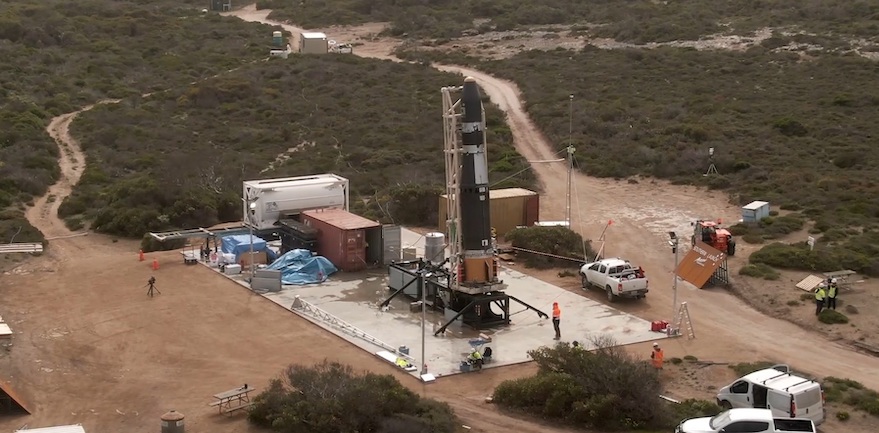
Synthetic aperture radar Earth observation satellite for Japanese Earth imaging company iQPS.
AST SpaceMobile’s Block 2 BlueBird satellites are designed to deliver up to 10 times the bandwidth capacity of the BlueBird Block 1 satellites, requi…
2 hyper-spectral Earth observation satellites from Chinese company STAR.VISION. Both satellites are built in corporation with foreign customers: *…
A batch of 24 satellites for the Starlink mega-constellation - SpaceX's project for space-based Internet communication system.
A batch of 9 Low Earth Orbit communication satellites for the Chinese state owned SatNet constellation operated by the China Satellite Network Group.…
A batch of 24 satellites for the Starlink mega-constellation - SpaceX's project for space-based Internet communication system.
Classified payload for the US National Reconnaissance Office.
2 Chinese classified satellites claimed to be for communication technology test purposes. Actual mission not known.
Tianlian is a Chinese data tracking and relay communications geostationary satellite series. The TL-3 (Tian Lian 3) satellites are the 3rd generation…
A batch of 24 satellites for the Starlink mega-constellation - SpaceX's project for space-based Internet communication system.