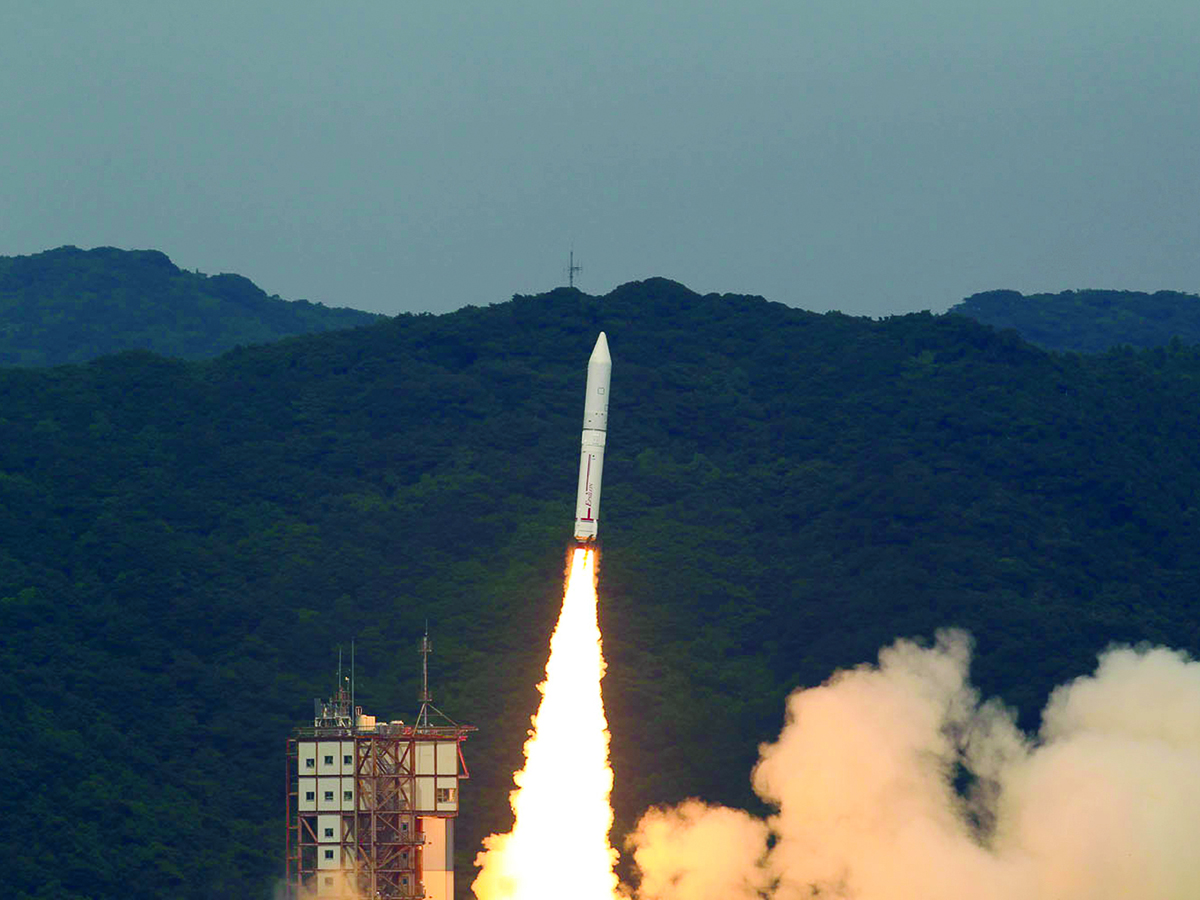
RAISE-3 (RApid Innovative payload demonstration Satellite-3) was a satellite for on-orbit demonstrations of 7 demonstration components and equipment selected by public solicitation. The satellite was to be operated in response to requests from the demonstration theme proposers, and will provide experimental data of the demonstration devices and environmental data during the experiments. The launch is also carrying QPS-SAR 3 & 4 radar Earth observation satellites for iQPS, and 5 cubesats for various Japanese institutions & companies.
The Epsilon rocket is a Japanese solid-fuel rocket designed to launch scientific satellites. It is a follow-on project to the larger and more expensive M-V rocket which was retired in 2006. The Japan Aerospace Exploration Agency (JAXA) began developing the Epsilon in 2007. It is capable of placing a 590 kg payload into Sun-synchronous orbit.
The Japan Aerospace Exploration Agency (JAXA) is Japan's national aero-space agency. Through the merger of three previously independent organizations, JAXA was formed on 1 October 2003. JAXA is responsible for research, technology development and the launch of satellites into orbit, and is involved in many more advanced missions, such as asteroid exploration and possible manned exploration of the Moon. JAXA launch their Epsilon vehicle from the Uchinoura Space Center and their H-II vehicles from the Tanegashima Space Center.
INFO WIKIA Japanese Epsilon small launch vehicle failed to reach orbit during an Oct. 11 launch, resulting in the loss of all eight smallsats on board.
Epsilon launched from the Mu Pad at the Uchinoura Space Center in Japan at 00:50 UTC on Oct. 12. This launch marked the sixth flight of JAXA’s Epsilon rocket, and the launch vehicle was to loft a rideshare mission into orbit consisting of …
2 satellites officially described as for "demonstration of new technologies for spatial targets detection" purposes.
A satellite officially described as for cartography purposes, details TBD.
A pair of Russian optical Earth observation satellites built by the Progress Rocket Space Centre for obtaining stereo images of the Earth's surface, …
China's geostationary meteorological satellite program FY-4 (Feng Yun 4) is the second generation of chinese geostationary meteorological satellites.
A batch of 9 Low Earth Orbit communication satellites for the Chinese state owned SatNet constellation operated by the China Satellite Network Group.…
Note: Assignment of payloads to this launch is uncertain. The Russian Obzor-R satellite is a planned X-band radar earth observation satellite desi…
AST SpaceMobile’s Block 2 BlueBird satellites are designed to deliver up to 10 times the bandwidth capacity of the BlueBird Block 1 satellites, requi…
First test launch of CASC/SAST’s Long March 12A rocket, with a dummy payload. The rocket’s 1st stage attempted to land on a landing pad about 300 km …
Maiden orbital launch attempt for the South Korean start-up Innospace and its HANBIT-Nano small launch vehicle. Onboard this flight are five small sa…
QZSS (Quasi Zenith Satellite System) is a Japanese satellite navigation system operating from inclined, elliptical geosynchronous orbits to achieve o…