Ariane 5 ECA+ | JCSAT-17 & GEO-KOMPSAT-2B
Launch Successful
L - -- : -- : -- : --
Launch Window
Feb. 18, 2020, 10:18 p.m. - Feb. 18, 2020, 11:20 p.m.


Feb. 18, 2020, 10:18 p.m. - Feb. 18, 2020, 11:20 p.m.

Arianespace at the service of SKY Perfect JSAT (Japan) and KARI (Korea) with JCSAT-17 and GEO-KOMPSAT-2B For its third flight of 2020, Arianespace will orbit two telecommunications satellites using an Ariane 5 launch vehicle from the Guiana Space Center: JCSAT17 for the Japanese operator SKY Perfec...
JCSAT-17 is a Japanese communication satellite of SKY Perfect JSAT Corporation. Its payloads incorporate S-band, C-band and Ku-band transponders, which will provide satellite communication services. The S-band and C-band transponders will serve NTT DOCOMO, Inc., the largest telecommunications company in Japan, for its flexible mobile communications services in Japan and the surrounding region under IRU contract (Indefeasible Right of Use). SKY Perfect JSAT will support NTT DOCOMO’s satellite communication services. JCSAT-17 also includes a flexible processor that will allow SJC to redirect capacity to concentrate on disaster relief efforts or other high-volume events. The GEO-KOMPSAT-2 program is a national program of the Korean government to develop and operate two civilian geostationary satellites sharing the same satellite bus: GEO-KOMPSAT-2A for meteorological and space weather monitoring missions; and GEO-KOMPSAT-2B for Earth environment monitoring and ocean monitoring missions. The GEO-KOMPSAT 2 program also ensures the succession for the COMS program (Communication, Ocean and Meteorological Satellite). The satellite carries two main payloads: GOCI II (Geostationary Ocean Color Imager II), provided by Airbus Defence and Space; and the GEMS (Geostationary Environment Monitoring Spectrometer), provided by Ball Aerospace & Technologies.
Ariane 5 ECA+ is a variant of the Ariane 5 heavy-lift vehicle, with a taller ECA-D upper stage.
ArianeGroup (formerly Airbus Safran Launchers) is an aerospace company based in France. A joint venture between Airbus and Safran, the company was founded in 2015 and is headquartered in Issy-les-Moulineaux. It consists of three core arms: aerospace, defence and security.
INFO WIKI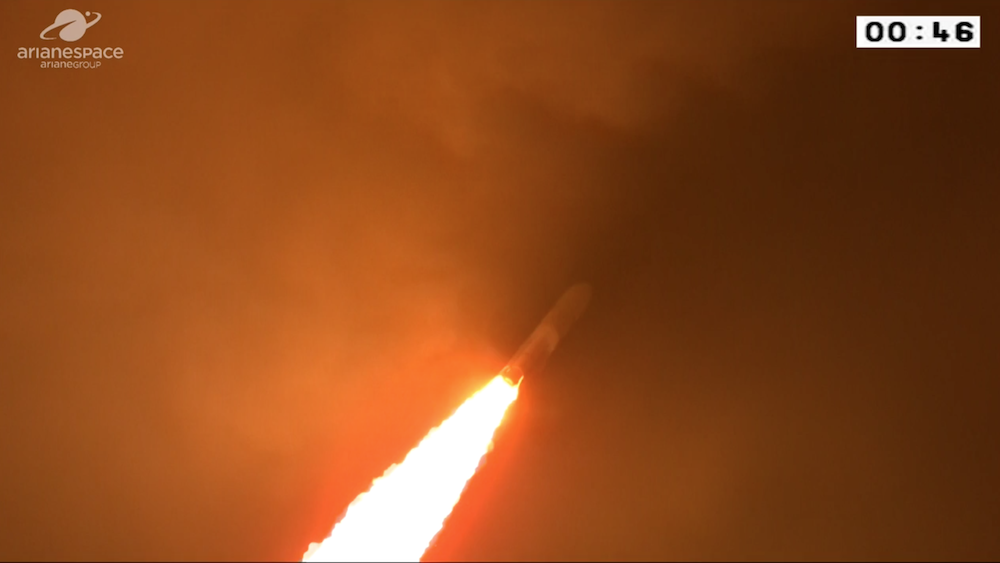

A batch of 24 satellites for the Starlink mega-constellation - SpaceX's project for space-based Internet communication system.
Synthetic aperture radar Earth observation satellite for Japanese Earth imaging company iQPS.
AST SpaceMobile’s Block 2 BlueBird satellites are designed to deliver up to 10 times the bandwidth capacity of the BlueBird Block 1 satellites, requi…
2 hyper-spectral Earth observation satellites from Chinese company STAR.VISION. Both satellites are built in corporation with foreign customers: *…
A batch of 24 satellites for the Starlink mega-constellation - SpaceX's project for space-based Internet communication system.
A batch of 9 Low Earth Orbit communication satellites for the Chinese state owned SatNet constellation operated by the China Satellite Network Group.…
A batch of 24 satellites for the Starlink mega-constellation - SpaceX's project for space-based Internet communication system.
Classified payload for the US National Reconnaissance Office.
2 Chinese classified satellites claimed to be for communication technology test purposes. Actual mission not known.
Tianlian is a Chinese data tracking and relay communications geostationary satellite series. The TL-3 (Tian Lian 3) satellites are the 3rd generation…