Ariane 5 ECA | Eutelsat Konnect & GSAT-30
Launch Successful
L - -- : -- : -- : --
Launch Window
Jan. 16, 2020, 9:05 p.m. - Jan. 16, 2020, 11 p.m.


Jan. 16, 2020, 9:05 p.m. - Jan. 16, 2020, 11 p.m.
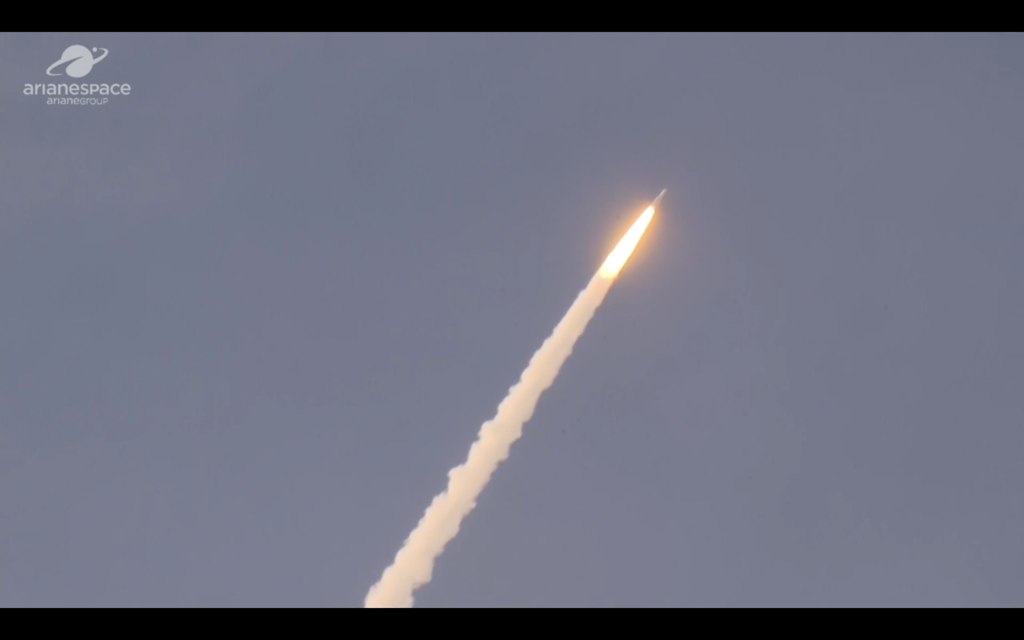
Eutelsat Konnect is an all-electric, Ka-band geostationary communications satellite built by Thales Alenia Space for Eutelsat. It will provide broadband services to users in Africa and Europe. The baseline mission of the satellite is to provide 75 Gbps of capacity across a network of 65 spotbeams that together provide quasi-complete coverage of Sub-Saharan Africa. The satellite will address direct-to-user consumer and enterprise broadband services using dishes from approximately 75 cm. It will also be used for community networks connected to Wi-Fi hotspots, mobile phone backhauling and rural connectivity. Eutelsat Konnect is the first to use Thales Alenia Space’s all-electric Spacebus NEO platform, developed under the Neosat Partnership Project conducted by the European and French space agencies (ESA and CNES). More robust, more modular, more powerful, more innovative, more flexible, this platform is perfectly adapted to operators' expectations in the evolving telecommunication market, and particlularly well positioned for very demanding VHTS missions. Eutelsat Konnect will allow the in-orbit validation of the complete end-to-end system of the new Spacebus Neo product line, including the fully-electric orbit-raising phase GSAT-30 is a telecommunications satellite designed and manufactured by ISRO. To be positioned at a longitude of 83° East, it will provide high-quality television, telecommunications and broadcasting services over Indian mainland and Islands. GSAT-30 is configured on ISRO’s enhanced I-3K platform to provide communications services from geostationary orbit in C-and Ku-band for a lifetime greater than 15 years. By operating GSAT-30, ISRO will once again foster the use of space to help bridge the digital divide in the Indian subcontinent as part of its ambitious space program. These objectives are to develop India by focusing on all types of space applications, including navigation, Earth observation, telecommunications and broadcasts of educational programs, while pursuing science research and planetary exploration.
Ariane 5 is a heavy-lift launch vehicle, part of the Ariane rocket family.
ArianeGroup (formerly Airbus Safran Launchers) is an aerospace company based in France. A joint venture between Airbus and Safran, the company was founded in 2015 and is headquartered in Issy-les-Moulineaux. It consists of three core arms: aerospace, defence and security.
INFO WIKI


A batch of 24 satellites for the Starlink mega-constellation - SpaceX's project for space-based Internet communication system.
Synthetic aperture radar Earth observation satellite for Japanese Earth imaging company iQPS.
AST SpaceMobile’s Block 2 BlueBird satellites are designed to deliver up to 10 times the bandwidth capacity of the BlueBird Block 1 satellites, requi…
2 hyper-spectral Earth observation satellites from Chinese company STAR.VISION. Both satellites are built in corporation with foreign customers: *…
A batch of 24 satellites for the Starlink mega-constellation - SpaceX's project for space-based Internet communication system.
A batch of 9 Low Earth Orbit communication satellites for the Chinese state owned SatNet constellation operated by the China Satellite Network Group.…
A batch of 24 satellites for the Starlink mega-constellation - SpaceX's project for space-based Internet communication system.
Classified payload for the US National Reconnaissance Office.
2 Chinese classified satellites claimed to be for communication technology test purposes. Actual mission not known.
Tianlian is a Chinese data tracking and relay communications geostationary satellite series. The TL-3 (Tian Lian 3) satellites are the 3rd generation…

