Spacecraft Landing
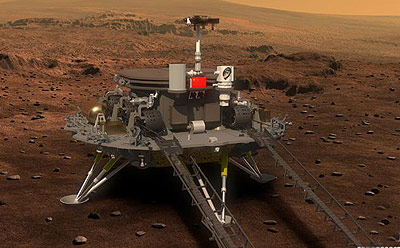
Tianwen-1 Rover Landing
Utopia Planitia, Mars Long March 5 | Tianwen-1 (Mars Global Remote Sensing Orbiter and Small Rover)
The Tianwen-1 rover will attempt to land on Mars using a parachute to slow down and a propulsive landing for the final 1.5km of the descent.
Updates

Cosmic_Penguin • May 13, 2021, 4:59 a.m.
New landing time.
Cosmic_Penguin • May 4, 2021, 1:07 p.m.
Updated landing date.
Cosmic_Penguin • April 11, 2021, 11:23 a.m.
Updated landing date.
Related Information
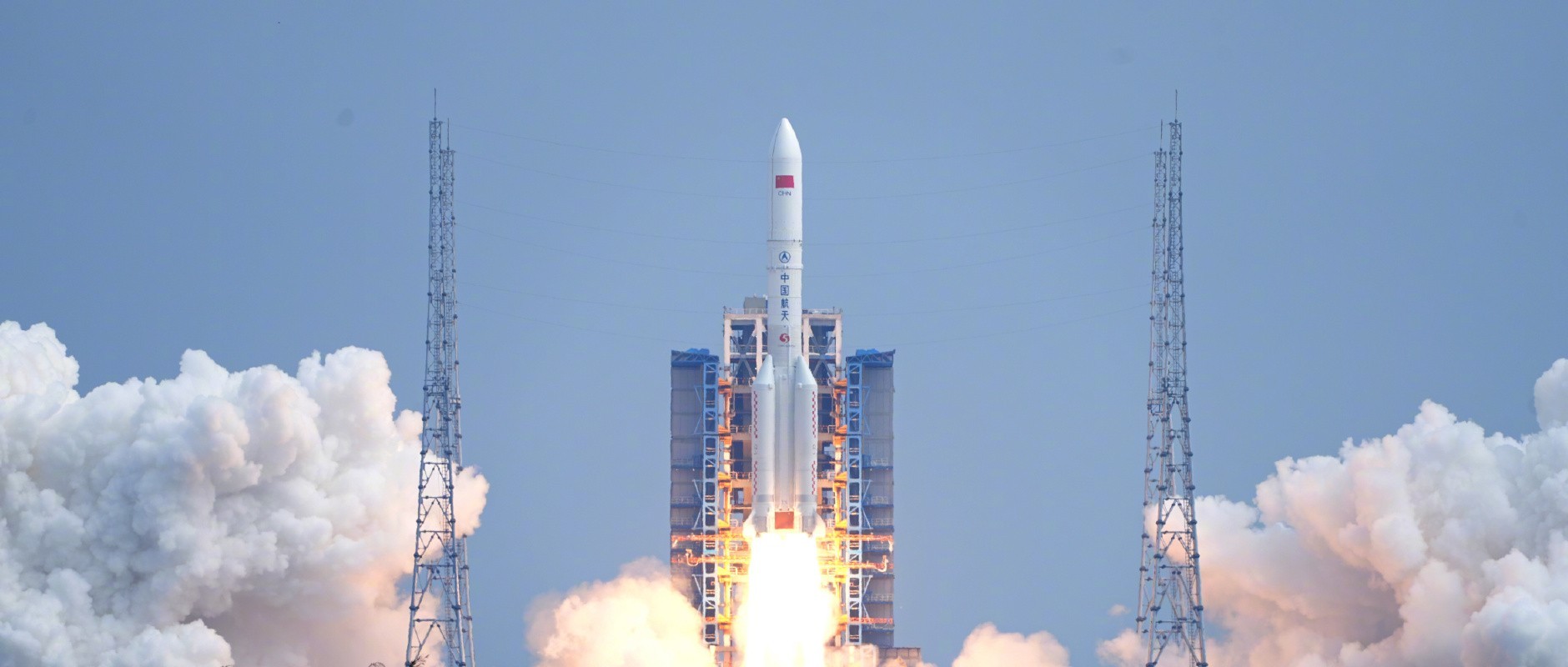
Long March 5 | Tianwen-1 (Mars Global Remote Sensing Orbiter and Small Rover)
China Aerospace Science and Technology Corporation | ChinaWenchang Space Launch Site, People's Republic of China
July 23, 2020, 4:41 a.m.
Status: Launch Successful
Mission:
Tianwen-1 ("questions to heaven") Mars mission includes a Martian orbiter and a lander/rover duo. This will be China's first mission to Mars. The spacecraft will reach Mars in February 2021. Lander will remain attached to the orbiter for two to three months before attempting its landing. The chosen landing area is Utopia Planitia, a huge basin formed by a large impact far back in Mars' history. The rover is expected to be in operation for about 90 Martian sols. The Tianwen-1 orbiter will provide a relay communication link to the rover while performing its own scientific observations for one Martian year. The orbiter will operate in a polar orbit in order to map Mars' morphology and geological structure while also using the Mars-Orbiting Subsurface Exploration Radar instrument to investigate soil characteristics and water-ice distribution. It will also measure the ionosphere and the electromagnetic and gravitational fields, the new paper reported. The rover will have 13 instruments detecting things such as topography, soil, environment, atmosphere, water ice, physical field and internal structure. It will investigate the surface soil characteristics and water-ice distribution with its own Subsurface Exploration Radar. It will also analyze surface material composition and characteristics of the Martian climate and environment on the surface.
Heliocentric N/AFalcon 9
Starlink Group 17-51
Space Launch Complex 4E - Vandenberg SFB, CA, USAA batch of 24 satellites for the Starlink mega-constellation - SpaceX's project for space-based Internet communication system.
Starship
Flight 13
Orbital Launch Pad 2 - SpaceX Starbase, TX, USA13th test flight of the two-stage Starship launch vehicle. Second flight of Starship V3. For the first time, Starship will carry 20 V3 Starlink sa…
Kinetica 1
5 satellites
Launch Area 130 - Jiuquan Satellite Launch Center, People's Republic of ChinaShare-ride of 5 commercial Earth observation and technology demonstration satellites to SSO, including SpaceTY's TY-48. Details TBD.
Long March 3B/E
Tianlian 2-06
Launch Complex 2 (LC-2) - Xichang Satellite Launch Center, People's Republic of ChinaTianlian is a Chinese data tracking and relay communications geostationary satellite series. The TL 2 (Tian Lian 2) satellites represent the second g…
Gravity-1
9 satellites
Yellow Sea (launch location 5) - Haiyang Oriental SpaceportCarried 9 satellites on a share-ride to sun-synchronous orbit. Details TBD.
Falcon 9
MRV-1
Space Launch Complex 40 - Cape Canaveral SFS, FL, USAThe Northrop Grumman/SpaceLogistics MRV-1 is a mission extension payload including a mission robotic vehicle (MRV) and multiple mission extension pod…
Falcon 9
Starlink Group 17-39
Space Launch Complex 4E - Vandenberg SFB, CA, USAA batch of 24 satellites for the Starlink mega-constellation - SpaceX's project for space-based Internet communication system.
Soyuz 2.1b
16 x Rassvet-3
43/4 (43R) - Plesetsk Cosmodrome, Russian FederationNote: Payload identities uncertain. Batch of 16 Rassvet-3 Low Earth Orbit communication satellites for the Russian Byuro-1440 (Bureau 1440) conste…
Vikram-I
Demo Flight
Satish Dhawan Space Centre First Launch Pad - Satish Dhawan Space Centre, IndiaFirst launch of Skyroot Aerospace's Vikram-I launch vehicle. This first launch will carry 4 payloads: - Grahaa Space's SOLARAS S3 satellite - C…
Falcon 9
SDA Tranche 1 Transport Layer E
Space Launch Complex 4E - Vandenberg SFB, CA, USATranche 1 Transport Layer E is one of six missions by the United States Space Force Space Development Agency (SDA) for the Proliferated Warfighter Sp…

