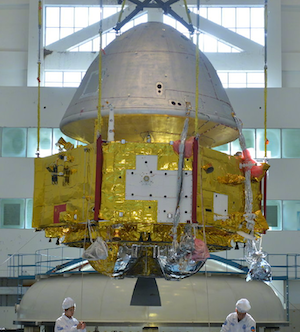
Orbital Insertion
Tianwen-1 Mars Orbit Insertion
Mars Long March 5 | Tianwen-1 (Mars Global Remote Sensing Orbiter and Small Rover)
The Tianwen-1 orbiter and rover will perform a 14 minutes long burn to enter an elliptical orbit around Mars.
Related Information
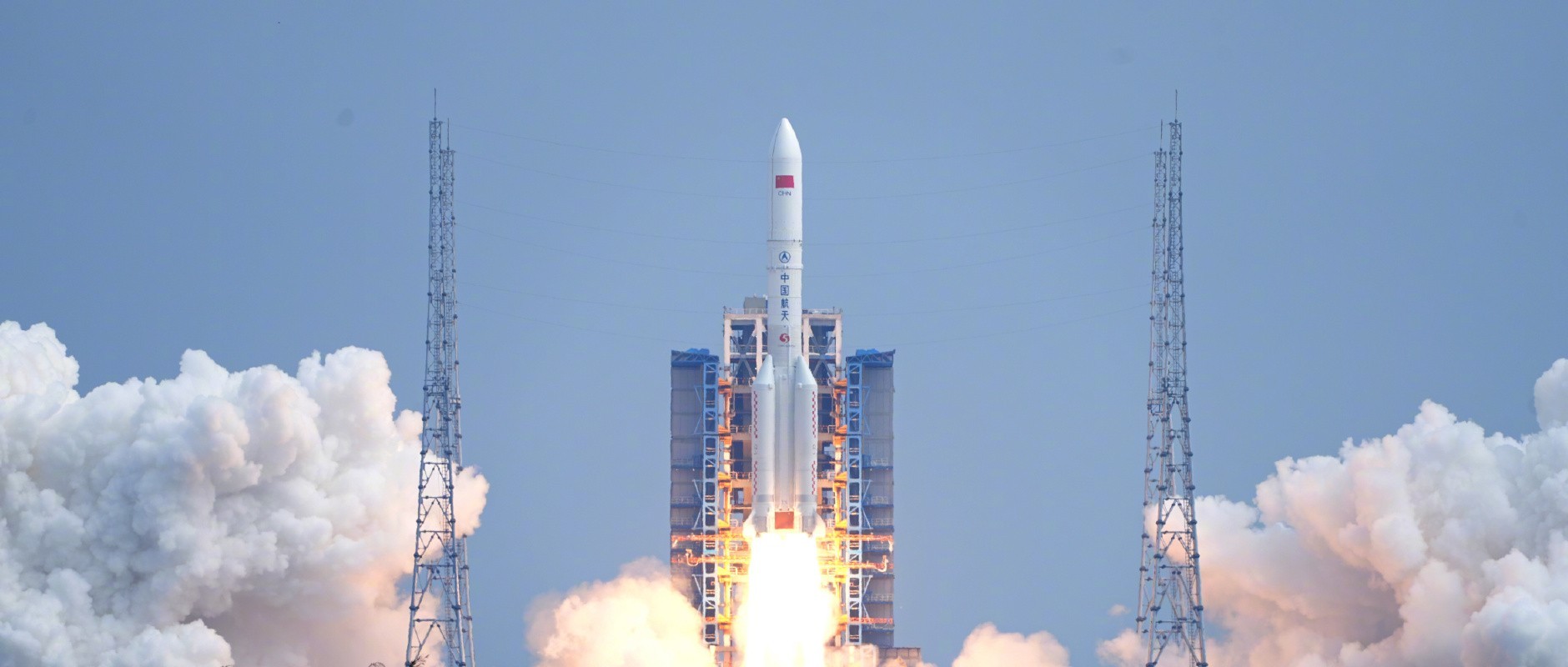
Long March 5 | Tianwen-1 (Mars Global Remote Sensing Orbiter and Small Rover)
China Aerospace Science and Technology Corporation | ChinaWenchang Space Launch Site, People's Republic of China
July 23, 2020, 4:41 a.m.
Status: Launch Successful
Mission:
Tianwen-1 ("questions to heaven") Mars mission includes a Martian orbiter and a lander/rover duo. This will be China's first mission to Mars. The spacecraft will reach Mars in February 2021. Lander will remain attached to the orbiter for two to three months before attempting its landing. The chosen landing area is Utopia Planitia, a huge basin formed by a large impact far back in Mars' history. The rover is expected to be in operation for about 90 Martian sols. The Tianwen-1 orbiter will provide a relay communication link to the rover while performing its own scientific observations for one Martian year. The orbiter will operate in a polar orbit in order to map Mars' morphology and geological structure while also using the Mars-Orbiting Subsurface Exploration Radar instrument to investigate soil characteristics and water-ice distribution. It will also measure the ionosphere and the electromagnetic and gravitational fields, the new paper reported. The rover will have 13 instruments detecting things such as topography, soil, environment, atmosphere, water ice, physical field and internal structure. It will investigate the surface soil characteristics and water-ice distribution with its own Subsurface Exploration Radar. It will also analyze surface material composition and characteristics of the Martian climate and environment on the surface.
Heliocentric N/ALong March 8A
SpaceSail Polar Group #14
Commercial LC-1 - Wenchang Space Launch Site, People's Republic of China20 Low Earth Orbit communication satellites with Ku, Q and V band payloads for the G60 constellation operated by Shanghai Spacesail Technologies with…
Falcon 9
Starlink Group 10-50
Space Launch Complex 40 - Cape Canaveral SFS, FL, USAA batch of 29 satellites for the Starlink mega-constellation - SpaceX's project for space-based Internet communication system. The Falcon 9 1st st…
Long March 6A
SpaceSail Polar Group #13
Launch Complex 9A - Taiyuan Satellite Launch Center, People's Republic of China18 Low Earth Orbit communication satellites with Ku, Q and V band payloads for the G60 constellation operated by Shanghai Spacesail Technologies with…
Pegasus XL
Swift Boost Mission
Kwajalein Atoll - Air launch to orbitContracted by NASA under the Small Business Innovation Research Phase 3 contract, Katalyst Space Technologies' LINK servicing spacecraft will rendezv…
Atlas V 551
Amazon Leo (LA-08)
Space Launch Complex 41 - Cape Canaveral SFS, FL, USAAmazon Leo, formerly known as Project Kuiper, is a mega constellation of satellites in Low Earth Orbit that will offer broadband internet access, thi…
Falcon 9
Starlink Group 17-46
Space Launch Complex 4E - Vandenberg SFB, CA, USAA batch of 24 satellites for the Starlink mega-constellation - SpaceX's project for space-based Internet communication system.
Long March 4B
Haiyang 2E
Launch Area 94 (SLS-2 / 603) - Jiuquan Satellite Launch Center, People's Republic of ChinaHaiyang 2E (Chinese: "Ocean"), abbreviated HY-2E, is a marine remote sensing satellite of China. The HY-2 series' primary objective is to measure oce…
Falcon 9
Sirius SXM-11
Space Launch Complex 40 - Cape Canaveral SFS, FL, USASXM-11 is the 12th high-powered, digital, audio radio satellite built by Lanteris Space (ex-Maxar, Space System/Loral) for SiriusXM. The SXM-11 satel…
Falcon 9
Starlink Group 17-40
Space Launch Complex 4E - Vandenberg SFB, CA, USAA batch of 24 satellites for the Starlink mega-constellation - SpaceX's project for space-based Internet communication system.
Electron
Ten Owl Of Ten (StriX Launch 10)
Rocket Lab Launch Complex 1B - Rocket Lab Launch Complex 1, Mahia Peninsula, New ZealandSynthetic aperture radar satellite for Japanese Earth imaging company Synspective.

