Abort Test
CST-100 Starliner Pad Abort Test
White Sands Missile Range, New Mexico
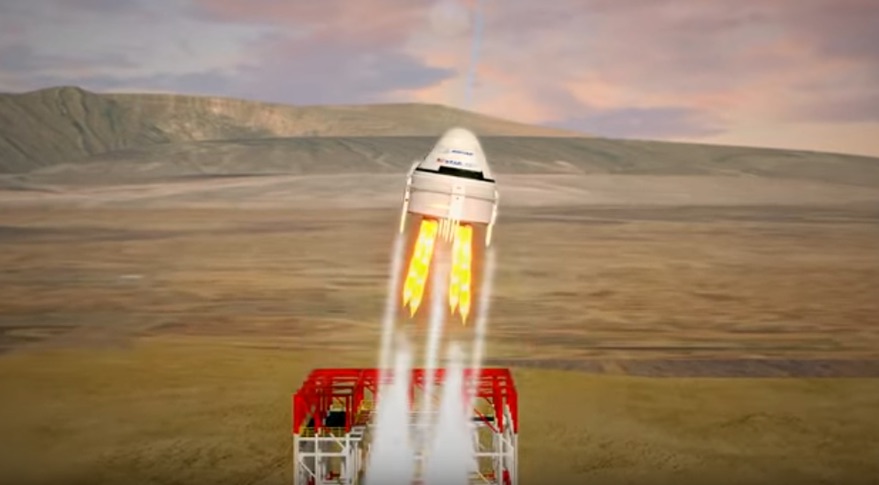
NASA and Boeing will broadcast live coverage of the CST-100 Starliner Pad Abort Test on Monday, Nov. 4, from Launch Complex 32 at White Sands Missile Range in New Mexico.
The test is designed to verify that each of Starliner’s systems will function not only separately, but in concert, to protect astronauts by carrying them safely away from the launch pad in the unlikely event of an emergency prior to liftoff. During the test, Starliner’s four launch abort engines and several orbital maneuvering and attitude control thrusters will fire, pushing the spacecraft approximately 1 mile above land and 1 mile north of the test stand.
Falcon 9
Starlink Group 17-52
Space Launch Complex 4E - Vandenberg SFB, CA, USAA batch of 24 satellites for the Starlink mega-constellation - SpaceX's project for space-based Internet communication system.
Falcon 9
NROL-95
Space Launch Complex 40 - Cape Canaveral SFS, FL, USAClassified payload for the US National Reconnaissance Office.
Long March 6A
TJSW-27A & B
Launch Complex 9A - Taiyuan Satellite Launch Center, People's Republic of China2 Chinese classified satellites claimed to be for communication technology test purposes. Actual mission not known.
Long March 7A
Tianlian 3-01
201 - Wenchang Space Launch Site, People's Republic of ChinaTianlian is a Chinese data tracking and relay communications geostationary satellite series. The TL-3 (Tian Lian 3) satellites are the 3rd generation…
Falcon 9
Starlink Group 17-51
Space Launch Complex 4E - Vandenberg SFB, CA, USAA batch of 24 satellites for the Starlink mega-constellation - SpaceX's project for space-based Internet communication system.
Starship
Flight 13
Orbital Launch Pad 2 - SpaceX Starbase, TX, USA13th test flight of the two-stage Starship launch vehicle. Second flight of Starship V3. For the first time, Starship will carry 20 V3 Starlink sa…
Kinetica 1
5 satellites
Launch Area 130 - Jiuquan Satellite Launch Center, People's Republic of ChinaShare-ride of 5 commercial Earth observation and technology demonstration satellites to SSO, including SpaceTY's TY-48. Details TBD.
Long March 3B/E
Tianlian 2-06
Launch Complex 2 (LC-2) - Xichang Satellite Launch Center, People's Republic of ChinaTianlian is a Chinese data tracking and relay communications geostationary satellite series. The TL 2 (Tian Lian 2) satellites represent the second g…
Gravity-1
9 satellites
Yellow Sea (launch location 5) - Haiyang Oriental SpaceportCarried 9 satellites on a share-ride to sun-synchronous orbit. Details TBD.
Falcon 9
MRV-1
Space Launch Complex 40 - Cape Canaveral SFS, FL, USAThe Northrop Grumman/SpaceLogistics MRV-1 is a mission extension payload including a mission robotic vehicle (MRV) and multiple mission extension pod…

