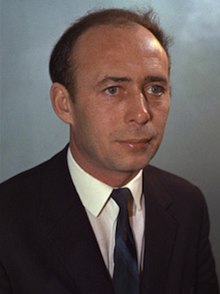
Viktor Patsayev
Russian - (RFSA)
Lost In Flight
Date of Birth: June 19, 1933
Date of Death: June 30, 1971
Viktor Ivanovich Patsayev (Russian: Ви́ктор Ива́нович Паца́ев; 19 June 1933 – 30 June 1971) was a Soviet cosmonaut who flew on the Soyuz 11 mission and was part of the second crew to die during a space flight. On board the space station Salyut 1 he operated the Orion 1 Space Observatory (see Orion 1 and Orion 2 Space Observatories), he became the first man to operate a telescope outside the Earth's atmosphere. After a normal re-entry, the capsule was opened and the crew was found dead. It was discovered that a valve had opened just prior to leaving orbit that had allowed the capsule's atmosphere to vent away into space, suffocating the crew. One of Patsayev's hands was found to be bruised, and he may have been trying to shut the valve manually at the time he lost consciousness.
Soyuz | Soyuz 11
Russian Federal Space Agency (ROSCOSMOS) | RussiaBaikonur Cosmodrome, Republic of Kazakhstan
June 6, 1971, 4:55 a.m.
Status: Success
Mission:
Soyuz 11 launched on 6 June 1971, 07:55:09 UTC. It carried commander Georgy Dobrovolsky, flight engineer Vladislav Volkov and test engineer Viktor Patsayev to orit. Crew arrived to Salyut-1 space station on 7 June 1971 and remained there until their departure on 30 June. It was the only mission to board the space station. Soyuz 11 returned to Earth on 30 June 1971, 02:16:52 UTC, with mission ending in disaster. During atmospheric re-entry crew capsule depressurised, killing all three crew members.
Low Earth OrbitThe Roscosmos State Corporation for Space Activities, commonly known as Roscosmos, is the governmental body responsible for the space science program of the Russian Federation and general aerospace research. Soyuz has many launch locations the Russian sites are Baikonur, Plesetsk and Vostochny however Ariane also purchases the vehicle and launches it from French Guiana.
Falcon 9
NROL-95
Space Launch Complex 40 - Cape Canaveral SFS, FL, USAClassified payload for the US National Reconnaissance Office.
Long March 6A
TJSW-27A & B
Launch Complex 9A - Taiyuan Satellite Launch Center, People's Republic of China2 Chinese classified satellites claimed to be for communication technology test purposes. Actual mission not known.
Long March 7A
Tianlian 3-01
201 - Wenchang Space Launch Site, People's Republic of ChinaTianlian is a Chinese data tracking and relay communications geostationary satellite series. The TL-3 (Tian Lian 3) satellites are the 3rd generation…
Falcon 9
Starlink Group 17-51
Space Launch Complex 4E - Vandenberg SFB, CA, USAA batch of 24 satellites for the Starlink mega-constellation - SpaceX's project for space-based Internet communication system.
Starship
Flight 13
Orbital Launch Pad 2 - SpaceX Starbase, TX, USA13th test flight of the two-stage Starship launch vehicle. Second flight of Starship V3. For the first time, Starship will carry 20 V3 Starlink sa…

